
Why a Smaller Gauss Number Can Hit Harder: Faraday's Law in Plain English
Two PEMF devices sit side by side on a shelf. One brochure says 7,000 Gauss. The other says 1,500 Gauss. The bigger number looks like the obvious winner. Faraday's law says it doesn't have to be.
Tissue inside the body doesn't respond to the strength of a magnetic field. It responds to how fast that field is changing. A short, sharp pulse from a lower-peak device can induce more electrical activity in tissue than a tall, slow pulse from a higher-peak device.
What Faraday's law actually says
In simple terms, Faraday's law says this: a changing magnetic field creates an electric field in any nearby conductor. The body is a nearby conductor. Cells, blood, and interstitial fluid all carry charge and behave electrically. As the PEMF pulse activates and the magnetic field increases, it generates a subtle electric field within the tissue. This field encourages ions to move across cell membranes, setting off the series of biological effects that underpin PEMF's therapeutic potential.
The keyword here is "changing." A magnetic field that doesn't change does nothing inside the body. A static magnet held against your wrist may feel reassuring, but it isn't inducing anything because nothing is moving. The field has to be turning on, turning off, or sweeping up and down. The faster the field changes, the stronger the induced electric field becomes. That is why PEMF works.
What dB/dt means
The shorthand engineers use for "how fast the magnetic field is changing" is dB/dt. The B is the magnetic field. The d/dt means "how much it's changing per unit of time." dB/dt is the slope of the pulse.
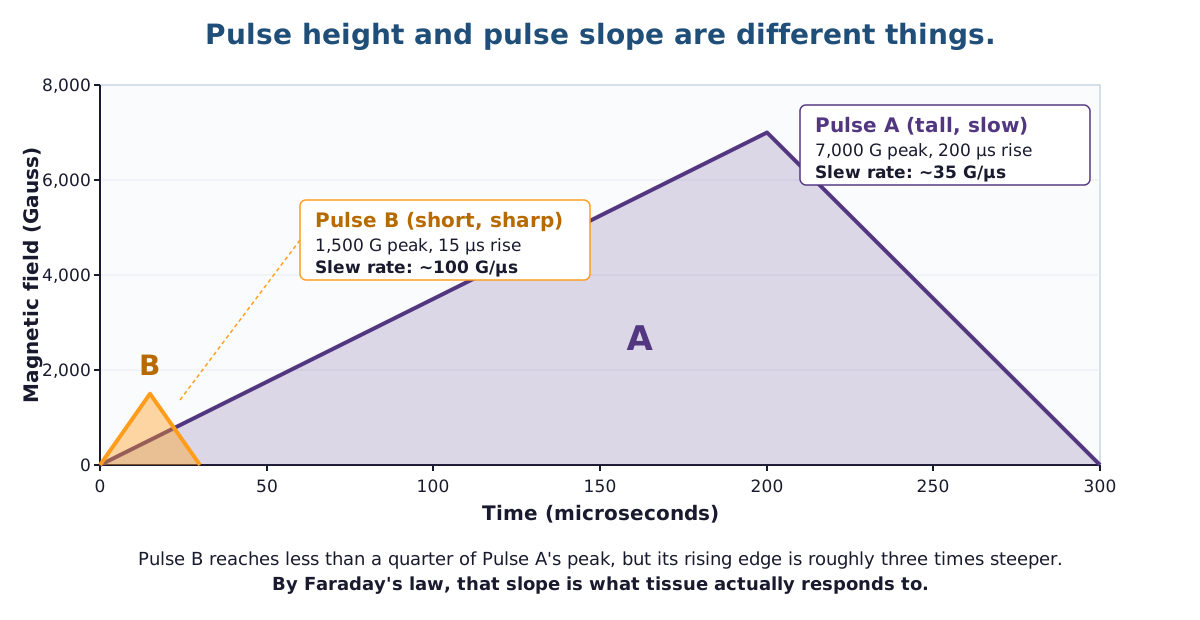
It's the slope of the pulse's rising edge, expressed in Gauss per microsecond. A pulse that climbs to 7,000 Gauss over 200 microseconds has a slope of about 35 Gauss per microsecond. A pulse that climbs to 1,500 Gauss over 15 microseconds has a slope of about 100 Gauss per microsecond. The second pulse is shorter and weaker at the peak. It also changes about three times as fast. By Faraday's law, that second pulse induces roughly three times the electric field in tissue, even though its peak is less than a quarter the size of the first.
What peak Gauss leaves out
Peak Gauss is the highest the field gets at any single location on the coil. It doesn't explain how quickly the Gauss peaked. The peak measures the field's strength. The slope determines the biological response. Both numbers are needed to know what the device delivers.
Slew rate: dB/dt explained
Manufacturers that publish thorough measurement data report two numbers together: peak Gauss and slew rate. Slew rate, written in Gauss per microsecond, is the average rate of change across the rising edge of the pulse. It is the same physical quantity as dB/dt, presented as an engineering performance metric. A device that publishes a slew rate is publishing the part of the pulse that determines how tissue responds.
Slew rate is computed simply: peak Gauss divided by the rise time, which is the time it takes the pulse to go from 10 percent to 90 percent of its peak. The same two pulses in the figure show what that arithmetic looks like. Pulse A (7,000 Gauss, 200 microsecond rise) has a slew rate of about 35 Gauss per microsecond. Pulse B (1,500 Gauss, 15 microsecond rise) has a slew rate of about 100 Gauss per microsecond. Pulse A has more than four times Pulse B's peak. Pulse B has roughly three times Pulse A's slope. These are two different design choices, both valid, and you can't tell them apart from peak Gauss alone.
What does this change when reading a spec sheet?
A brochure that prints a peak Gauss number and nothing else leaves you guessing how well the device will perform. A brochure that prints peak Gauss alongside slew rate (or peak Gauss alongside rise time, which is the same information) provides enough information to compare two devices based on what tissue actually responds to.
The next time you're comparing two PEMF devices, ask each manufacturer for the slew rate or rise time at the highest power setting. If both can answer with a specific number, you can rank them on Faraday's law instead of marketing math. If one or neither can, that's information too.
None of this is an argument against peak Gauss. The peak is a real, useful number with a clear role. Peak Gauss describes the field's strength. Slope describes how fast the field changes, which is what determines biological response.
What a real report shows
Our published example reports capture the full oscilloscope waveform at every power setting and derive the rise time, fall time, slew rate, peak dB/dt, and pulse balance from it. Every per-setting table lists those numbers next to peak Gauss, so you can see exactly how the slope changes as the device is dialed up or down. The public BBMPulser 5B device report, for example, records a measured slew rate of about 140 Gauss per microsecond at its top setting, paired with a measured peak field of roughly 22,000 Gauss. That second line in the table is the slope. Once you've read a published report, the empty space on a brochure becomes much more noticeable.
Check the slope, not just the peak.
Our example reports show what a fully tested pulse looks like, with rise time, fall time, and slew rate published at every setting. If you'd like to talk through what to look for on a specific device, we're happy to take the call.
Schedule a Call See Example ReportsPeak Gauss measures the field's strength. Slope determines biological response. With both in mind, every spec sheet is easier to read.