
Six questions take the guesswork out of your next PEMF purchase.
If you're about to spend a few thousand dollars on a PEMF device and the spec sheets all start to blur together, you don't need to become an expert in electromagnetics. You need six questions, and the discipline to ask all of them.
Each question targets a value the brochure either left off or rounded into uselessness. Asked together, they replace marketing copy with a measured picture of what the device actually does.
Question 1. Where was the peak measured?
The reading depends on two things: how far the probe sits from the accessory surface, and where on the surface it sits. Standoff distance alone can change the value by a factor of ten on the same accessory. Position on the surface can change it by the same amount. A peak Gauss value without both conditions stated is just a number.
A good answer sounds like this. "Peak measured at the center of the accessory surface with a calibrated axial Hall probe, at the highest power setting."
A bad or missing answer sounds like this. "It's up to 7,000 Gauss." That value gives you no probe type, no location, no standoff, and no power setting. Without those four conditions, you can't compare it to any other vendor's value, or verify what the vendor is actually claiming.
Question 2. Is the peak value a single point, or a profile?
Is that headline value from a single tiny spot on the accessory surface, or does it describe what the field is doing across the whole surface? Peak alone tells you the highest field at one spot. A profile tells you the field across the whole surface. Two accessories can share the same peak value while spreading useful field over very different areas.
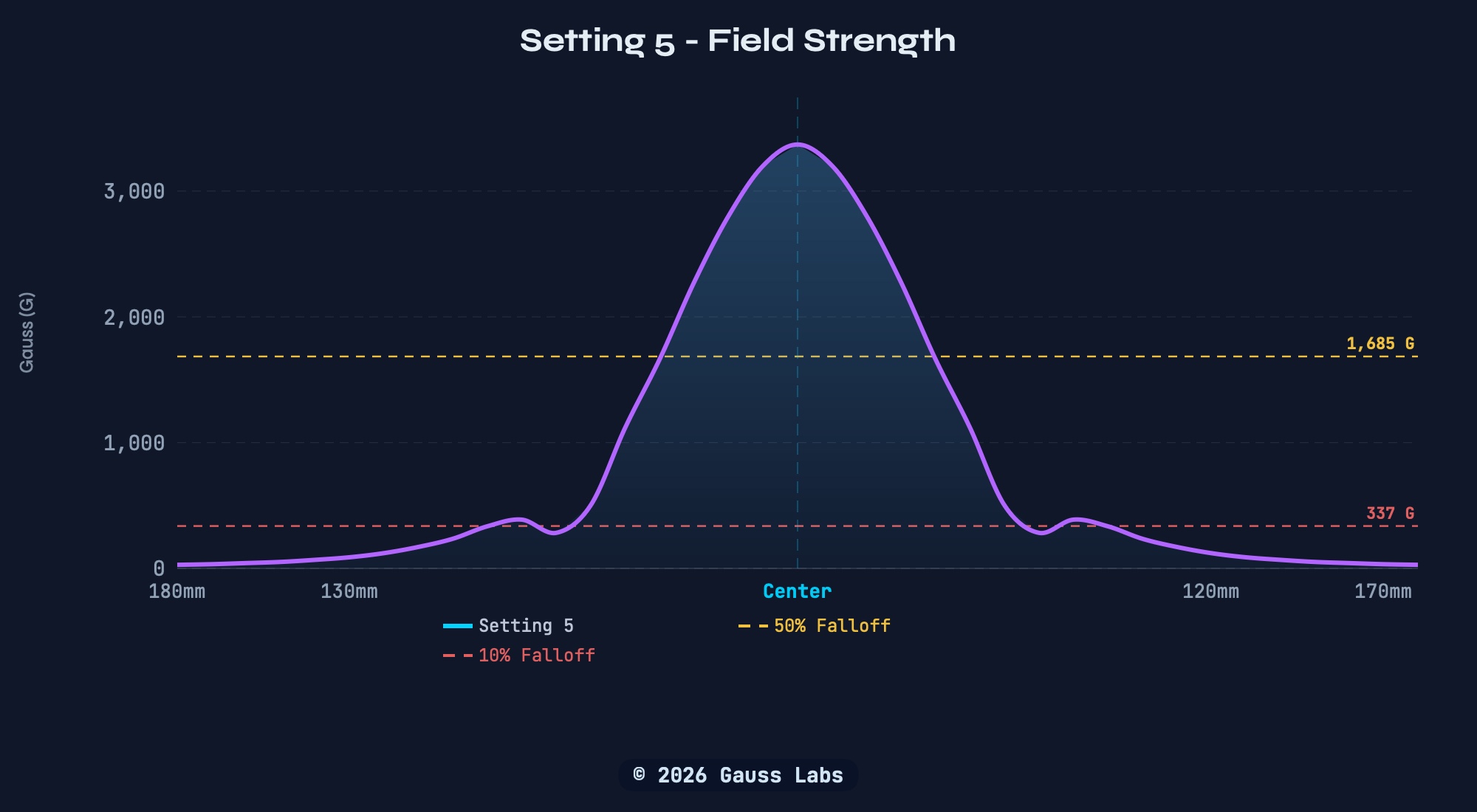
A good answer sounds like this. "We publish the mirrored falloff profile from one edge of the accessory through the center to the other edge, with the 50 percent and 10 percent thresholds marked." That gives you both boundaries that matter: the zone where the field is still at or above half its peak, and the effective field radius, where the useful field tapers off below 10 percent.
A bad or missing answer sounds like this. "It's X Gauss." That value gives you the highest reading the accessory can produce, but nothing about the field anywhere else. Without a profile or scan, you can't compare coverage between two accessories, or tell how the field falls off.
Question 3. What's the coil geometry inside the accessory?
Two discs of identical outer diameter can house very different coil geometries, producing very different field patterns. A pancake coil is a flat spiral, and its field peaks at the geometric center. A donut coil is wound in a ring, and its field peaks in a ring around the center, producing broader, more even coverage across the surface.
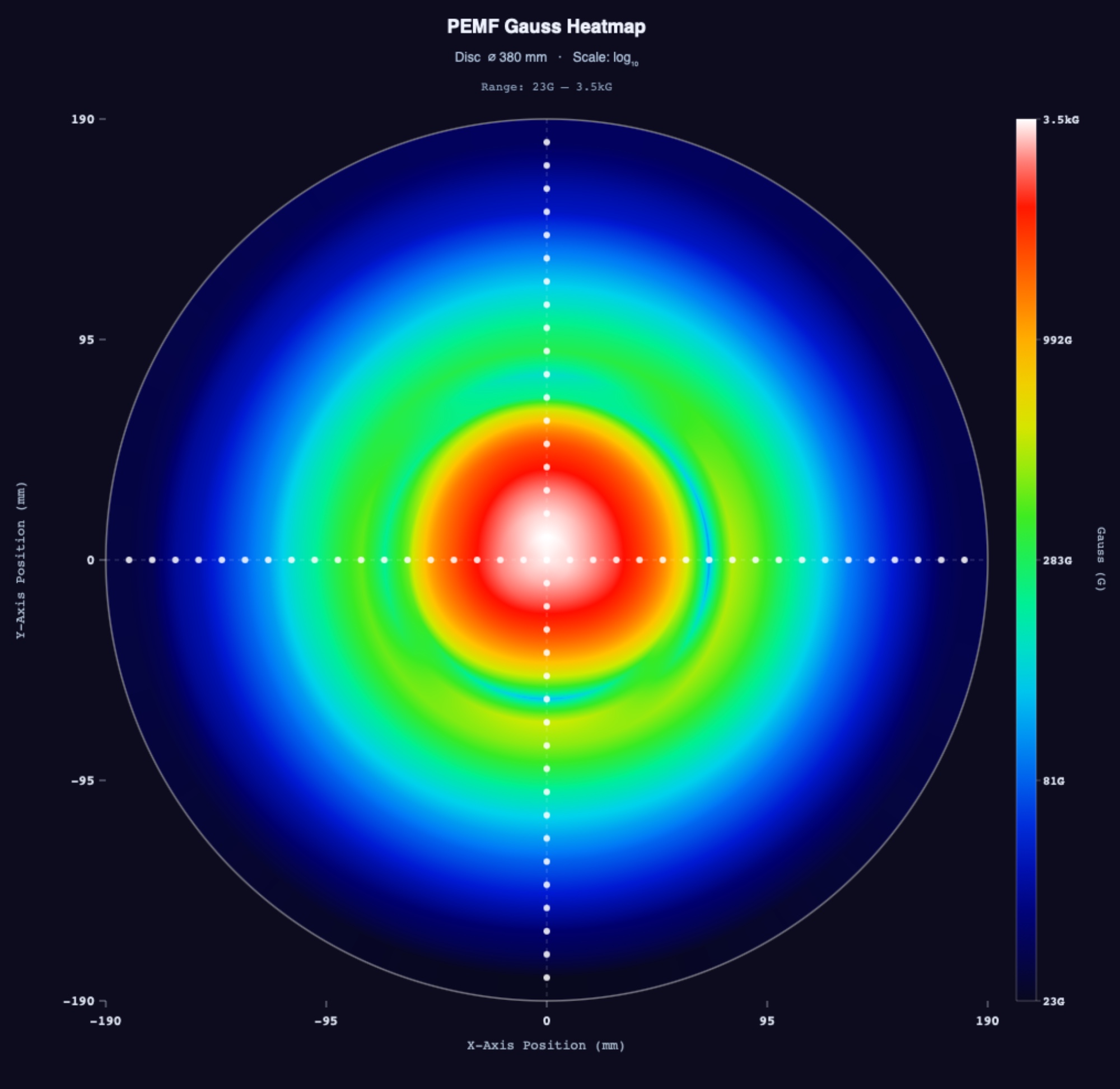
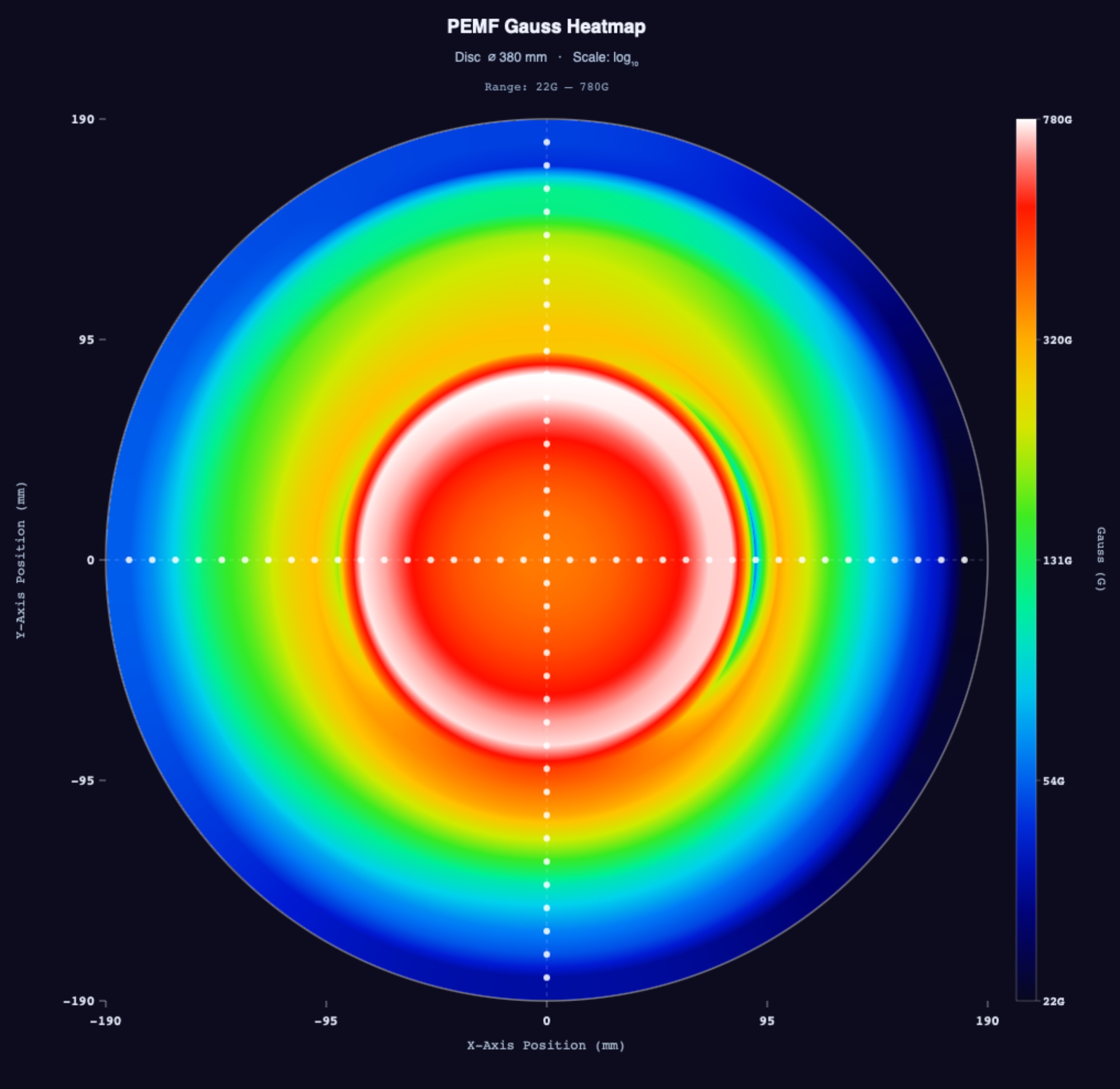
A good answer sounds like this. "It's a pancake coil inside a 380mm (15 in) diameter disc. Peak field is at the center, falling off symmetrically toward the edges."
A bad or missing answer sounds like this. "It's a 380mm (15 in) diameter disc." That answers a different question. The size of the housing says nothing about the geometry of the coil inside, or the shape of the field it produces.
Question 4. What's the rise time or slew rate?
How quickly does each pulse climb to its peak? By Faraday's law, what stimulates tissue is the rate of change of the magnetic field, not the peak field itself. A 1,500 Gauss pulse with a sharp rising edge can deliver more stimulus than a 7,000 Gauss pulse that ramps up slowly. So the peak is only half the story. The slope is the other half.
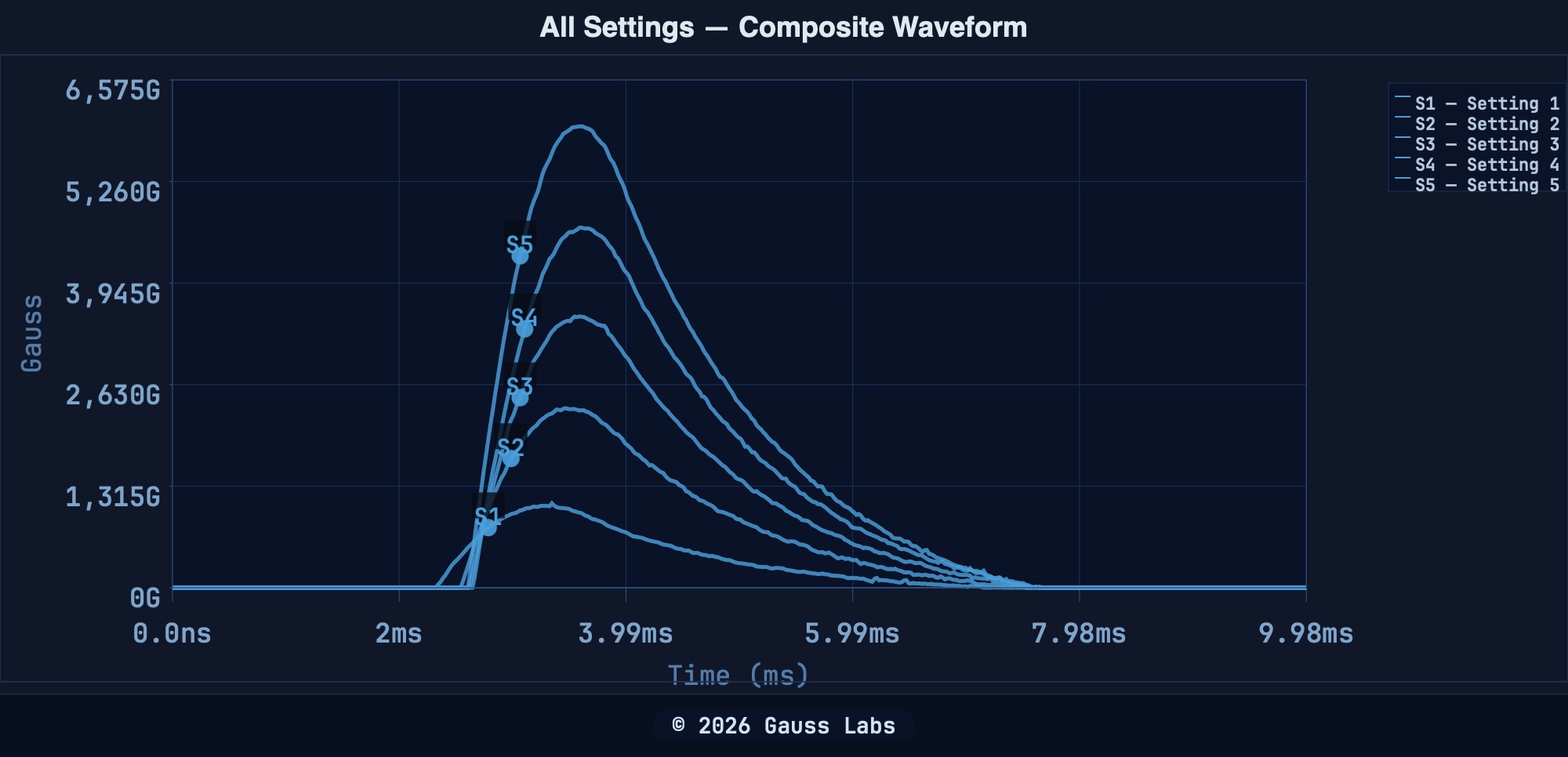
A good answer sounds like this. "Slew rate is 109 Gauss per microsecond at top setting. Rise time is 160 microseconds. We capture the actual oscilloscope waveform at every power setting and publish those traces."
A bad or missing answer sounds like this. "The peak is 7,000 Gauss." That value gives you no rise time, no slew rate, no shape of any kind. A sharp low-Gauss pulse and a soft higher-Gauss pulse look identical on the brochure.
Question 5. On a multi-coil mat, do the coils fire together or one at a time?
When the mat has several coils embedded in it, do they all fire simultaneously at full strength, or does the device cycle through them one at a time? This is a decisive question for mats, because "rated intensity per coil" means very different things in those two cases. A mat that fires its eight coils sequentially at "full intensity per coil" puts full intensity on any given square inch for only one-eighth of the session. A mat that fires all eight in parallel keeps every square inch at full intensity the whole time.
A good answer sounds like this. "All coils fire simultaneously at rated intensity. Every square inch of the mat receives full peak Gauss for the entire session."
A bad or missing answer sounds like this. "Each coil produces X Gauss." That's a per-coil value with no firing scheme. You can't tell whether you're getting continuous coverage or a rotating spotlight, and the difference is easily a factor of eight in delivered energy per square inch.
Question 6. Are unit tolerances disclosed?
Does the manufacturer acknowledge that no two production units are identical? Is the variation published? Every electronic device varies a little from the next one off the assembly line. A spec sheet that prints a single exact value with no tolerance is either an oversimplification, or proof the variation hasn't been measured.
A good answer sounds like this. "Peak field is 7,000 Gauss plus or minus 30 percent across production units."
A bad or missing answer sounds like this. "Peak field is 7,000 Gauss." That's implied to be exact for every unit shipped, which is almost certainly not true. The absence of a tolerance is itself a tell. Either the variation hasn't been measured, or it has been measured and isn't being shown.
Six clear answers separate the shortlist from the noise.
A vendor who can answer all six clearly has nothing to hide and has done the engineering work behind the marketing. A vendor who answers three and hedges on three has told you which parts of the device they're confident in and which they're not. A vendor who can't answer any of them isn't being dishonest, but they're selling a product they haven't fully characterized, which means you'd be buying it on their word alone.
None of this requires the manufacturer to be Gauss Labs certified, although certification gives you a way to verify the answers independently. Some of the answers can come from internal QC data, some from the original engineering, some from a competent reseller who happens to have them on hand. What matters is that the answers exist, that they're specific, and that they're consistent with each other.
Our example reports show what these six answers look like in detail.
The fastest way to recognize a good answer is to see it broken down into clear charts and per-setting tables. We publish complete example reports for a device analysis, a pancake accessory, and a donut accessory. Each one shows all six questions answered with the actual measurements, charts, and tolerances. Read one, and the pattern of a real answer feels obvious.
Bring the right questions to the next call.
Read the public example reports to see what each of these six questions looks like answered in full. If you'd like to talk through what to look for in your specific use case, we're happy to take a call.
Schedule a Call See Example ReportsYou don't have to be an expert in electromagnetics to make a smart purchase. You need six answers. The vendors who can give them go on the shortlist. The vendors who can't have just told you something useful about themselves.