
A donut disc looks just like a pancake disc, but its field peaks in a ring, not at the center.
You place a disc's center over a small joint, run the full session, and the relief comes up short. With a pancake coil, that's usually a placement miss. With a donut coil, the placement itself is the miss: you've aimed the field's weak spot at the joint.
Two discs can share the same outer size and housing and still deliver very different fields. The coil wound inside sets the field's shape. A pancake concentrates its strength at the center. A donut spreads its strength into a ring and leaves a dip in the middle.
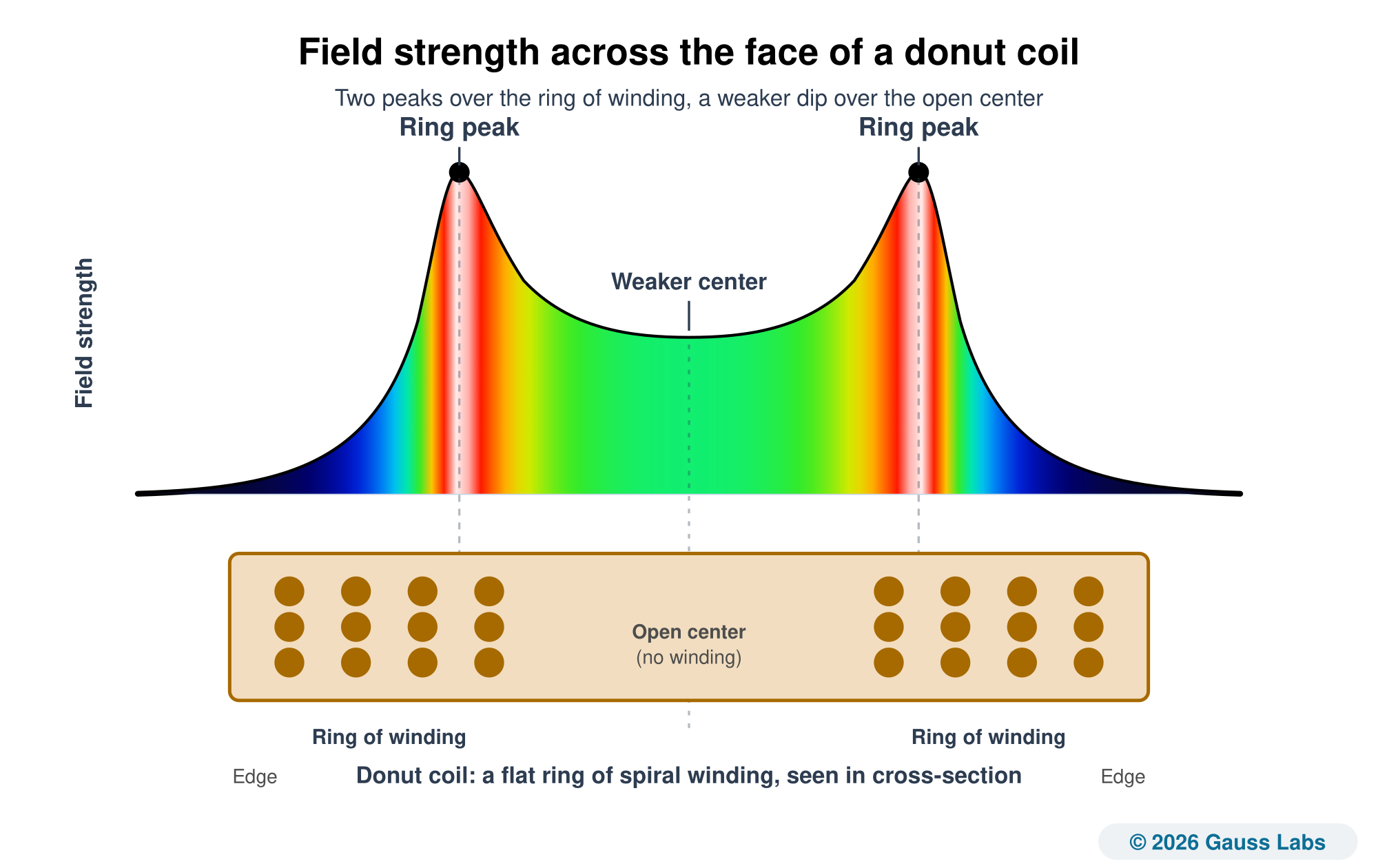
The field is strongest directly over the wire.
A donut coil is wire wound into a donut shape: a flat ring with an open middle. A magnetic field forms around wire that carries current, so the field is strongest above the ring of wire and weaker above the open middle, where there's no wire. That's the curve in the diagram above: a peak over each side of the ring, and a dip over the middle.
The same rule explains the pancake. A pancake coil is wire wound into a pancake shape: a solid flat spiral with no open middle. The wire runs all the way to the center, so that's where its field peaks.
One clarification about the word "donut": a donut coil isn't a toroid, a different geometry where the wire wraps around a ring-shaped core and the field stays inside that core. The two share a nickname, not a field shape. A donut coil is fully enclosed in its housing, and its field comes out through the flat side you place against the body, not out through the open middle. That flat side is the surface we measure.
The donut measures about twice the Gauss of the donut hole.
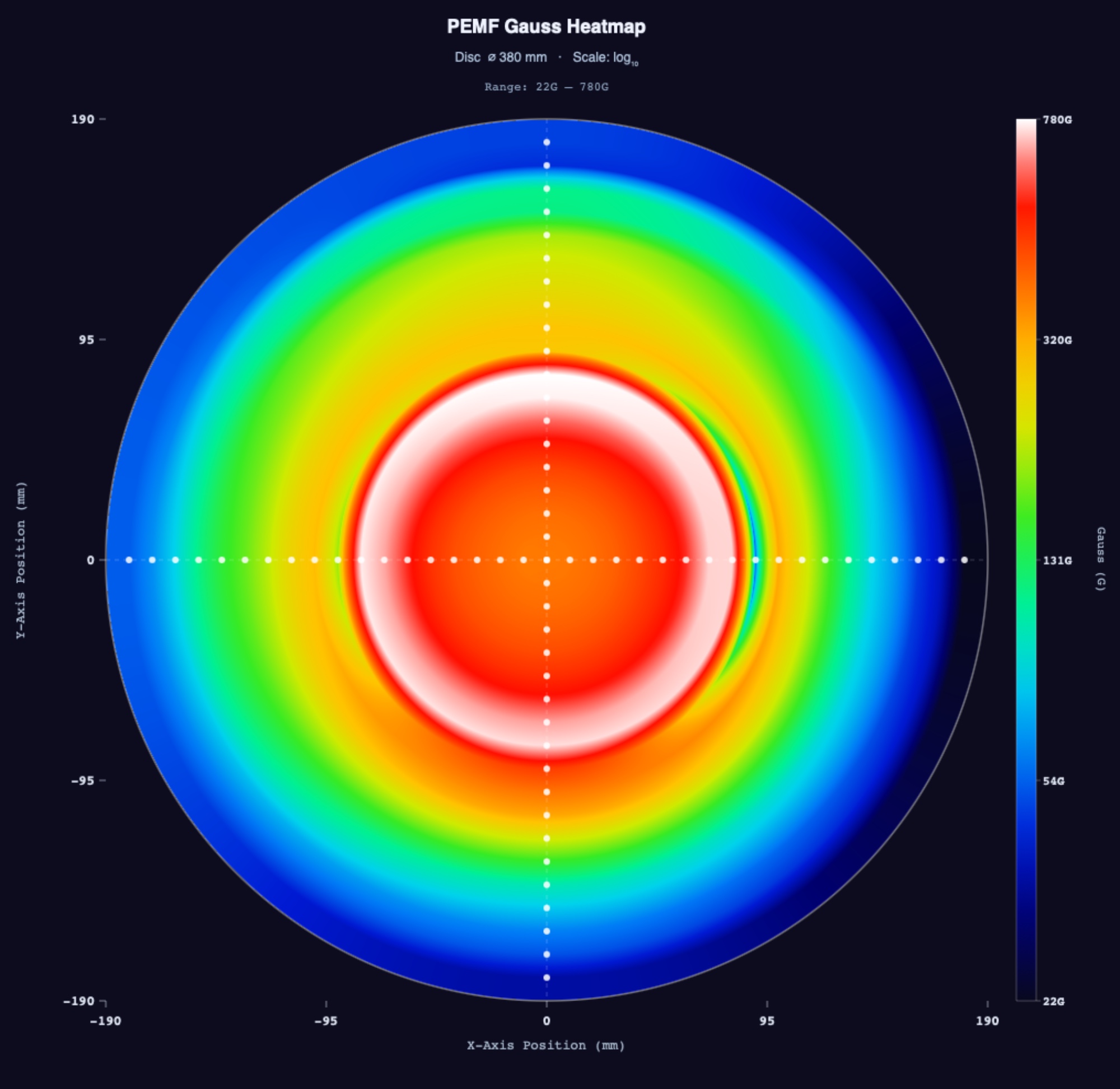
The strongest field on this disc, about 755 Gauss at the top setting, sits in the ring. The middle gets about half that.
What the ring pattern buys you is coverage. The ring of wire inside this disc is only about 180mm (7 in) in diameter, but the field reaches well past the wire. The zone still carrying meaningful field is about 320mm (12.6 in) wide, most of the disc's 380mm (15 in) diameter. A donut spreads usable field across a broad area instead of stacking it into a single point.
A donut is built for coverage, not for a pinpoint target.
A donut isn't a weaker pancake. It's a different tool, built for a broad area rather than a single small target. That wide ring is an advantage when you're covering a long stretch of soft tissue or a larger region. The strength is spread out on purpose.
The mismatch only shows up when you use a donut like a pancake. Center it over a small joint and the joint lands in the cooler middle, an inch or two from the ring of strongest field. The fix isn't a stronger device. Place the disc so the ring straddles the target, or pick a pancake when the target really is that small. Match the field shape to the area you're covering, and the donut delivers the coverage it was built for.
The spec sheet should name the coil inside the disc.
"Disc" describes the housing. A disc accessory can hold a pancake coil, a donut coil, or something else, and from the outside the discs can look identical. A peak Gauss value won't tell them apart either. It says how strong the strongest spot is, not where that spot sits. If the spec sheet doesn't say which coil is inside, ask the manufacturer for a heatmap or a falloff chart, a picture of the field's shape. A single bright spot at the center means a pancake. A bright ring around a weaker middle means a donut, whatever the housing looks like.
See a fully measured donut in our example reports.
Our published example reports include the heatmap, a falloff chart, and per-setting tables of the field's strength, coverage width, and concentration. The donut example on the public reports page shows the offset ring, the cooler center, and how wide the usable field is. Once you've read one of these reports, a brochure that prints only a peak Gauss value leaves an obvious gap: it never tells you where on the surface that peak sits.
Ask where the field peaks, not just how high.
A donut coil is strongest in a ring, with a cooler center. Knowing that changes where you place the disc and which target it suits. Our example reports show what a fully tested donut looks like, end to end.
Schedule a Call See Example ReportsA donut and a pancake can ship inside the same disc, and the housing won't tell you which one you're holding. The field will. The next post puts the two side by side: same disc size, same device, one peak at the center and one ring offset from it.