
How PEMF works comes down to a changing field, not a strong one.
You're looking at your first PEMF device, and the marketing throws around Gauss numbers, waveforms, and frequencies. Underneath all of it is one plain idea, and once you have it, the specs start to make sense. A PEMF device works by pulsing a magnetic field on and off. The pulsing is the point.
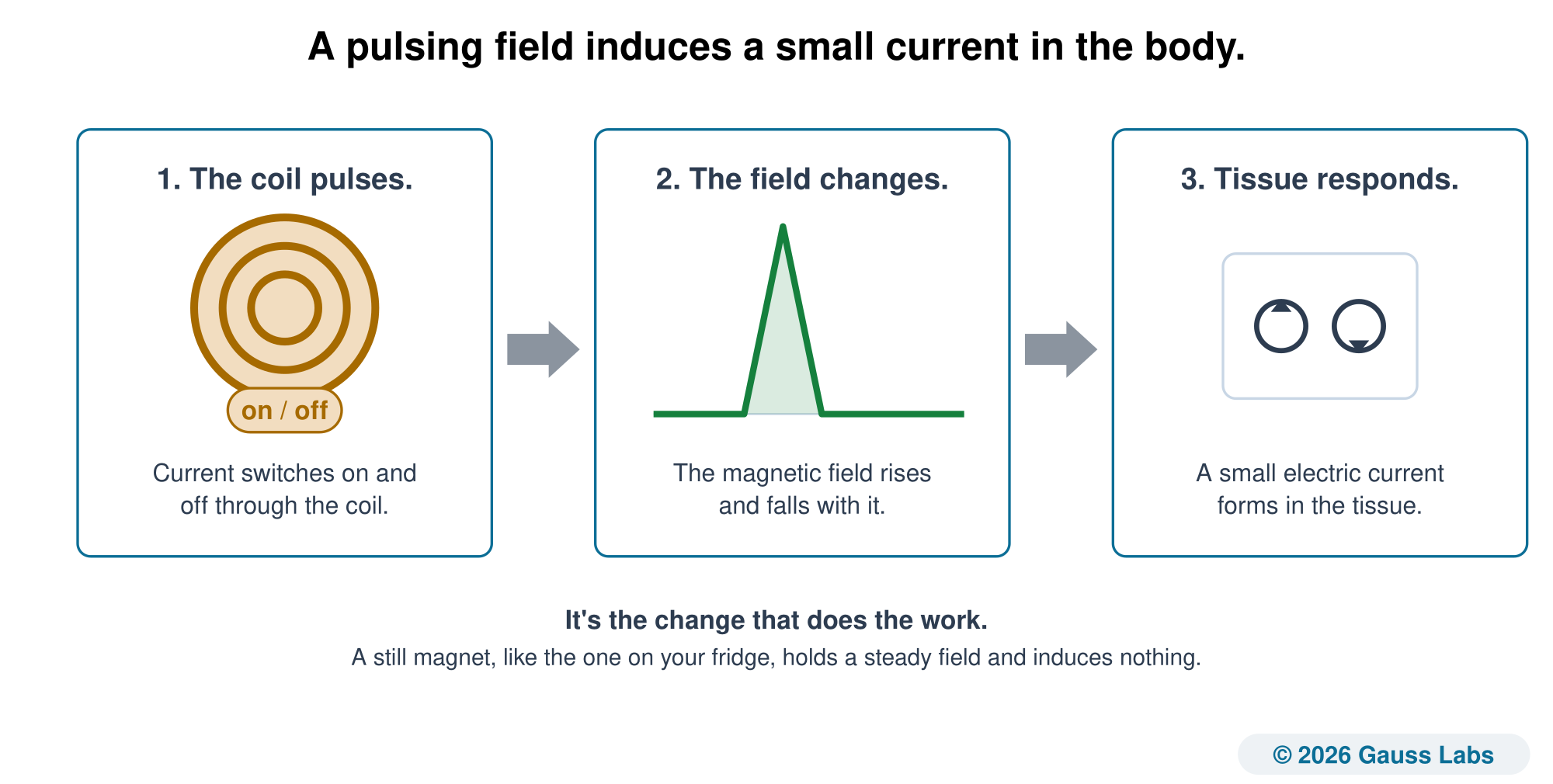
A fridge magnet is strong, but a still field does nothing to your body.
Hold a magnet against a photo on your fridge and it stays there for years. That's a strong, steady field, and it does nothing to the cells in your hand. The field never changes, so there's nothing for your body to respond to.
A PEMF device is built to do the opposite. It switches its field on and off many times a second. Each switch is a sharp change in the field, and that change is the part your body reacts to. A still magnet, however strong, never delivers it.
The change is what reaches your tissue.
Here's the physics, in one sentence. When a magnetic field changes near anything that conducts, including the fluids and cells in your body, it creates, or induces, a small electric current. The faster the field changes, the stronger that induced current. Physicists call this Faraday's law, and it's the engine underneath every PEMF device.
So the useful part of a pulse isn't how high it climbs. It's how sharply it rises and falls. Engineers write that rate of change as dB/dt. It's why a device with a fast, sharp pulse can induce a stronger current in tissue than a device that reaches a higher peak slowly.
Two devices can share a peak and still reach tissue differently.
Peak field, the highest Gauss a device reaches at its surface, is the value you'll see quoted most. It's real, but it's one instant at one point. Two devices can hit the same peak and induce very different currents in tissue, because one reaches that peak with a sharp rise and the other with a slow one.
What actually reaches you depends on the shape of the pulse over time (its waveform) and how fast its edges rise and fall (its slew rate). A single peak value can't show you any of that. That's why a manufacturer who has measured a device can show you the pulse shape and a field map, while one who only quotes a peak is handing you the least useful part of the picture.
Want to see what a device's field actually does over time?
Tell us about your device and we'll scope a test, or see what a finished report looks like first.
Schedule a Call See Example ReportsSo when a device leads with a big Gauss number, remember what that number leaves out. A strong field that never changes does nothing on its own. What makes PEMF work is a field that keeps changing, and that change is what reaches your body.