
The FEI has proposed cutting the PEMF field limit at its events from 1,000 Gauss to 100.
If you take a PEMF system to competition, the value that decides what you're allowed to bring could drop by a factor of ten. Nothing has changed yet, since this is a proposal going to a vote on 5 December 2026, and the reason the Fédération Équestre Internationale (FEI) gives for it is one we deal with every week: it says device outputs are questionably labelled and hard to control. That's a measurement problem, and it's the one we work on, so we'd rather see it fixed by measuring what this equipment actually puts out.
Here is what the FEI proposed, in its own words.
The proposal appears on slide 35 of the FEI's Veterinary Matters presentation from the 2026 Sports Forum in Lausanne, under the heading "Supportive Therapies - Human Safety: PEMF machines." It lists three issues, that strong electromagnetic fields are a health risk to people and interfere with pacemakers, that there are "reports of questionable labelling of outputs and careless use and noise," and that output is "difficult to control." Against those it proposes to "only allow battery powered products with output below 100 Gauss," noting in a parenthesis that electromagnetic rugs would still be allowed.
The slide quotes the rule this would replace directly underneath, Article 1062.5, which permits a PEMF machine only if its field stays below 0.1 Tesla, or 1,000 Gauss. Setting the two side by side is what makes this a tenfold cut rather than a reading of one. The heading says PEMF machines, so it isn't only about rugs; rugs are named as an example of what would still pass under the new ceiling.
We've written before about the current 1,000 Gauss limit and how a certification confirms a device / accessory pairing doesn't exceed it, and that's the rule this would change.
The reason given is a measurement problem, not a field problem.
The second issue is the one worth reading closely. "Questionable labelling of outputs" and "difficult to control output" describe a spec sheet nobody can trust rather than a field that's dangerous, and closing that gap is what Gauss Labs does. A regulator reaches for a blunt rule when the numbers in front of it can't be relied on, so the proposal is a reasonable answer to a real problem with the information available.
We support the welfare and safety goal, and the human-safety half is a genuinely separate quantity from the competition ceiling. The 1,000 Gauss article is about the field delivered to a horse, while pacemakers and bystanders are about the field in the stable around the equipment, and a rule that moves one number is making a claim about both.
A battery doesn't set how strong the field gets.
The proposal has two conditions, battery power and an output below 100 Gauss, and it reads as though the first delivers the second. That's the part we can speak to directly, since the peak field is the thing our measurements describe.
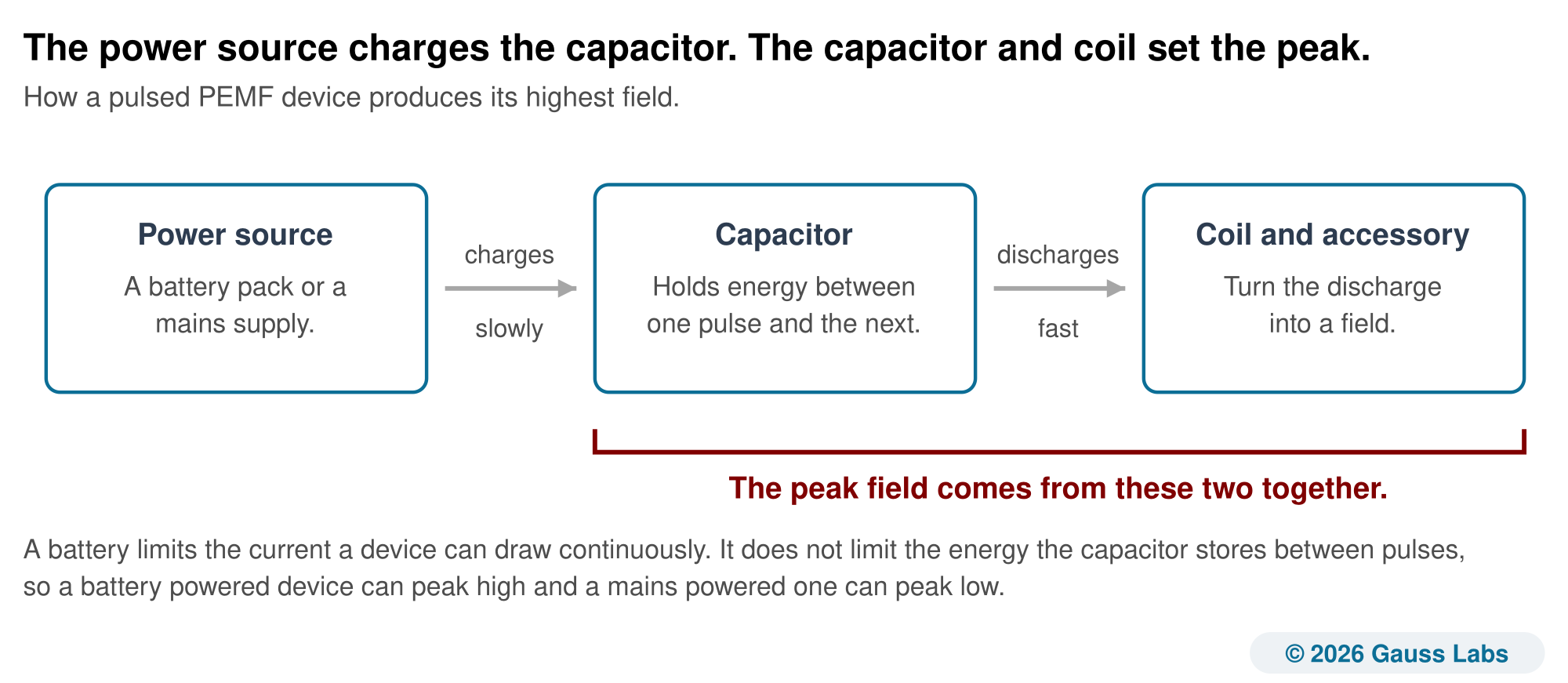
A battery limits how much current a device can draw continuously, which is a real constraint on how often it can fire and how long it runs, but it isn't a constraint on the peak. Most pulsed PEMF devices use a capacitor-discharge topology, charging a capacitor over the quiet stretch between pulses and dumping that stored energy into the coil in a few hundred microseconds, so the peak field strength comes from the energy in the store and the coil it lands in.
So the supply is one of several things that set the peak, and it isn't the one that limits it. Coil inductance, turn count, the drive circuit and which accessory is fitted all move the peak, and a device that swaps a small paddle for a large loop produces a different peak on the same battery. That's why a rule written around the power source misses in both directions: a battery powered unit can easily exceed 100 Gauss, and a unit running off mains can fall well under it.
A 12 volt battery pack makes the point concretely. Daboo Designs, which is the side of our business that builds PEMF coils and devices, will tell you that a pack that size comfortably charges a capacitor to the point where the coil produces a field of thousands of Gauss at the accessory surface. So a label reading "battery powered" doesn't narrow the output much at all, and it certainly doesn't put it near 100 Gauss.
Most of what we've measured sits well above 100 Gauss.
The other thing worth putting on the table is scale, because a ceiling only means something next to what equipment actually produces. We keep anonymized medians across the accessories we've tested, grouped by shape with a minimum of five tests per group, so no figure traces back to one device or one company.
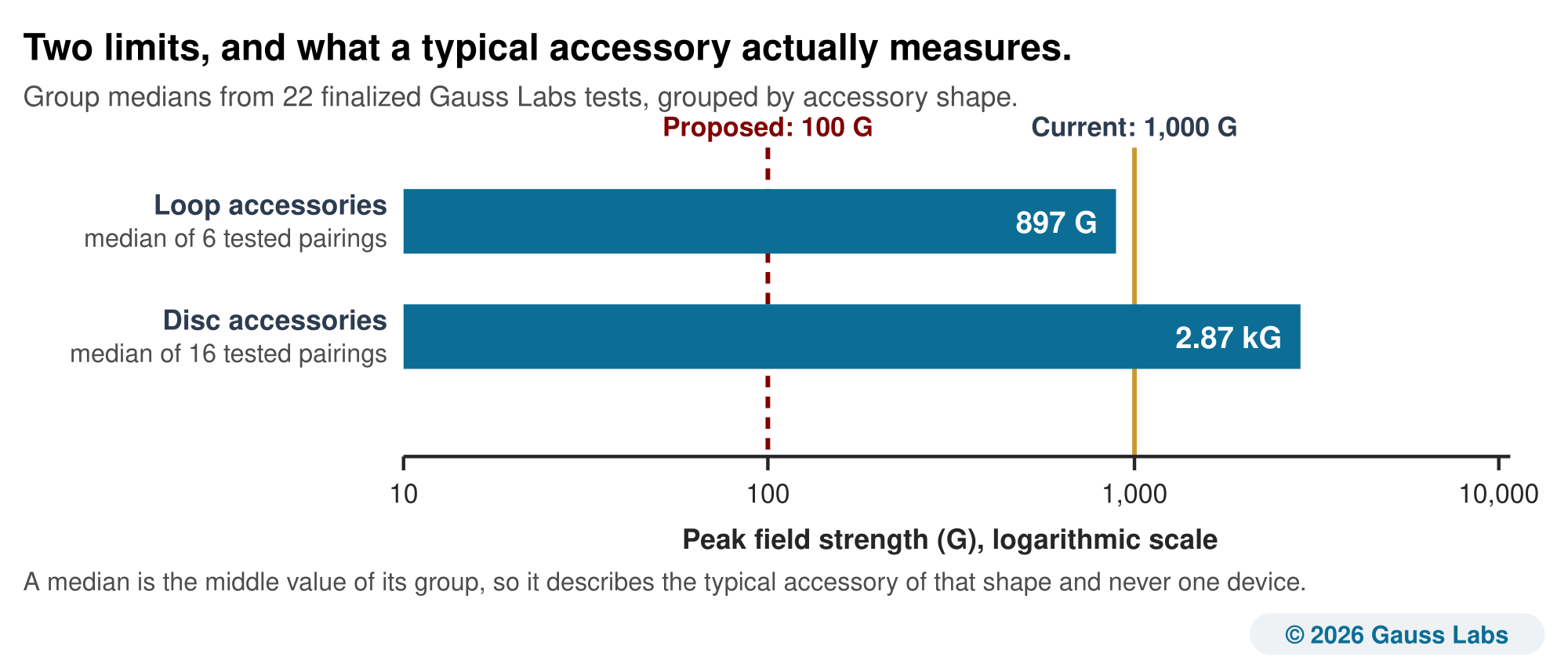
Across 22 finalized tests, the typical loop accessory peaks at 897 Gauss and the typical disc at 2.87 kilogauss, which is 2,870 Gauss. Those describe the middle of each group rather than any product, and they say something plain about a 100 Gauss ceiling: it would sit an order of magnitude below where this equipment is built to operate. That is a large change, and whether it's the right one is the FEI's call rather than ours.
A verified measurement does what the battery rule is meant to do.
A spec sheet is the maker's claim, and an independent measurement is a checked fact. If the goal is a field below a stated value, measuring the field is what reaches it, and that isn't a position we've taken for this proposal; it's what we do for every pairing that comes through the lab.
A measurement also does something a power-source rule can't, which is identify the equipment that already complies instead of excluding it alongside everything else. Conformance belongs to a device and accessory together rather than to a device on its own, since the peak comes from the driver and the coil working as a pair, and that's why our registry records it that way. Of the 29 certifications on the public registry today, four are recorded as conforming to the FEI's current standard, and the registry now carries a Standard dropdown that lists exactly those pairings. A certification is a measurement under our own rubric rather than an FEI endorsement, and the conformance it records is a ceiling the pairing stays under. If the word "certified" is doing a lot of work on the product pages you're reading, our companion post covers what a certified device is and how that differs from a certified practitioner.
There's a design answer alongside the rulemaking one, and it belongs to the manufacturer. If a device is meant to be used around competition horses, the way to keep it inside the limit is to design the device and accessory pairing to that limit from the start, then have the pairing measured to confirm it lands there. That's a decision about the coil, the stored energy and the drive, and it holds whatever number the FEI settles on. Choosing a power source and hoping the output falls where the rule wants it is the version that doesn't.
We know that's achievable because designing coils is the other half of our business. A disc can be built to hold under a given limit, as long as it's designed deliberately for the machine it will run on, since the same disc driven by different electronics is a different pairing with a different peak. On a digital PEMF machine the programming carries a large share of that work, because the firmware decides the drive the coil receives, so the field a horse ends up in comes out of the winding and the code together rather than the winding alone.
What a rule written around measurement would ask for.
- The peak field of the pairing, not the device. A driver has a different peak with every accessory fitted to it, so a limit written against a device alone can't be checked.
- The setting the value came from. A unit with several output levels has a different peak at each one, and a figure with no setting attached leaves the reader guessing which end of the range it sits at.
- Where the reading was taken. A value read at the accessory surface and one read at a standoff distance differ, so the condition is what makes the number checkable.
- Who measured it. A maker's own figure and an independent one carry different weight, and only one of them was checked by somebody with nothing riding on the answer.
The vote is on 5 December, and nothing is decided yet.
There is still time for this to change, and the dates say how much. Proposals from National Federations closed on 1 March 2026, the FEI issued its first draft on 20 July, and the comment window closed on 7 September. What remains is the Final Draft to National Federations on 6 November, the Rules Session on 4 December, and the vote at the General Assembly on 5 December. Some trade coverage has put the vote in November, which doesn't match the FEI's own published timeline.
We haven't read the draft wording of Article 1062 itself, because it sits on the Rules Revision Platform that National Federations use rather than on a public page, so everything above is read off the Sports Forum slide and nothing is paraphrased beyond it. The formal comment channel has closed, which means the remaining influence runs through the people who will vote and through the Veterinary Committee before the Final Draft is written. If you're a National Federation, a veterinary committee member, or a manufacturer whose equipment this would reach, we're glad to put measured evidence in front of whoever needs it.
Want your equipment measured against this limit?
We measure the peak field of a device with each accessory fitted to it, at every setting, and publish what the pairing produces. If you'd like to see what that looks like, our example reports are open to read.
Schedule a Call See Example ReportsThe FEI is being asked to swap one number for another a tenth its size, because the numbers on the labels can't be trusted. Making the labels trustworthy reaches the same goal, and it's the version that lets a pairing measured under the limit stay in the arena.