
You're spending real money on a PEMF device. The spec sheet leaves out most of what matters.
If you've ever stood in front of two PEMF devices, compared their published values, and felt like you couldn't tell which one was better, you're not the problem. The values are the problem.
You might be a chiropractor pricing a clinic system, an equine therapist comparing high-intensity machines, or a buyer for a wellness practice. What you need is a measured field map across the whole accessory surface, at every setting on the dial, on the unit you'll be paying for.
Almost no spec sheet carries that. Product pages have the room, but the information just isn't included. Most companies don't have the testing equipment to produce it.
Spec sheets are normally lacking in multiple areas.
These four areas show up across major brands, mid-tier clinical equipment, and DIY hobbyist gear.
A single peak Gauss value. "Up to 24,700 Gauss." The value is real, but it doesn't say much. Where on the accessory surface was the reading taken? How does the field fall off from there? Does the peak sit at the center, or off-center in a ring? You're left with a single value and no map.
Stylized field-line illustrations. These are drawings of magnetic field lines arcing out of a coil, often with a body silhouette nearby. They're useful for teaching the underlying physics. They're not measurements. The lines you see are the textbook field of an idealized coil. They're not the measured field of the product you're considering.
Three-point falloff curves. "500 Gauss at 1 inch, 300 Gauss at 2 inches, 100 Gauss at 3 inches." This is better than a single value. It tells you how the field weakens with vertical distance from the accessory surface. It doesn't tell you anything about how the field is distributed across the surface. Where does the peak sit? How does the field fall off horizontally? Is coverage symmetric? Both measurements matter, and the one buyers need most is the one almost no one publishes.
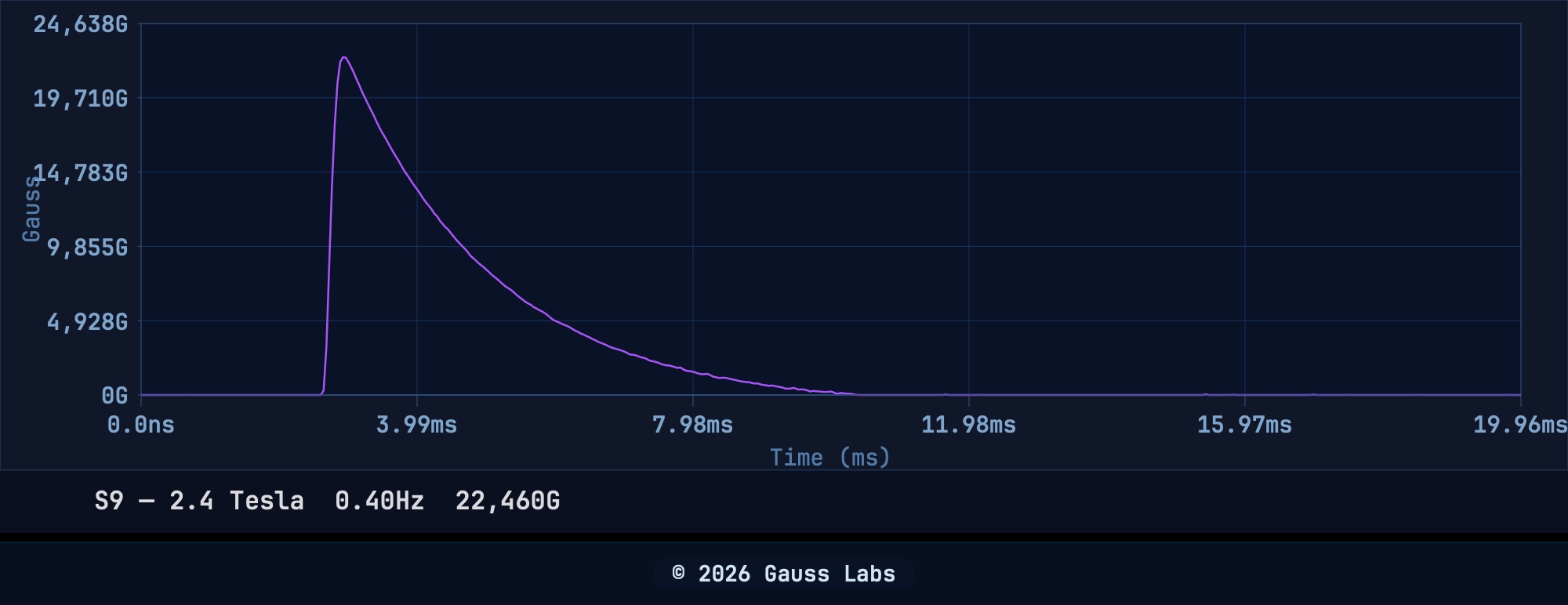
Refusing to publish a value at all. Some manufacturers argue that Gauss alone is misleading. They're right. By Faraday's law, tissue responds to the rate of change of the field, not the peak. But the answer to "one value isn't enough" is to publish more values, not none. A complete picture includes both the peak and the rise time. Neither is proprietary once the device ships.
A real test shows what a spec sheet leaves off.
We publish full analysis reports for the example devices and accessories we tested ourselves. You can compare what they show to any spec sheet you're holding.
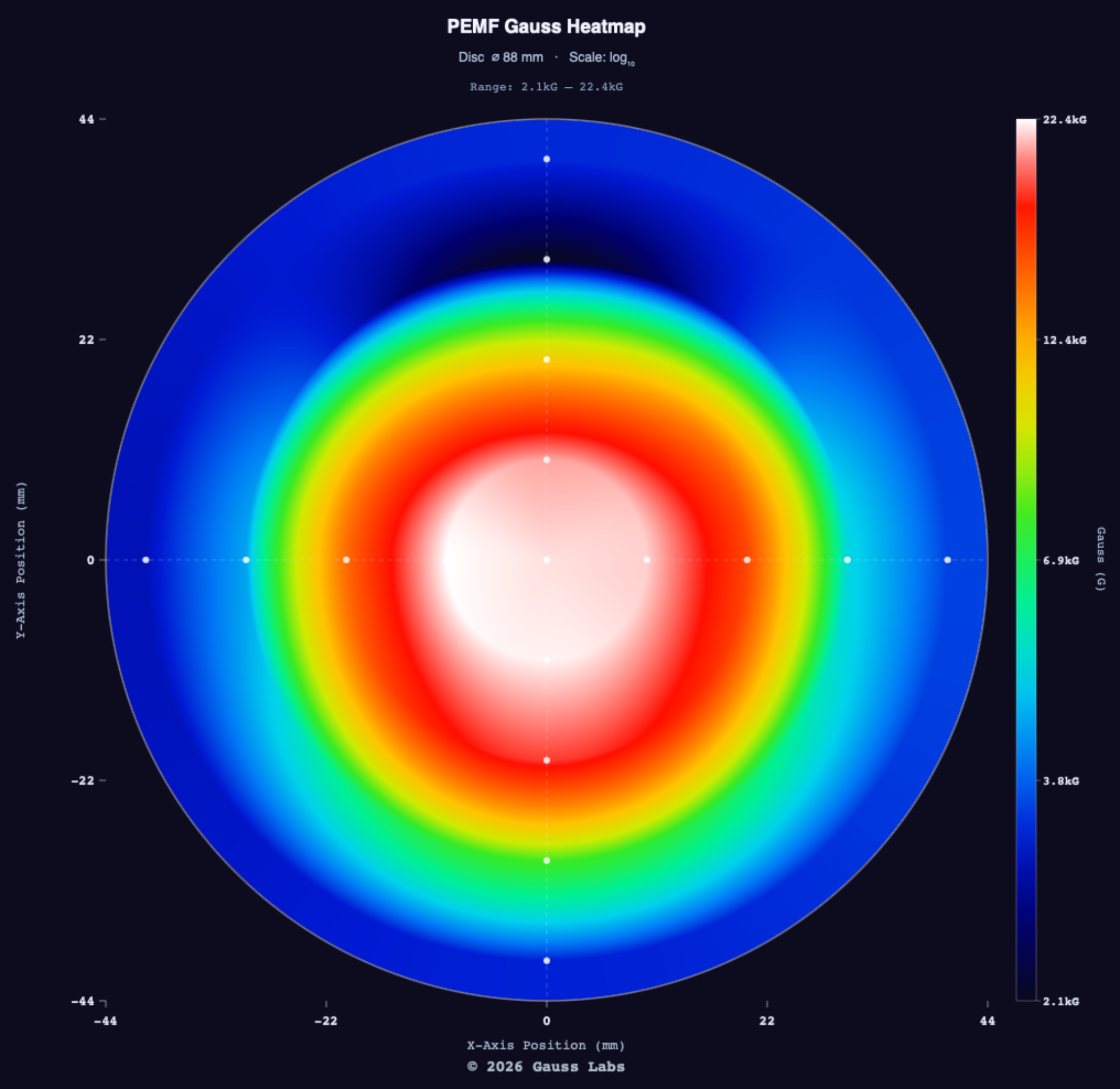
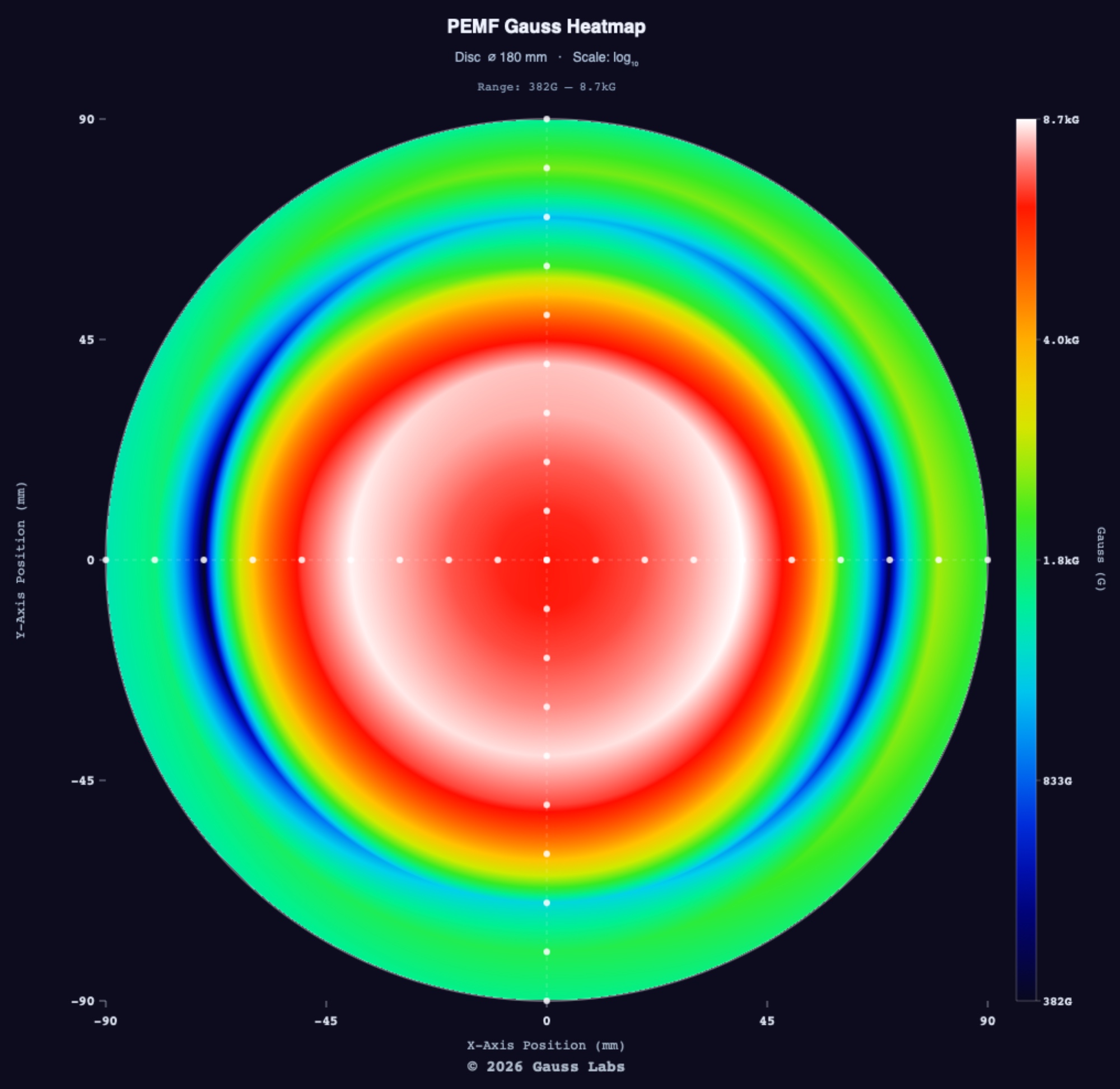
Pancake and donut accessories peak in different places.
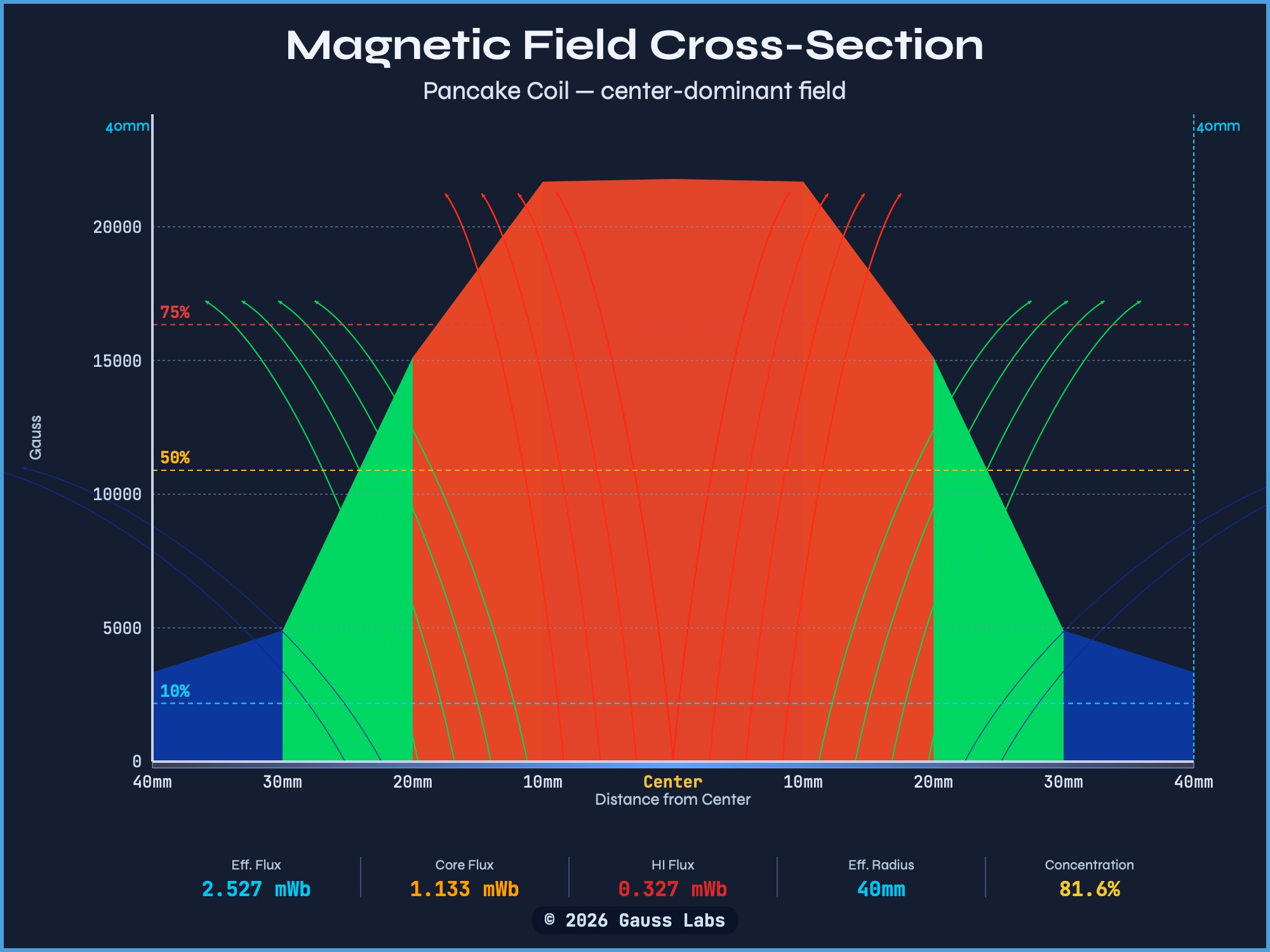
A pancake coil peaks at the geometric center. A donut coil peaks in a ring around the center. Each geometry exists for a different use case: a pancake for concentrated targeting, a donut for broader coverage. Place a donut accessory expecting the peak at the center, and you miss the peak. Your target sits in the lower-field area inside the ring. A measured heatmap shows exactly where the peak sits.
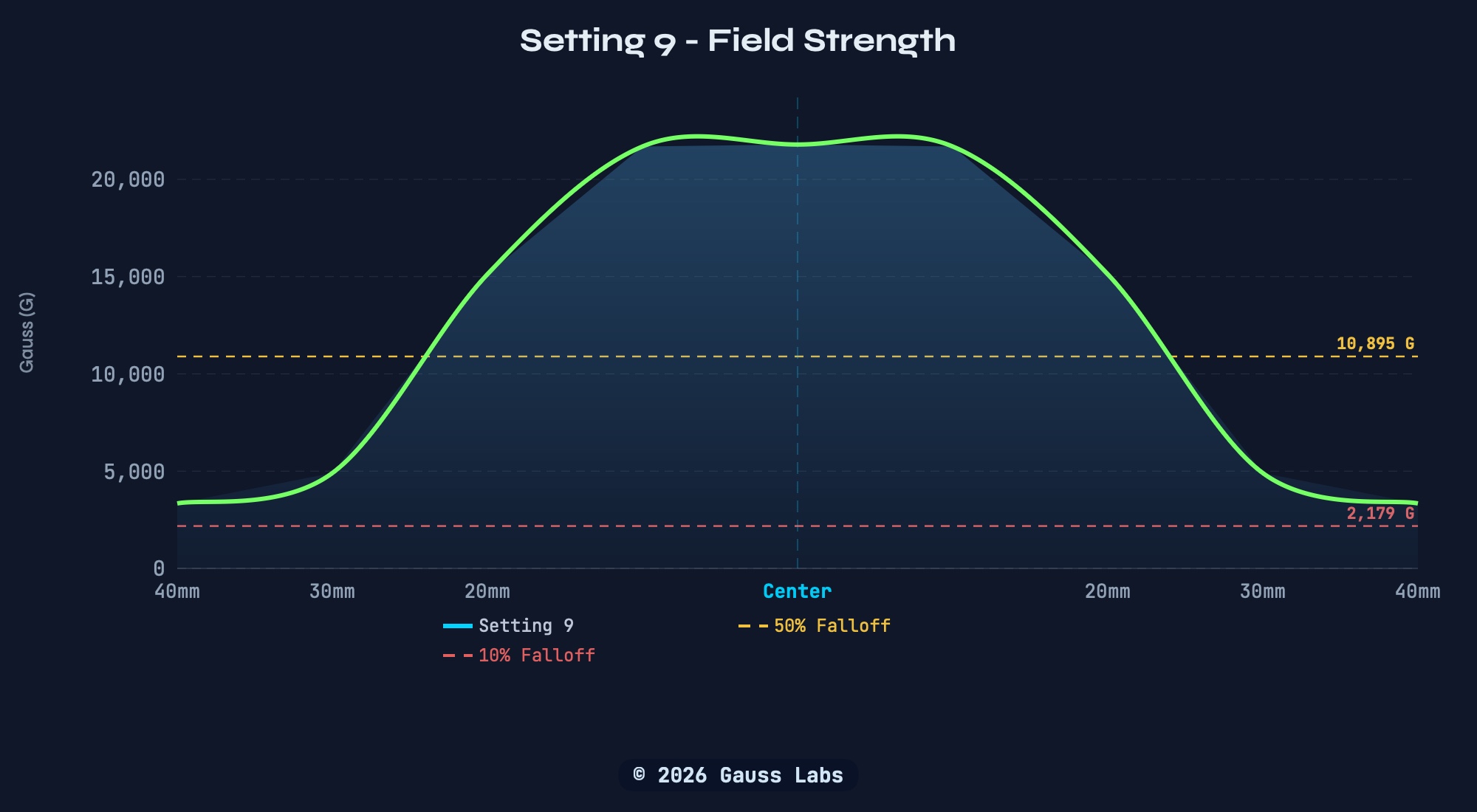
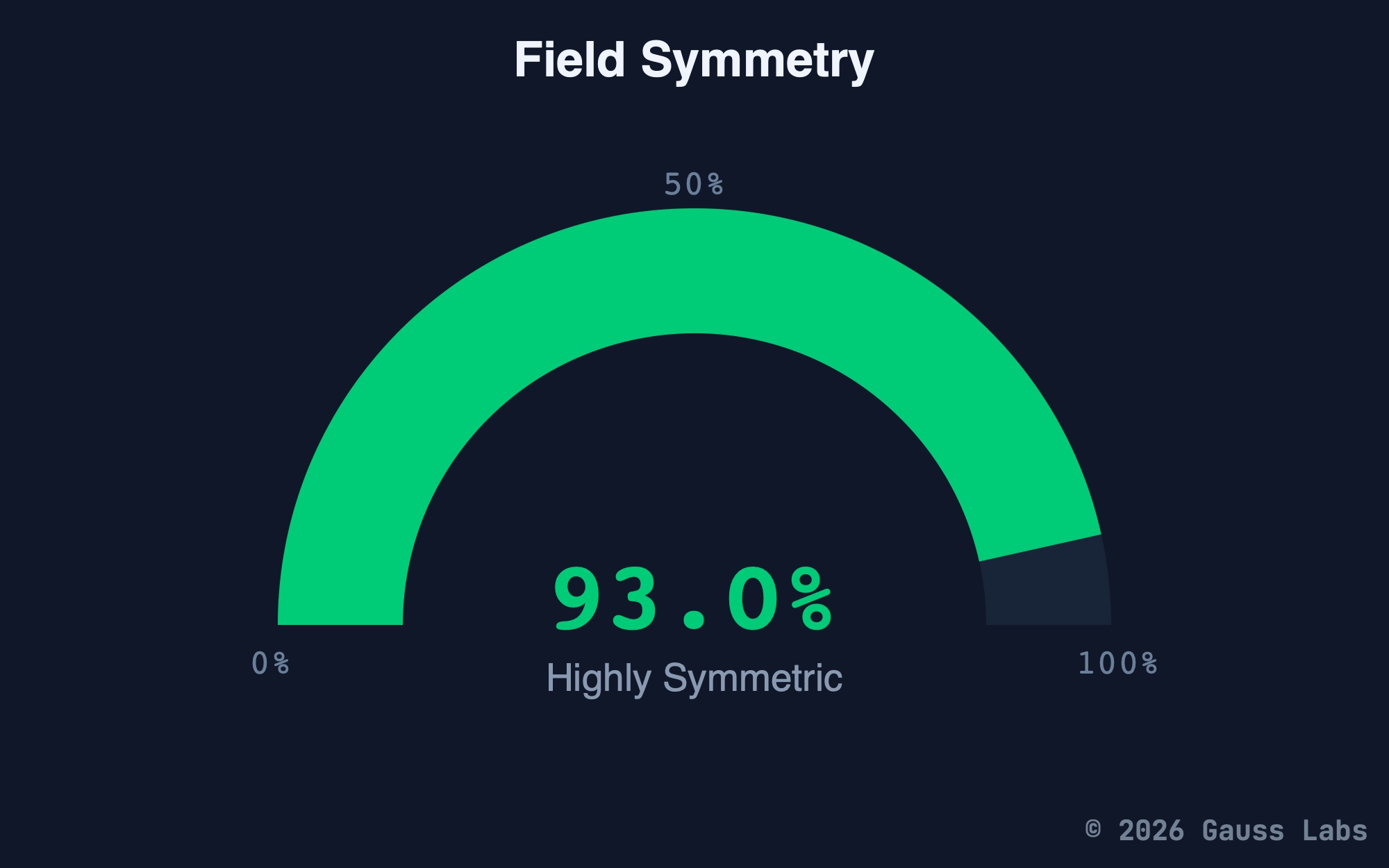
The falloff curve and symmetry score show what the peak alone can't.
Two accessories with the same peak Gauss value can produce completely different effective coverage. The mirrored falloff profile shows how the field weakens across the accessory surface, with the 50 percent and 10 percent thresholds marked. The symmetry score reveals whether coverage is even across all four axes. A low symmetry score means the accessory works more like a directional wand than an evenly covering disc.
The pulse shape determines tissue response.
The manufacturer who said "Gauss alone is misleading" was right. Two devices with the same peak Gauss can deliver very different stimulus. What matters is the rise time: how fast the field reaches the peak. A 21,000 Gauss pulse with a slow rise induces less current than a 5,000 Gauss pulse with a sharp edge. So the peak alone isn't enough. You also want to see the waveform.
Six questions cut through the marketing.
Six questions to ask before you buy.
- Where was the peak measured? On the accessory surface? At 1 cm? At "body distance"? A surface reading and a body-distance reading from the same accessory can differ by an order of magnitude.
- Is the peak value a single point or a profile? A peak alone tells you the highest field at one location. A profile tells you the field across the whole accessory surface.
- What coil geometry is it: pancake, donut, loop, or something else? If the manufacturer doesn't say (and many don't), assume nothing about where the strongest field sits. Each geometry produces a different field shape. The same peak Gauss value can mean very different coverage.
- What's the rise time or slew rate? If a device only publishes Gauss and not dB/dt, the parameter that determines tissue response is missing.
- For a multi-coil mat, do the coils fire in parallel or sequentially? A "rated intensity per coil" value means very different things in those two cases.
- Are unit-to-unit tolerances disclosed? Every electronic device varies. Spec sheets that claim a single exact value with no tolerance are oversimplified at best.
If a manufacturer can answer those six cleanly, you're in good shape. If they can't, you have your answer.
Our example reports show what real testing covers.
Read a couple of complete reports and see what's in them: heatmaps, falloff profiles, waveforms, per-setting analysis, honest tolerance disclosures. After that, every spec sheet you read looks different.
See what a real test looks like.
Our published example reports are free to read: a pancake accessory, a donut accessory, and a full device analysis with oscilloscope-captured waveforms. If you'd like to talk through what to look for in your specific use case, we're happy to take a call.
Schedule a Call See Example ReportsYou don't need to be an electromagnetics expert to buy a PEMF device. You just need a few values the spec sheet usually leaves off. Our reports show you what those values look like. After that, the choice between any two devices on your shortlist gets a lot clearer.