
Your PEMF device performs. Can you prove it?
If you design and build PEMF equipment, you already know your product works. Your buyers are starting to want more than your word for it. A third-party certification of measured performance gives them what they need. It also gives you an edge over manufacturers who can't produce one.
Five years ago, a confident peak Gauss value on a glossy product page was enough to close most sales. Today, the buyers calling you are different. Some are clinicians burned on a previous purchase that didn't live up to its claims. Some are veterinary professionals comparing your machine against a competitor whose marketing math doesn't add up. Some are technically literate enough to ask about rise time, slew rate, and field uniformity and won't buy from companies that can't answer.
You can answer those questions. Your engineering team knows the device inside and out. The data exists. The hard part is sharing it in a format that a buyer can easily understand and a competitor's claims can't beat. That takes specialized equipment, documented methodology, and a serious investment in test infrastructure most product teams don't own.
The standard PEMF spec-sheet playbook no longer differentiates.
You probably already know the playbook. Lead with peak Gauss. Add a frequency range. Name the waveform (sawtooth, sinusoidal, square). Include a stylized field-line diagram. Maybe add a three-point falloff curve. That's the format.
Every competitor uses it. Every buyer has seen it dozens of times. Increasingly, buyers know what it leaves out:
- Peak Gauss alone says nothing about where on the accessory surface the field peaks. A donut presented as a pancake misses the target. The operator expects concentrated field at the center and gets the lower-field zone inside the ring.
- Field-line diagrams aren't measurements. They're textbook illustrations. Sophisticated buyers know the difference and increasingly ask for the actual data.
- A single-axis falloff curve hides directional bias. If your coil is stronger on one axis than another, a competitor with a four-axis scan can show that on a slide.
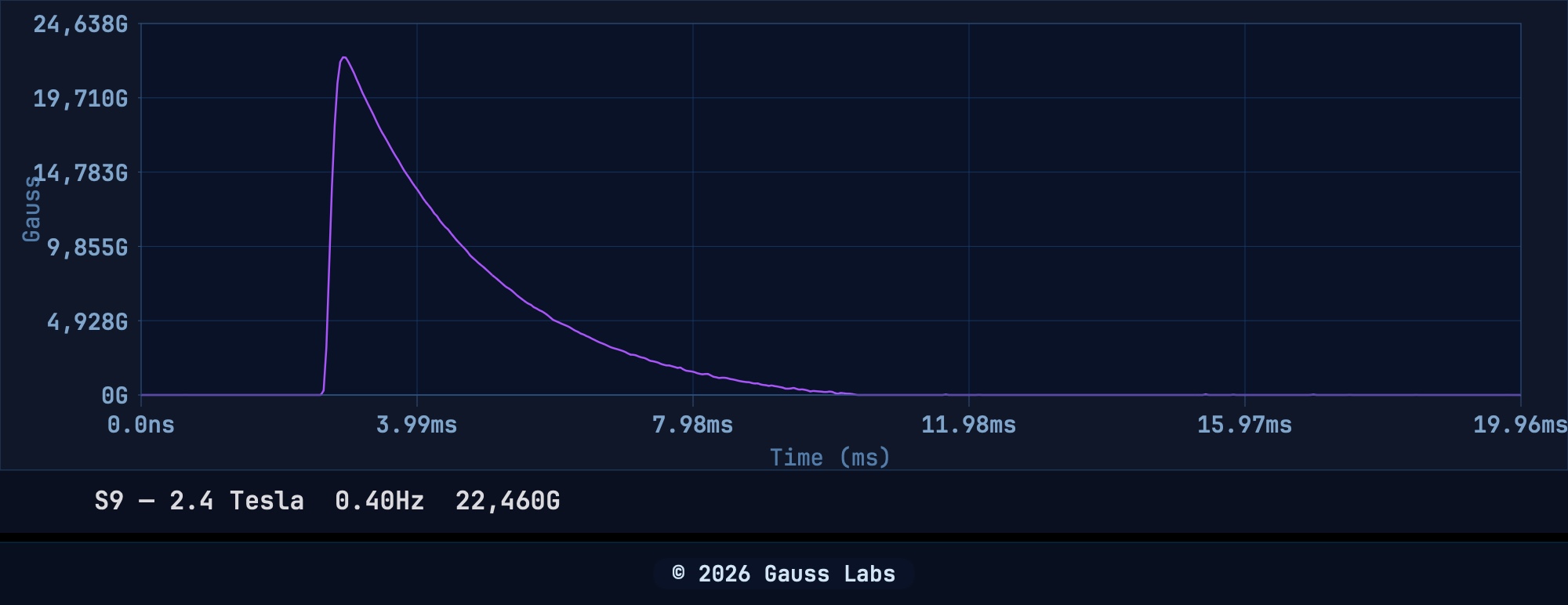
- Peak Gauss without rise time tells the buyer nothing about dB/dt. That's what drives induced current in tissue, and the technically literate buyers know it.
- Per-coil intensity values on multi-coil mats hide the parallel-versus-sequential question. A competitor who explicitly publishes "all coils fire simultaneously at rated intensity" while you're silent on the topic wins that comparison every time.
A third-party certification gives buyers something your spec sheet can't.
This is what Gauss Labs does. We test PEMF devices and accessories using calibrated lab test equipment. We produce a multi-axis, multi-setting analysis report with measured spatial distribution and time-domain pulse data. We certify that the unit performs as documented. The methodology is recorded in enough detail that another lab can reproduce the results. You receive values, charts, and waveforms you can publish in your own documentation, with our certification standing behind them.
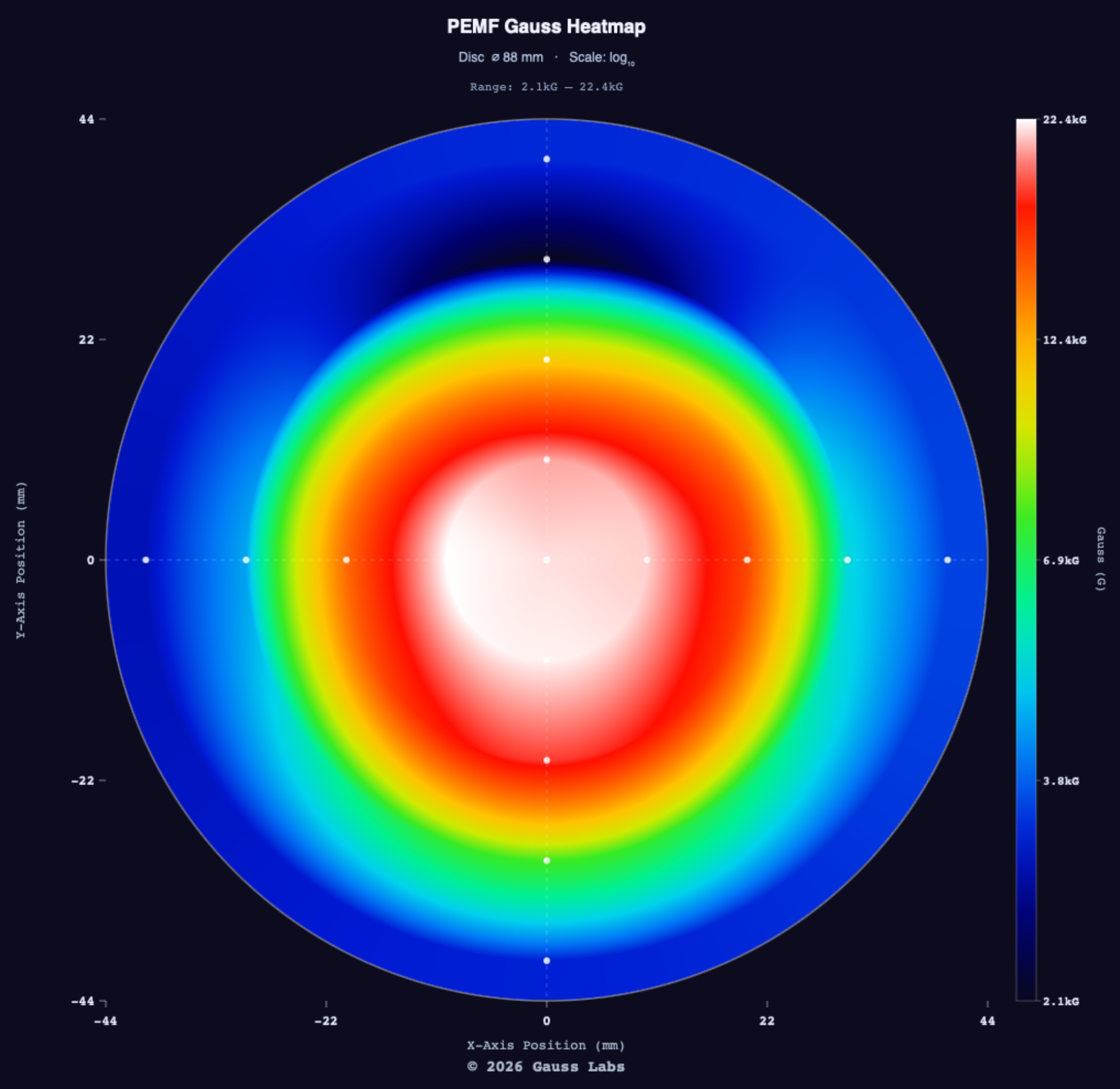
You get a complete deliverable package, ready to share.
Each certification ships as a complete report with charts, graphs, methodology, and analysis in distributable form. You also get every chart and graph as a separate high-resolution image file, ready to drop into spec sheets, product pages, or submissions. Three example reports are publicly available: a full device analysis, a pancake accessory analysis, and a donut accessory analysis.
Four ways certification pays back in your business.
Sales conversations get shorter and end better. When a buyer asks the hard question, you point to a third-party certification, not an internal measurement or a marketing claim. You don't have to talk around the answer. Competitors who can't do this lose ground in every comparison.
Your engineering team gets a calibration check. An independent measurement of your product is useful even before you publish it. Every manufacturer we've worked with has found something in our report that improved the product: a per-setting behavior, a coil saturation curve, a pulse-balance asymmetry.
You build a moat the competition has to match. Publishing third-party certification first raises the bar for everyone else in your segment. Competitors who follow do so because they have to. The ones who don't start to look like they're hiding something, even when they aren't.
Buyers can verify your certification independently. Every certified product is listed on our certified clients directory . A buyer who sees your badge can click through and verify it. That kind of trust signal can't come from your own spec sheet.
Here's how a certification engagement works, end to end.
Four steps from first call to certified report.
- Schedule a Call. We discuss your device's coil count and geometry, drive scheme, machine settings, and the accessories you want tested. We send you a proposal with scope and timeline.
- Send Us Your Devices. We coordinate logistics so the equipment is handled correctly at every step.
- We'll Analyze Your Equipment. We run a multi-axis spatial scan at every relevant setting, capture the oscilloscope pulse, perform electrical characterization, document photographically, and record methodology notes.
- Review Your Results. You receive the full report, every chart and graph as separate high-resolution image files, certification badges, a listing on our public certified clients directory, and the right to publish, distribute, and reference everything freely.
If you want to see exactly what the deliverable looks like before you talk pricing, the three published example reports are a complete preview. The format, depth, and methodology are what you'd receive for your own product.
Talk to us about certifying your equipment.
Each proposal is tailored to your specific device and accessories. The initial conversation costs nothing, and we'll tell you up front whether your certification needs are a fit for what we do.
Schedule a Call See Example ReportsYour buyers will keep asking harder questions. The manufacturers who can prove their answers keep winning the comparisons. The format of PEMF marketing is shifting, whether the industry admits it or not. Being able to prove your device performs is what separates the leaders from the rest.