
A pancake coil is strongest at the center. An inch off-target cuts the strength in half.
When you place a disc on a knee for a 40-minute session and the patient feels less relief than expected, the instinct is to blame the device. Placement is the more likely culprit.
A brochure can list peak Gauss without saying where the field is strongest. That value alone doesn't tell you where to place the disc. Two discs of the same outer size can deliver very different fields. A pancake coil peaks at the center; a donut coil peaks in a ring around the center.
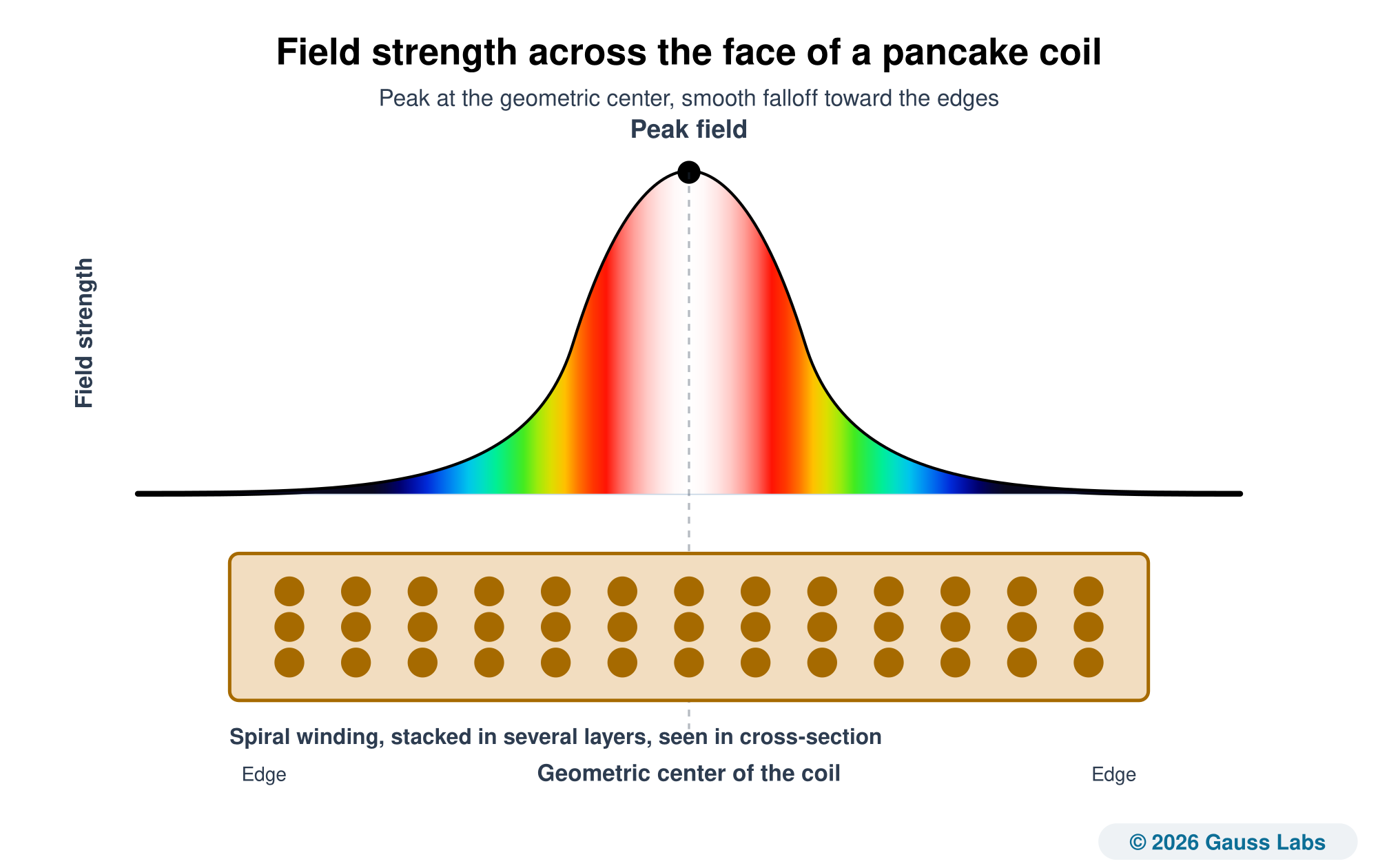
The turns reinforce at the center, where the peak sits.
Most are built up in several stacked layers; some are wound in a single layer. Either way, the layered turns reinforce each other, and the disc-shaped form sets the field pattern above the accessory surface. The field has a strong peak at the center and a smooth falloff toward the edges. There's nothing else to the pattern.
Picture each turn of wire as a small contribution to the total field. At the center of the spiral, every turn pushes in the same direction, straight out of the disc, and the contributions stack. Off-center, the turns on the far side push against the turns on the near side, and the contributions partially cancel. The peak sits at the geometric center because that's the only place where all the contributions line up.
The heatmap shows the same center peak.
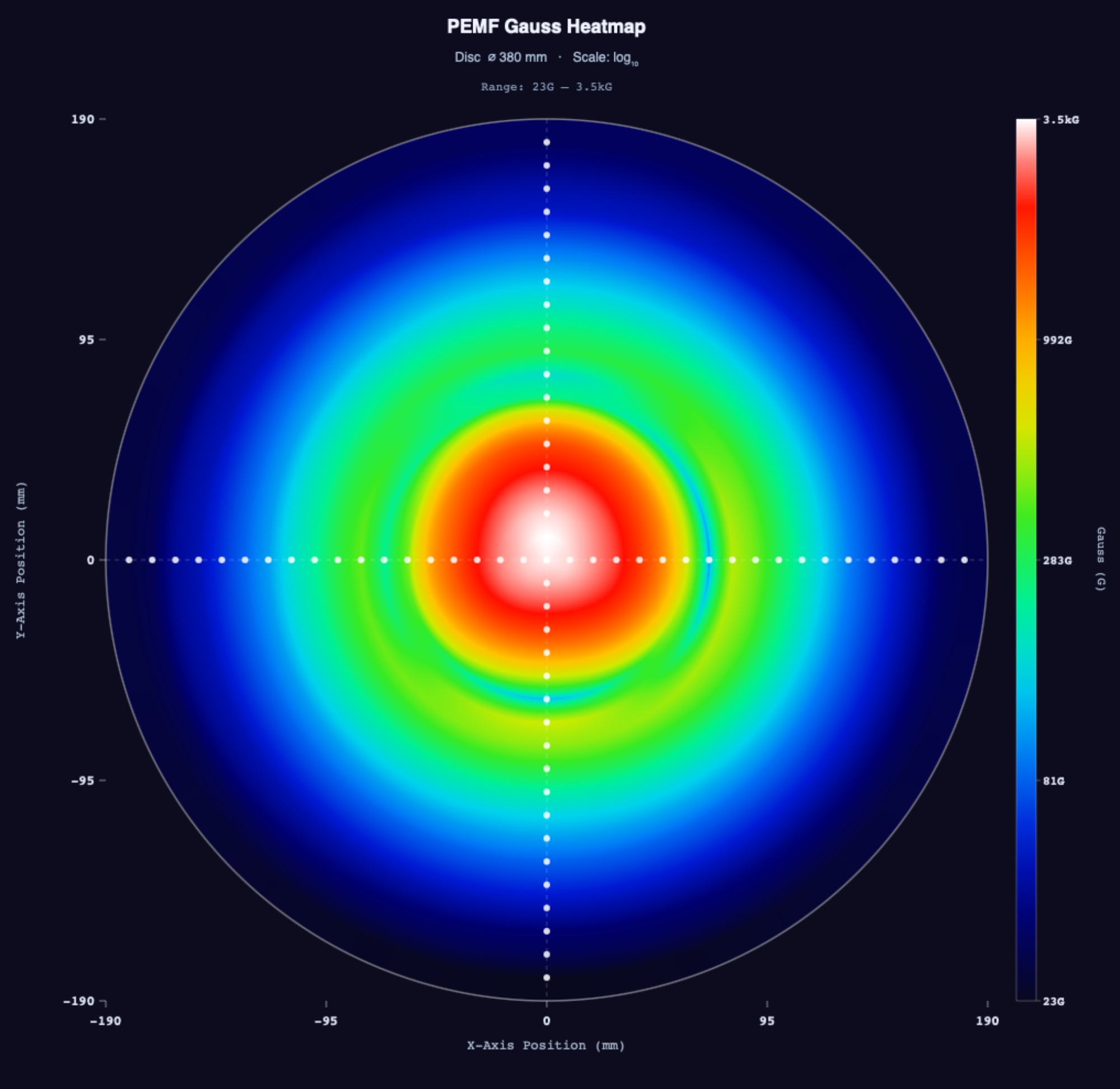
The peak hits 3,370 Gauss at the geometric center. By 40mm (1.6 in) out, the field has dropped to half that. By 68mm (2.7 in) out, it's down to one tenth, and what's left past that point is too weak to count. For this disc at its top setting, 77.8 percent of all the measured strength on the accessory surface sits inside the strong zone, the band where the field is at or above half its peak. That concentration is the signature of a tightly focused field.
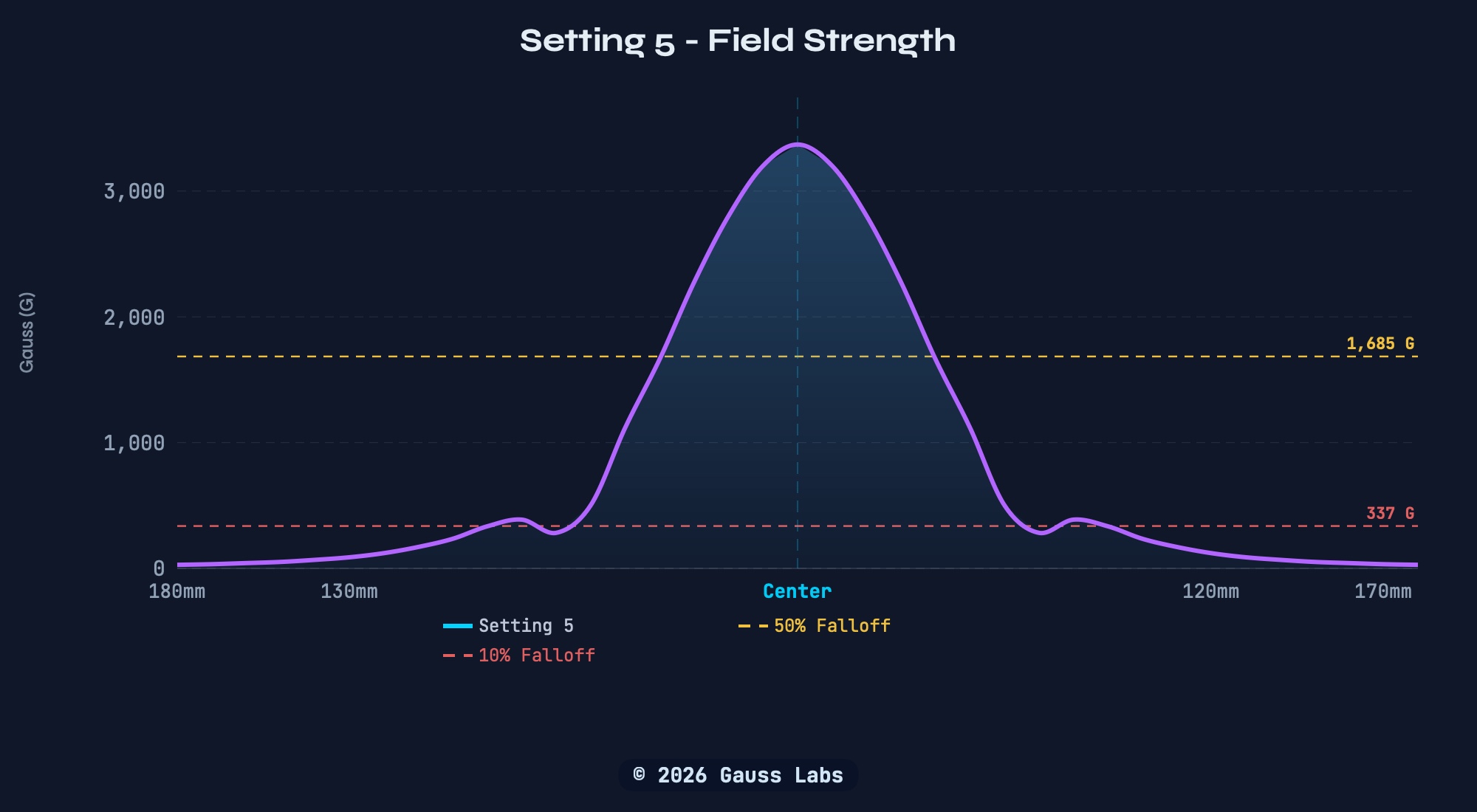
Place the center on the target. Miss, and a strong device looks weak.
The strong zone for this disc is roughly 80mm (3.1 in) across at top setting. That's small enough that placement matters and large enough to give you some margin. When the center of the disc sits over the target, the strongest part of the field lands there. That's the whole reason the geometry exists.
Slide the disc 50mm (2 in) to one side, and the joint that used to sit at the peak is now in the 50 percent zone. It's the same disc, the same power setting, the same 3,370 Gauss peak. The peak is just no longer on the joint. The session still runs the full 40 minutes. The field still concentrates where the disc center is, which is now an inch off the knee. You might look at the brochure again and wonder whether the device is the problem. It usually isn't. The fix is more careful placement, not a different device.
The housing is the shape; the coil inside shapes the field.
"Disc" describes the housing. A disc accessory can hold a pancake coil, a donut coil, or something else. The spec sheet should say which one. If it doesn't, ask the manufacturer for more information: specifically, a heatmap or a falloff chart that shows the field shape in one glance, and the distance from the center where the field drops to half its peak, which tells you how wide the strong zone is. If the peak doesn't sit at the geometric center of the heatmap, the construction is a donut, not a pancake, no matter what the housing looks like.
Once you know the strong zone, match it to your target. A small joint needs a small strong zone and careful placement; a larger soft-tissue area may call for a different geometry. A pancake is a different tool, built for concentrated targeting.
Our example reports do what a brochure can't.
Our published example reports include the heatmap, a falloff chart, and per-setting tables of the field's strength, coverage width, and concentration. The pancake example on the public reports page shows a peak at the center, a smooth falloff, and a narrow strong zone. Once you've read one of these reports, the empty space on a brochure that prints only peak Gauss becomes loud.
Ask for the heatmap, not just the value.
A pancake coil is strongest at the center. Place the disc's center over the target and the geometry works as designed; place it elsewhere and the device gets blamed for a placement problem. Our example reports show what a fully tested pancake looks like, end to end.
Schedule a Call See Example ReportsThe next post in this thread covers the donut, where the peak shifts off the geometric center into a ring.