
How to convert Gauss to Tesla, and why a Weber figure won't convert.
You're comparing two PEMF devices, and the spec sheets don't even agree on units. One lists Gauss, the next lists Tesla, and a full report might add a Weber figure too. Gauss and Tesla convert cleanly: 1 Tesla is 10,000 Gauss. Weber doesn't convert at all. Here's how to do the conversion both ways, and how to tell which values you can line up against each other.
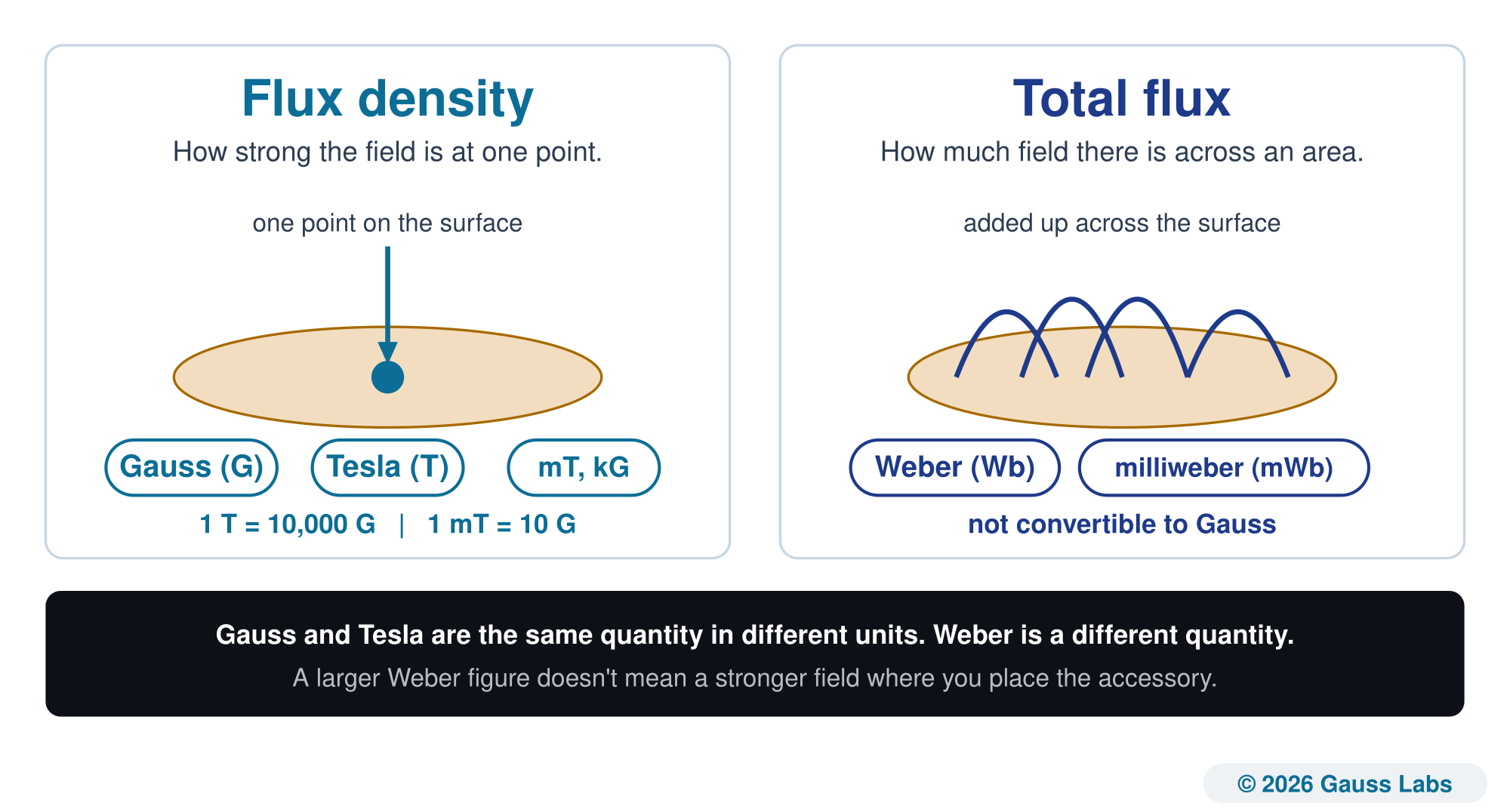
Gauss to Tesla and back: it's one conversion factor.
Gauss and Tesla both measure flux density, the strength of the field at one point, so they convert with a single factor. To convert Gauss to Tesla, divide by 10,000. To convert Tesla to Gauss, multiply by 10,000. That one rule covers the related units too: a kilogauss (kG) is 1,000 Gauss, a millitesla (mT) is 10 Gauss, and a microtesla (µT), the unit most EMF meters use, is 0.01 Gauss.
1 Tesla = 10,000 Gauss = 10 kilogauss = 1,000 millitesla.
| To convert | Do this | Example |
|---|---|---|
| Gauss to Tesla | divide by 10,000 | 5,000 G = 0.5 T |
| Tesla to Gauss | multiply by 10,000 | 1.5 T = 15,000 G |
| Kilogauss to Tesla | divide by 10 | 15 kG = 1.5 T |
| Millitesla to Gauss | multiply by 10 | 2 mT = 20 G |
| Microtesla to Gauss | divide by 100 | 50 µT = 0.5 G |
A few values in both units, to anchor it: a strong PEMF peak of 5,000 G is 0.5 T, a 1.5 T MRI is 15,000 G (15 kG), and the earth's own field of about 0.5 G is roughly 50 µT. You can see the full unit definitions in our PEMF dictionary.
Gauss and Tesla are the same measurement, just different-sized numbers.
Because they measure the same thing, a device listed at 0.5 Tesla and a device listed at 5,000 Gauss describe the same field. It's the same strength either way. The unit a spec sheet picks just changes how big the value looks: Gauss gives you the larger-looking figure, Tesla the smaller one. So a bigger number isn't a stronger field until you've put both claims in the same unit.
Weber measures something different, so it won't convert to Gauss.
Weber measures total flux: the field added up across the accessory's whole surface. In a report, it usually shows up as milliweber. That's a different question from how strong the field is at the spot you place against the body. A large accessory can produce a lot of total flux while its peak strength stays modest. A small, intense coil can reach a high peak with less total flux overall. So a Weber figure won't convert to a Gauss value, and a bigger Weber doesn't mean a stronger field where you need it.
Sort the how-strong values from the how-much values.
When two claims sit in front of you, the comparison comes down to three quick checks.
Three steps before you compare two field claims.
- Sort each value into its family. Flux density covers Gauss, Tesla, mT, and kG. Total flux covers Weber and mWb.
- Convert within a family. Put both flux-density values into the same unit, then compare them directly.
- Don't compare across families. There's no conversion that lines up a Weber figure with a Gauss value.
Even once you're comparing the same unit, a flux-density value still describes a single point, so it's worth asking where on the surface it was measured.
See every value reported in the unit it belongs in.
Our example reports show field strength in Gauss with a Tesla companion, and total flux in milliweber, each one labeled for what it measures.
Schedule a Call See Example ReportsA magnetic figure is easy to make impressive. Once you know which units say how strong and which say how much, and how to convert between the ones that line up, the unit on the page can't make a device look like more than it is.