
Peak strength tells you how high a pulse reaches. Rise time, fall time, and slew rate tell you how it gets there.
You've probably seen these terms on a spec sheet or a buyer's guide: rise time, fall time, slew rate. Each one describes what happens in the few microseconds of a single pulse. Together they tell you how the pulse behaves, which is exactly what a peak Gauss value leaves out. Here's what each one means, measured on a real device.
A pulse has a shape, and three values describe it.
A PEMF pulse isn't a single number. The field climbs from near zero up to a peak, then falls back toward zero. Three values describe that motion.
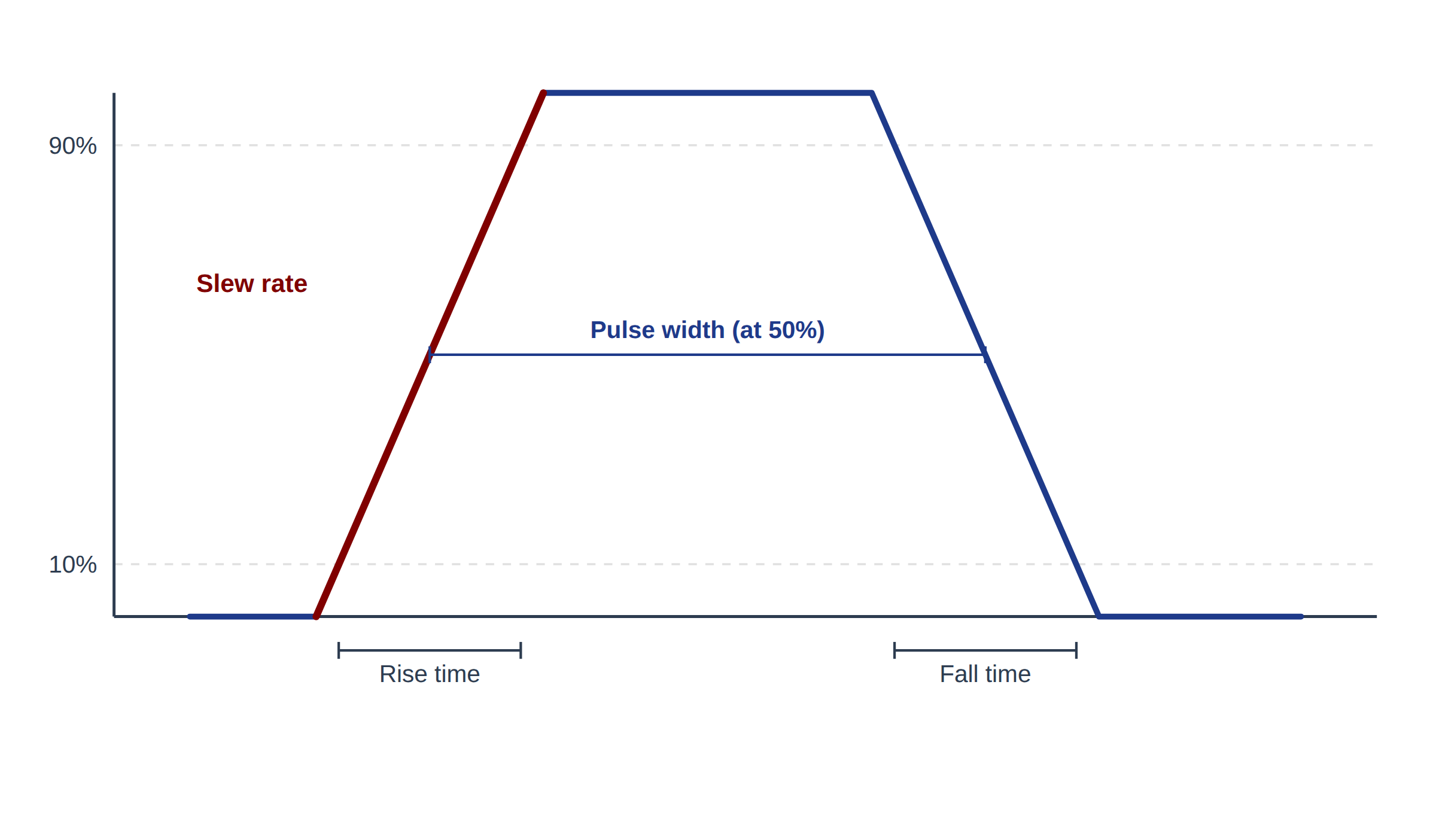
Rise time is how quickly the field climbs to its peak. We read it as the time the field takes to go from 10 percent to 90 percent of its peak, the way an oscilloscope measures an edge. Fall time is the mirror: how quickly the field collapses once the pulse ends, measured from 90 percent back down to 10 percent.
Slew rate is how steep that rising edge is, in Gauss per microsecond. A field that climbs 100 Gauss in one microsecond has a slew rate of 100 G/µs. The steeper the climb, the higher the slew rate.
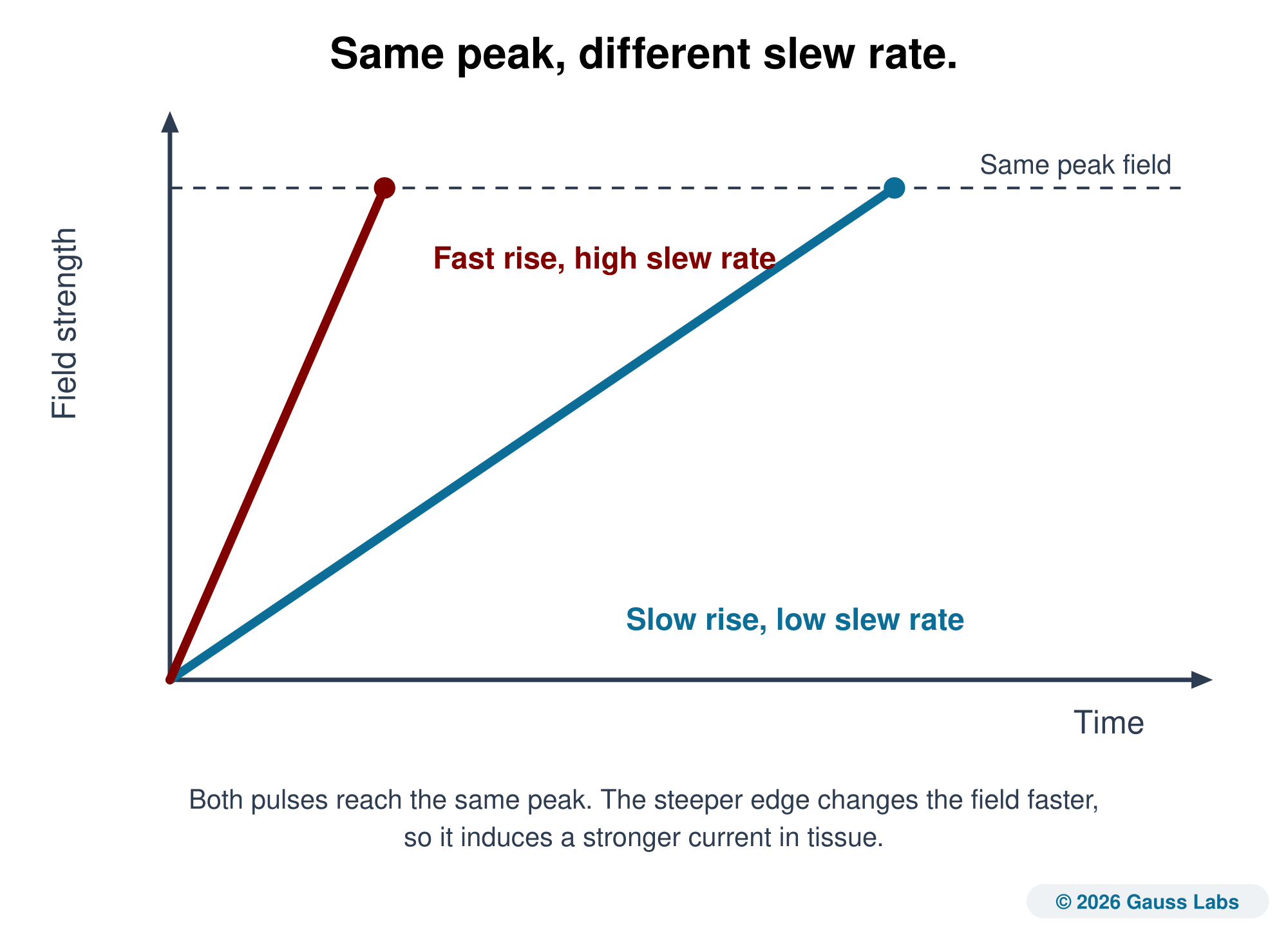
Tissue responds to how fast the field changes, not how strong it gets.
Of the three, slew rate matters most, and there's a reason. A changing magnetic field induces an electric current in whatever sits nearby, tissue included. That's Faraday's law. The size of the induced current tracks how fast the field changes, not how strong it gets at its peak.
So two devices can reach the same peak field and still deliver very different pulses. The one with the steeper rising edge, the higher slew rate, produces the stronger induced current. A tall, gentle pulse and a tall, sharp one look the same on a spec sheet that lists only peak Gauss.
That's why slew rate is worth measuring. (You'll also see it written in Tesla per second. It's the same quantity: 1 G/µs equals 100 T/s.)
What these values look like on a device we measured.
Here are the three values on a real accessory: a 2.4 Tesla BBMPulser 5B we bought for in-house testing, driving a 3-inch (76mm) strip coil. It runs a sawtooth pulse, which climbs fast and falls slowly.
The pulse is strongly one-sided. Across the nine power settings the field rises to its peak in about 140 to 160 microseconds, then takes roughly 3,700 to 4,200 microseconds to fall back down. The rise is more than twenty times faster than the fall. We track that lopsidedness as pulse balance, the ratio of rise time to fall time. A balance of 1.0 would climb and fall at equal speed; this pulse sits near 0.04.
The rise time barely changes from one setting to the next, but the peak field climbs from 10.45 kG at the lowest setting to 22.41 kG at the highest. A higher peak reached in about the same time means a steeper edge, so the slew rate rises too, from 48.7 G/µs at the lowest setting to 109.3 at the highest.
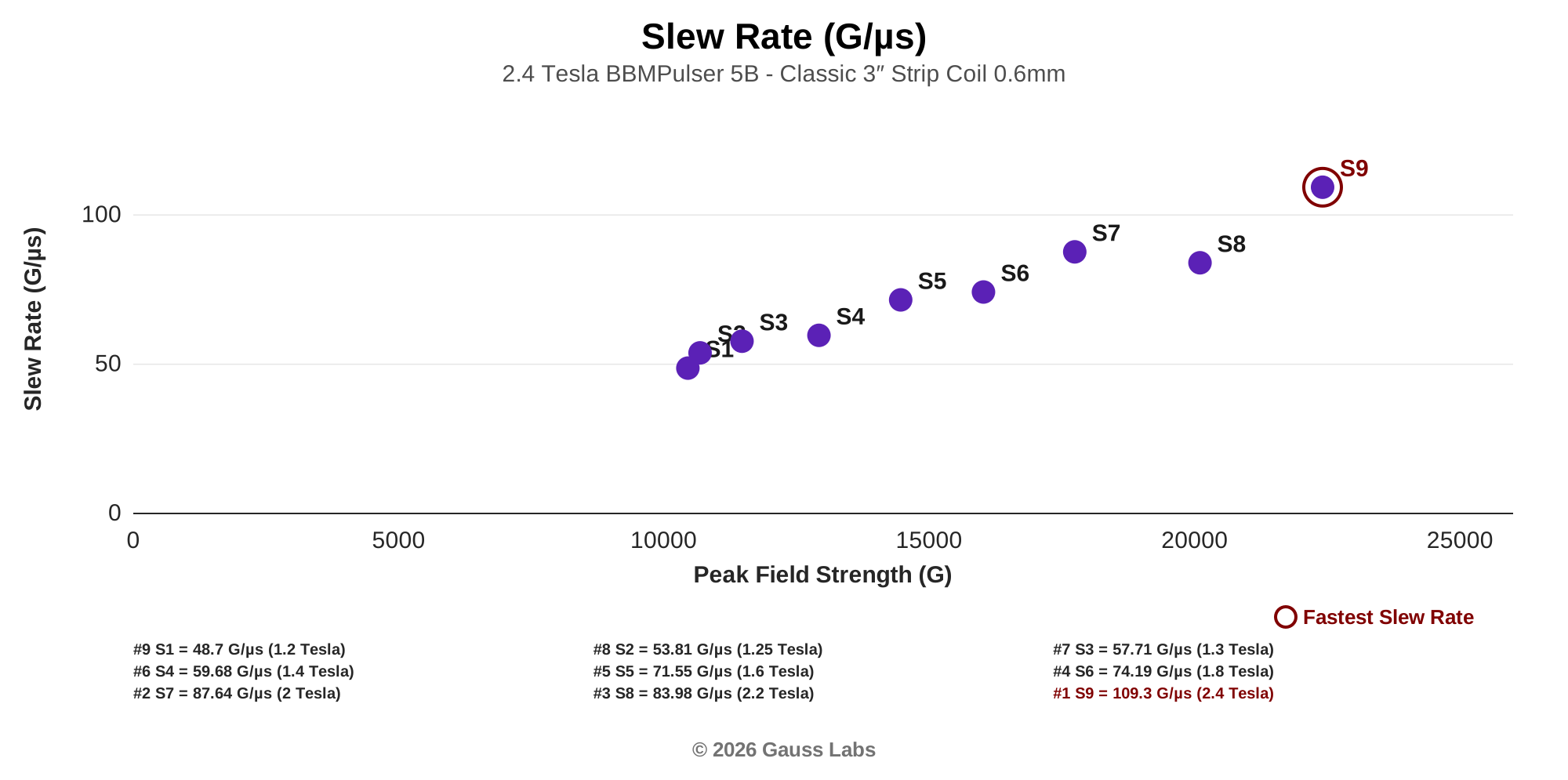
That's a fast, steep rising edge. The falling edge is gentle by comparison, under 5 G/µs, so the quick climb is where most of the pulse's induced current comes from.
We measure slew rate and rise time. We don't name an ideal one.
You'll sometimes see a buyer's guide name an ideal slew rate, or a target rise time. We measure and report both values, but we don't mark any range as the optimal one. Those windows trace back to marketing pages rather than published research, and a single best value for the pulse edge isn't established. A faster-changing field does induce a stronger stimulus, and that part is real physics. Naming one ideal figure is not.
So we give you the measured value and the reason it matters, and we let the number stand on its own. That's the honest version: what the pulse does, in figures you can check.
Want the whole pulse measured on your device?
We capture rise time, fall time, and slew rate on every device we test, and publish the full waveform in the report. If you'd like to see what that looks like, our example reports are open to read.
Schedule a Call See Example ReportsA peak value marks the highest point a pulse reaches. How it gets there and back, sharp or gentle, is what rise time, fall time, and slew rate measure, and it's what a single Gauss number leaves out.