
A higher Gauss value doesn't automatically beat a sharper pulse.
You're comparing two PEMF devices, and one posts a higher Gauss value while the other claims a sharper pulse. You want to know which is the better buy. The two specs measure different things, though, so the answer depends on how you'll use the device, not on whichever figure looks bigger.
The Gauss value is strength at a point, not the stimulus that reaches you.
A device's headline Gauss value is its peak field strength: the highest reading anywhere on the accessory surface at its strongest setting. That's a real, useful figure, since it explains how strong the field gets and, with the coil's size, how far it reaches. What it doesn't tell you is the stimulus that actually reaches tissue, because a magnetic field only induces a current when it's changing. By Faraday's law, a steady field of any strength induces nothing, while a field that snaps on quickly induces a lot. So the peak tells you how high the field climbs, not how sharply it gets there.
How fast the pulse climbs is the part of the waveform that tissue feels.
When people praise a device's waveform, this is what they mean: how sharply each pulse rises. We measure that as rise time and slew rate, the time the field takes to climb to its peak and the speed of that climb. The induced stimulus tracks that speed, so a pulse that reaches a lower peak quickly can induce a larger change than a taller pulse that gets there slowly. That's why a sharper edge is a genuine spec and not just marketing polish, and it's covered in more depth in our post on rise time, fall time, and slew rate.
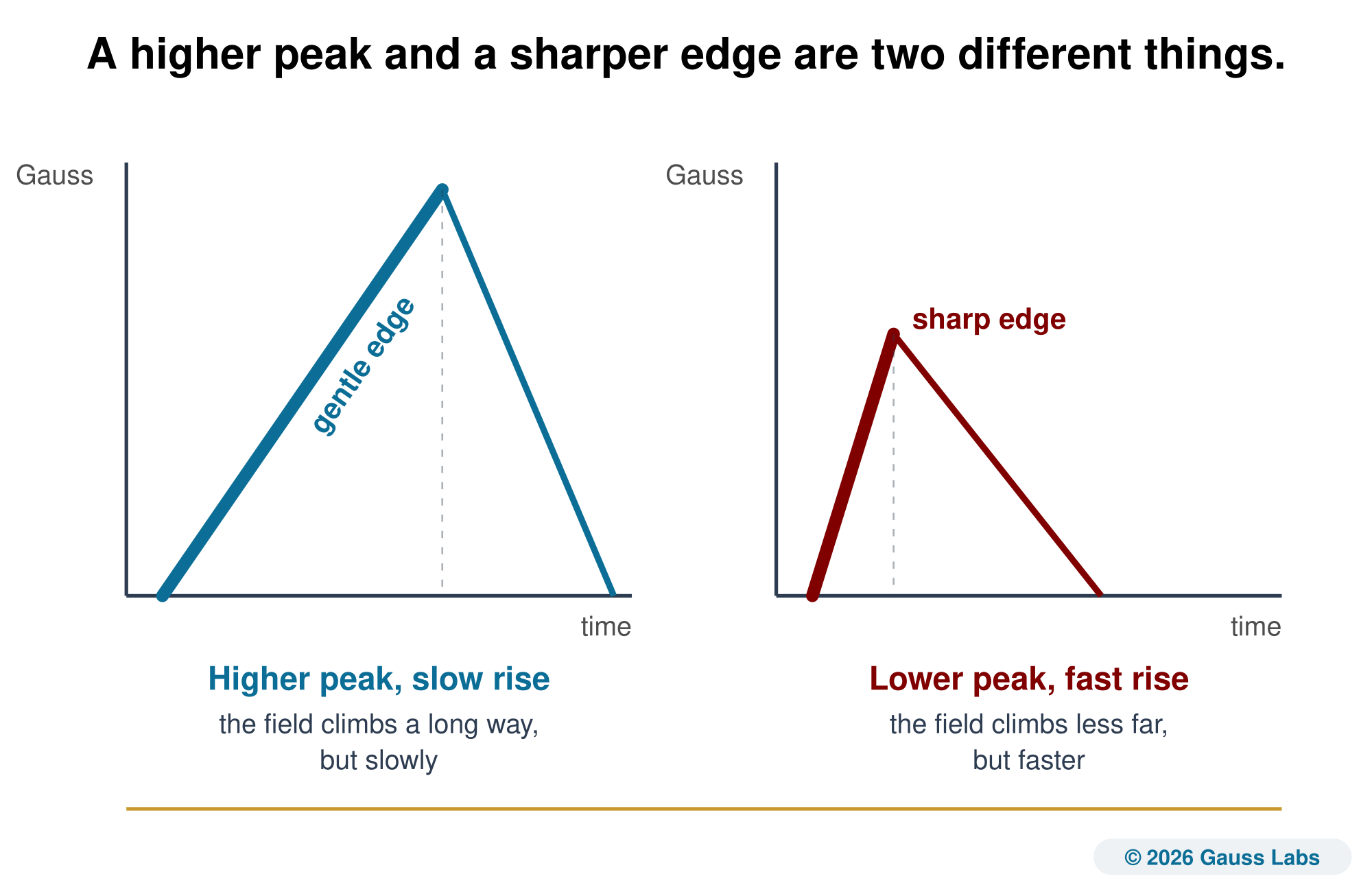
A faster-changing field really does induce a stronger stimulus, so a sharper edge is worth looking for. Be wary, though, of any guide that names one ideal edge speed to aim for, because that target traces back to marketing pages, not to research. We measure the edge speed on every device we test and report the value we found, not a vague target.
A higher peak doesn't guarantee a sharper pulse.
If a higher Gauss value always came with a sharper edge, you could shop on that one figure and be done. It doesn't, and the reason is in how the two are produced. A device's peak comes from how strong a field it can push out, set by its power and its coil. The sharpness of the edge is a separate matter: how fast the device can switch that field on. Those come from different parts of the design, so a device can run high on one and only average on the other. A strong Gauss figure, then, is no reason to assume a sharp pulse. Check the edge on its own, and don't let a big peak stand in for it.
A higher Gauss value mostly buys reach, not a stronger effect.
It helps to know what the extra strength actually gets you. A higher peak, or a larger coil, keeps the field above a usable level farther from the surface, which is more reach. That reach is geometry: the field passes through the body nearly unblocked at these frequencies, so a stronger field carries farther, rather than forcing its way deeper or working better where it lands.
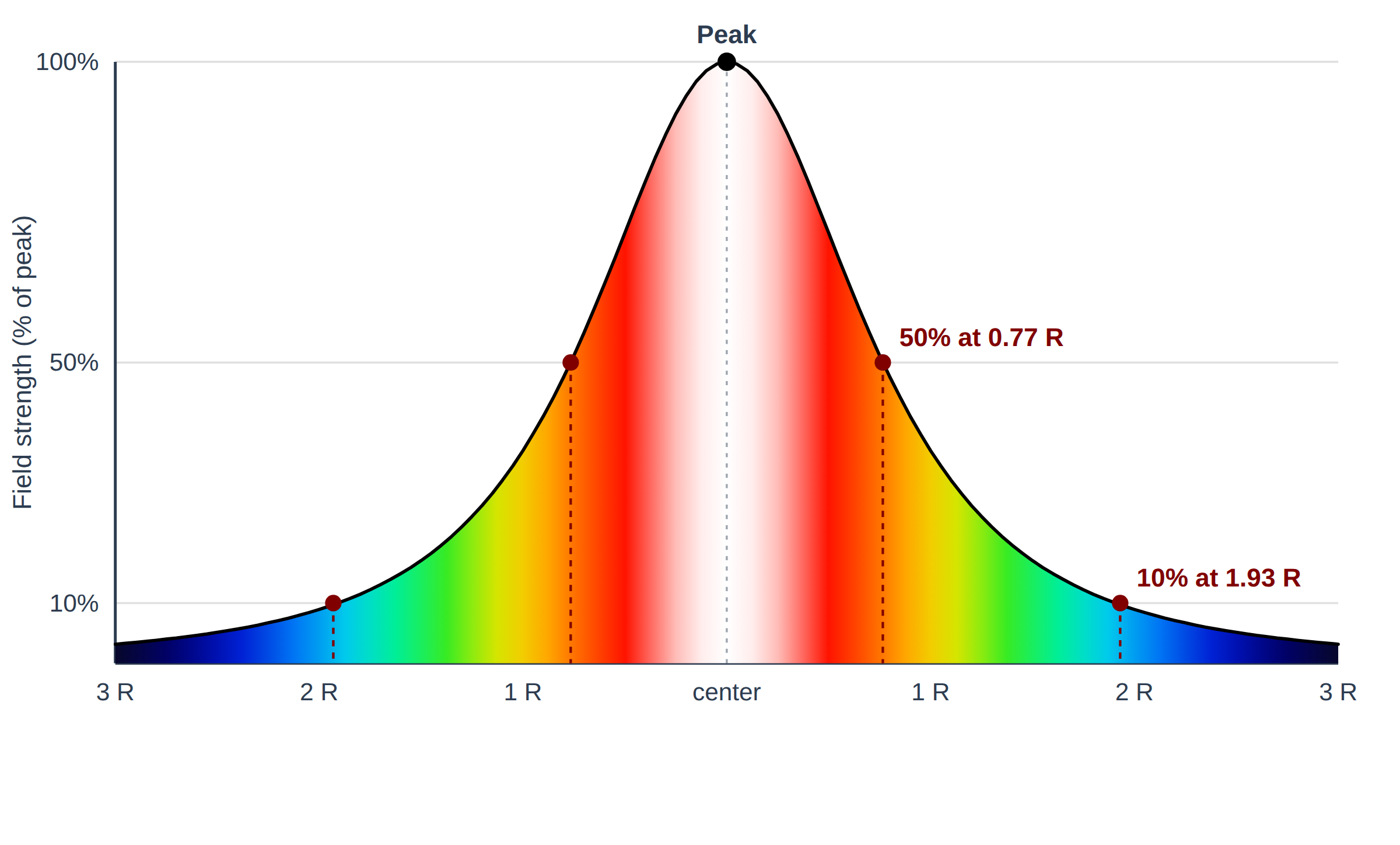
The 2026 buyer guides have started saying this plainly too: a higher Gauss rating means the field is physically stronger at a given distance, not that the session does more for you.
Higher-Gauss and lower-Gauss devices are built for different jobs.
That difference in reach is really the line between two kinds of gear. PEMF splits roughly into low-intensity and high-intensity devices, and the gap is wide. The low-intensity ones run from a few microtesla up to about 1,000 gauss. The high-intensity ones start around there and climb into the thousands, with a few reaching 1 or 2 tesla. Here's how the two compare on the things you'd actually notice.
| Lower-Gauss devices | Higher-Gauss devices | |
|---|---|---|
| Typical strength | A few microtesla up to about 1,000 gauss | About 1,000 gauss into the thousands, a few up to 1 or 2 tesla |
| Common form | Mats, pads, and whole-body systems | Small applicators and spot pulsers |
| Field coverage | Broad: the whole body or a large area | Concentrated on one spot |
| Reach from the surface | Shorter | Farther, since more strength carries the field farther out |
| Typical session | Longer, everyday or whole-body | Short and targeted |
The dividing line, around 1,000 gauss, is a way to classify devices, not a quality threshold. Crossing it doesn't make a device work better, it changes what the device is for. A lower-Gauss mat is made to cover a lot of you at a gentle level, while a higher-Gauss applicator is made to reach one spot. So the question that matters isn't which Gauss value is larger, but which of those two jobs is yours.
How to weigh a higher-Gauss device against a better-waveform one.
So when one device is stronger and the other has the sharper pulse, here's how to weigh them against your own situation.
Weigh the two specs separately.
- Read strength and edge as two different specs. The Gauss value tells you how strong the field is; the rise time and slew rate tell you how sharply each pulse climbs. A big figure in one doesn't imply the other, so check both.
- Match the device to what you'll cover. Are you working a single spot, or covering a large area of the body? Answer that first, because it points to the kind of device you need: a small, higher-intensity applicator for one spot, or a lower-intensity mat for the whole body. The Gauss value should follow from the job, not drive it.
- Ask for both, measured at each setting. A peak Gauss with no rise time or slew rate is half the story, and a range printed on the box isn't always what the controller lets you select. The measured value at each setting is the one you can check.
That last point is the one we can help with. On every device we test, we measure the peak field strength and the pulse edge at each setting and report them side by side, so you can see when a strong field comes with a gentle edge, or a modest field with a sharp one. You get both halves of the picture, checked on our own equipment, instead of a single figure that hides one of them.
Want to see a device's strength and waveform in one place?
We measure the peak field strength, the pulse edge, and the frequency at every setting, and publish them together. If you'd like to see what that looks like, our example reports are open to read.
Schedule a Call See Example ReportsA higher Gauss value and a sharper pulse are both worth having. Neither automatically beats the other, so read them apart and buy for the way you'll actually use the device.