
Registered, cleared, medical grade, certified: a certification rests on measurements that can be repeated.
You're on a PEMF product page, and the badges on it all sound like approval: FDA (Food and Drug Administration) registered, FDA cleared, medical grade, and certified. Each one means something different, and only a third-party certification comes with a public checklist backed by measurements that can be repeated. Here's what each one means and what to ask a seller before you buy.
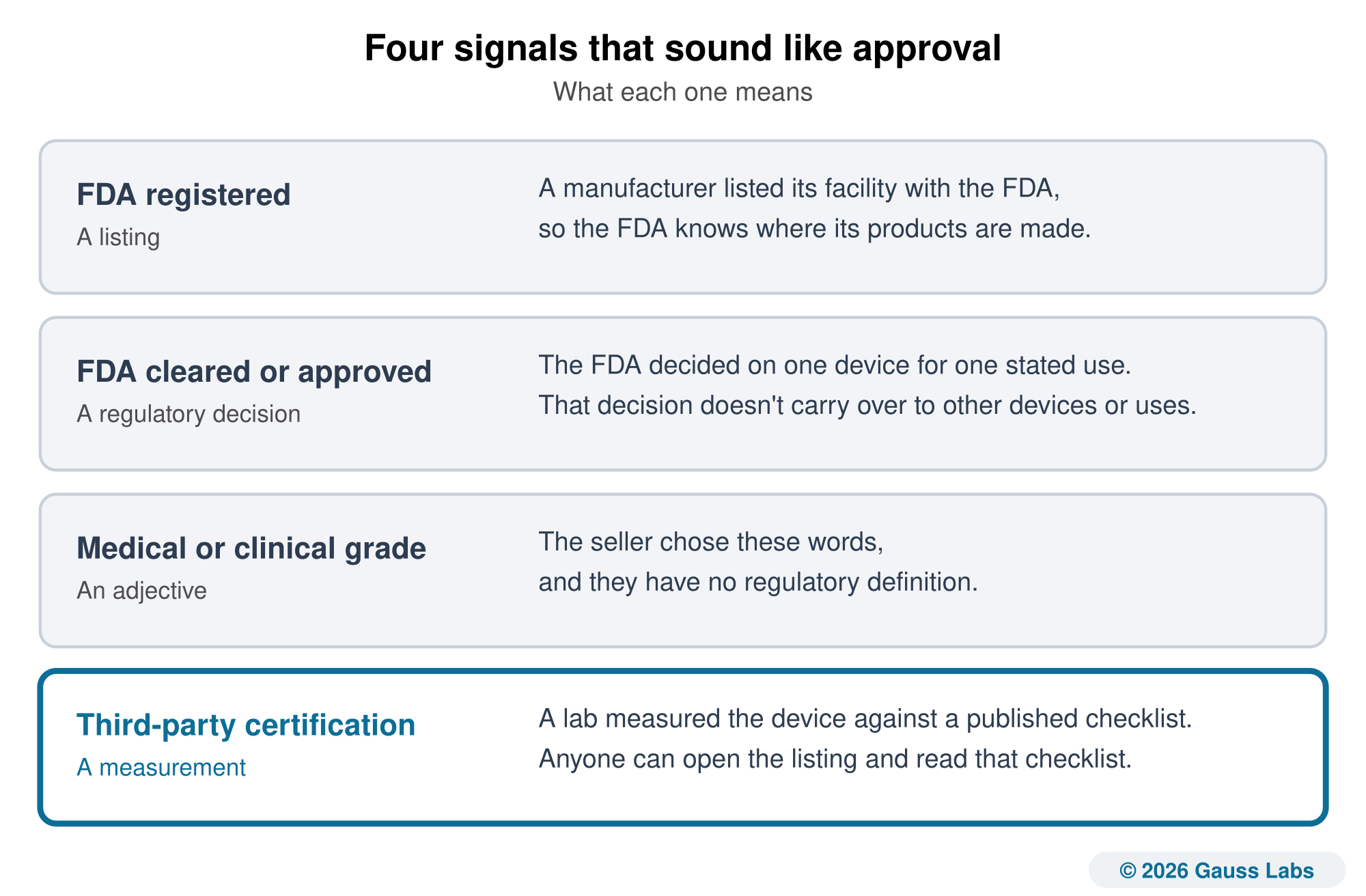
FDA registered means a company put its facility on a list.
Registration is paperwork a manufacturer files so the FDA knows where its products are made. The FDA isn't evaluating a device when that happens, so the badge tells you only that the company's facility is on the FDA's list.
Is PEMF FDA approved? Only for particular devices and uses.
The honest answer is that it depends on the device and the use. Some non-implantable PEMF bone growth stimulators are FDA approved as an add-on to a patient's main care for fractures that haven't healed, and in some cases for spinal fusion, under medical supervision. The first one was approved in 1979, and the FDA's approval record is public. That approval covers one defined orthopedic use. It doesn't extend to general-wellness devices, the kind most buyers meet online, which belong to a different regulatory category.
Clearance works the same way, as a decision about a particular device for a particular use. So when a page says "FDA approved" or "FDA cleared," ask which device and which use, since a badge that names neither is describing PEMF in general rather than the product in your cart.
Medical grade and clinical grade have no official meaning.
Neither phrase has a regulatory definition, so any seller can print them in their documentation. When we see them on a page, we look for what's behind them, which should be an FDA decision for a named use or a measurement anyone can open. Without one of those, the words only tell you how the seller wants the device seen.
Third-party certification comes with a public listing anyone can look up.
We test a device together with one accessory, which we call a pairing. We measure the field the pairing produces at a sampling of the device's settings and compare what we find with a published checklist. The process is documented and the same for every pairing, so a measurement can be repeated. Each certification gets a public page on our registry, and you can find it by typing the company name or the certificate number into the search box. The page lists the checklist as plain sentences, like "The device runs at a deliberate therapeutic frequency, clear of power-line interference" and "The field reaches the body evenly in every direction around the accessory." Some checklist items concern the device and others the accessory, so open the listing for the pairing that matches what's in your cart.
The measured values go to the company that commissioned the testing, so ask the seller for the report. What's public is the certification, the pairing it covers, and its checklist. Our post on what a PEMF certification covers shows how to read a listing.
Four questions tell you which claim you're looking at.
Put these to the seller before you buy.
- "Which device and which use did the FDA decide on?" A real clearance or approval names both, and a seller who can't is pointing at a category.
- "What backs up 'medical grade'?" The phrase has no official definition, so the answer should be a decision or a measurement.
- "Who measured it?" A company's own figures and an independent lab's are different kinds of evidence, and a lab's can be checked by anyone who looks.
- "Can I open it myself?" A certification should have a public page, and its number should match the one you were shown, for the accessory you're about to buy.
Want a badge your buyers can check?
We measure your device with each accessory you sell and publish the certification and its checklist on a page any buyer can open. Your measured values and your full report stay with you. If you'd like to see the measurement work first, our example reports are open to read.
Schedule a Call See Example ReportsThe next time a page says certified, ask what was actually checked. If the answer is a measurement, the page behind it is public, so open it.