
The FEI's Final Draft keeps the cut to 100 Gauss (10 mT), so check your equipment's peak before the vote.
If you take PEMF equipment to competition, the field limit at events run by the International Federation for Equestrian Sports (FEI) could still drop from 1,000 Gauss (0.1 T) to 100 Gauss (10 mT). The FEI published the Final Draft of its 2027 Veterinary Regulations on 6 November, and the tenfold cut it proposed in the spring is still in it. The General Assembly votes on 5 December, so below we set the final wording against what we've measured and end with three things to check about your own equipment.
The Final Draft bases its limit on the field alone.
The limit is in paragraph 2 of Article 1062, "Non-Restricted Supportive Therapies," which reads: "The use of PEMF machines is only permitted if their electromagnetic field is below 0.01 Tesla (100 Gauss)." The FEI's mark-up of the current article shows 0.1 Tesla (1,000 Gauss) struck out and 0.01 Tesla (100 Gauss) written in, the same cut proposed in March. The text is on page 139 of the FEI's General Assembly memo and page 76 of the mark-up, both listed under agenda item 21.2 in the General Assembly 2026 documents.
The wording has changed since March, though. The slide from the FEI's Sports Forum that we covered in our first post on this proposal said "Only allow battery powered products with output below 100 Gauss," which made battery power one of two conditions. In the Final Draft, battery-powered magnetic rugs and leg wraps appear in paragraph 1(b) as examples of PEMF machines, and paragraph 2 sets the field limit with no condition about the power source. We think that's the better version, since a limit on the field is one a measurement can check. A battery doesn't set how strong a pulsed field gets, as our post on battery-powered devices explains.
The FEI now gives human safety as its reason.
The reason the FEI gives has changed twice this year. In March the slide pointed to "questionable labelling of outputs" and output that was "difficult to control." The explanation attached to the first draft in July said the FEI proposed reducing PEMF output "on public health grounds." The FEI's response in the 6 November memo, on page 138, reads:
"The reduction in the output of PEMF devices that can be used at FEI events has been made with respect to human safety. Higher powered PEMF devices can interfere with human medical devices such as pacemakers and hearing aids and the thresholds for safe use of higher powered PEMF devices cannot be properly applied at events."
So the FEI's reason is now the safety of people near the equipment at an event, rather than how outputs are labeled. Either way, the limit is a figure for the field a machine produces, so the way to know whether your equipment is under it is still to measure that field.
One federation asked how anyone would know a field's strength.
The memo also records comments from the National Federations, the national equestrian bodies that vote on the regulations. In a proposal of 1 March, one federation wrote that "it is not possible to know if a PEMF machine has an electromagnetic field below 0.1 Tesla except to take the manufacturer's word for it," and asked the FEI either to list the machines that qualify or to drop the clause. The FEI answered that it "is not in favour of specifying a list of devices that can be used."
We don't take the maker's word for a field's strength, since we measure the peak ourselves. We test a device together with one accessory, which we call a pairing, because the peak comes from the two working together. PEMF makers have no common standard for device performance, so every pairing has to pass the same high test standards before we certify it. Anyone can look the pairing up on our registry by company name or certificate number, and the listing shows whether it conforms to today's 1,000 Gauss (0.1 T) limit, so nobody needs a list from the FEI to check it.
Most equipment we've measured sits well above 100 Gauss (10 mT).
A limit means more next to what equipment produces, so here's where the typical accessory peaks. We keep anonymized medians across the accessories we've tested, grouped by shape with at least five tests in each group, so each figure describes the middle of a group rather than one device or one company.
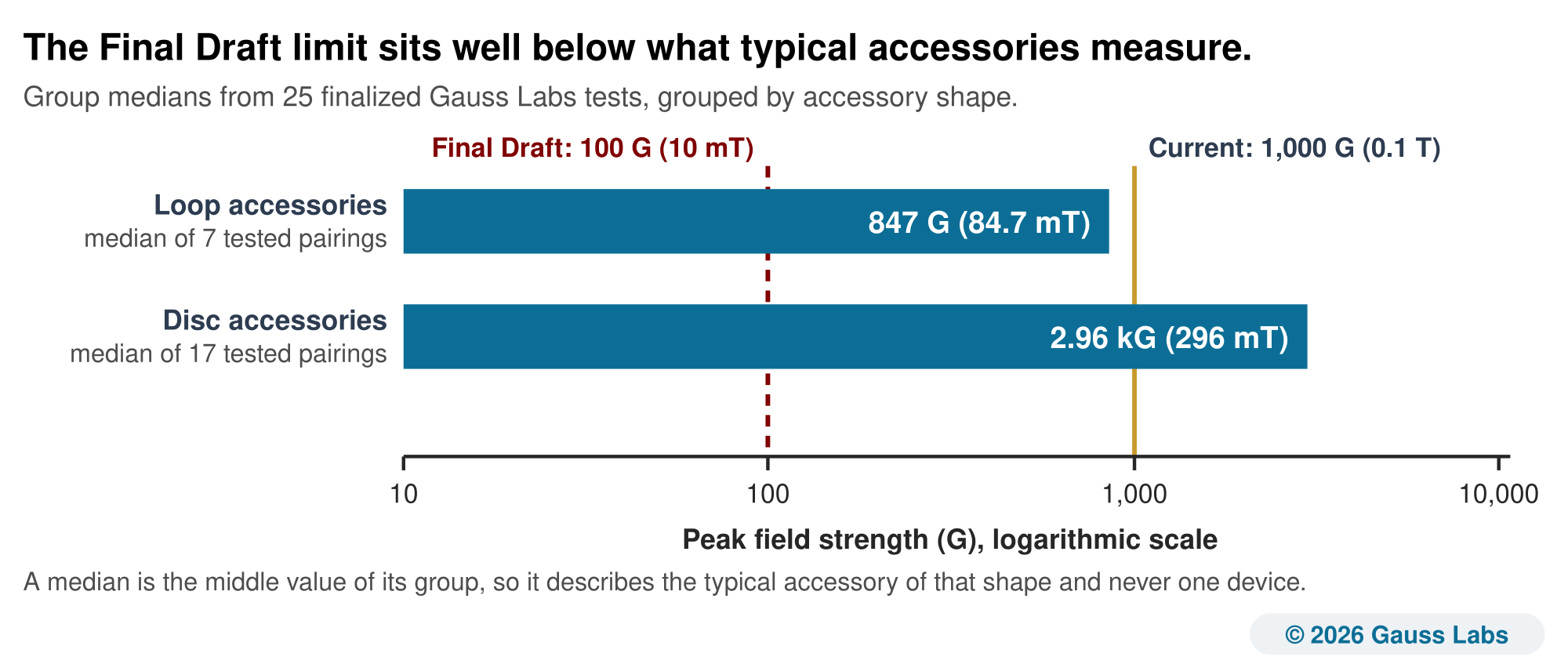
Across 25 finalized tests, the typical loop accessory peaks at 847 Gauss (84.7 mT) and the typical disc at 2.96 kilogauss, which is 2,960 Gauss (296 mT). The typical loop is under today's limit and more than eight times over the proposed one, so the cut would apply to equipment that passes today, not only to the strongest devices.
Our registry's FEI listing checks against today's 1,000 Gauss (0.1 T) limit.
Our public registry lists 27 certifications today, and four of them are recorded as conforming to the FEI Gauss limit of 1,000 Gauss (0.1 T). The registry's Standard dropdown narrows the list to exactly those pairings. Conformance belongs to the pairing rather than the device alone, and the registry records it as a ceiling the pairing stays under. Our post on the current limit covers how that works for horse owners.
If the General Assembly adopts the 100 Gauss (10 mT) figure, a pairing that stays under 1,000 Gauss (0.1 T) could still be well over the new one. The report behind a certification records the peak field strength at each setting we measured, so the same report can be read against either figure without a new test. The detailed results go to the company that commissioned the testing, so ask the seller or manufacturer for the report.
Three things to check about your device and accessory.
- Find the pairing on the registry. Type the company name or the certificate number into the search box, and make sure the listing names the accessory you actually use.
- Ask the seller for the peak at the strongest setting that was measured. That's the figure to compare with a limit, and it should come from a measurement rather than a product page.
- Ask where the peak was measured. A peak measured at the accessory surface and one measured at a standoff distance differ, so a figure with no distance given can't be compared with a limit.
The 1,000 Gauss (0.1 T) limit still applies, and the vote is on 5 December.
The Final Draft goes to the Rules Session on 4 December and to a General Assembly vote in Jiangyin, China, on 5 December. National Federations can still raise items at the Rules Session, and their comments on the first draft went both ways: some opposed the cut because it would rule out devices in wide use and asked for it to be phased in, while others argued that PEMF shouldn't be permitted at events at all. The memo doesn't say when a new limit would take effect if it passes, so the current 1,000 Gauss (0.1 T) limit applies at FEI events until the FEI sets that date.
Making PEMF equipment for competition horses?
We measure the peak field of a device and accessory as a pair, at a sampling of the device's settings, and report what the pairing produces at each one. Our example reports are open to read.
Schedule a Call See Example ReportsBefore 5 December, ask the seller for the measured peak of your device and accessory at its strongest tested setting, so you know where it sits against both 1,000 Gauss (0.1 T) and 100 Gauss (10 mT).