
A mat's coil count doesn't tell you what actually reaches your body.
You're shopping for a full-body PEMF mat, and the spec that jumps out is the coil count. More coils sound like more field. But a count is a headline, and it leaves out two things that shape what your body actually gets: whether the coils fire all at once or one at a time, and how evenly the field is spread across the surface.
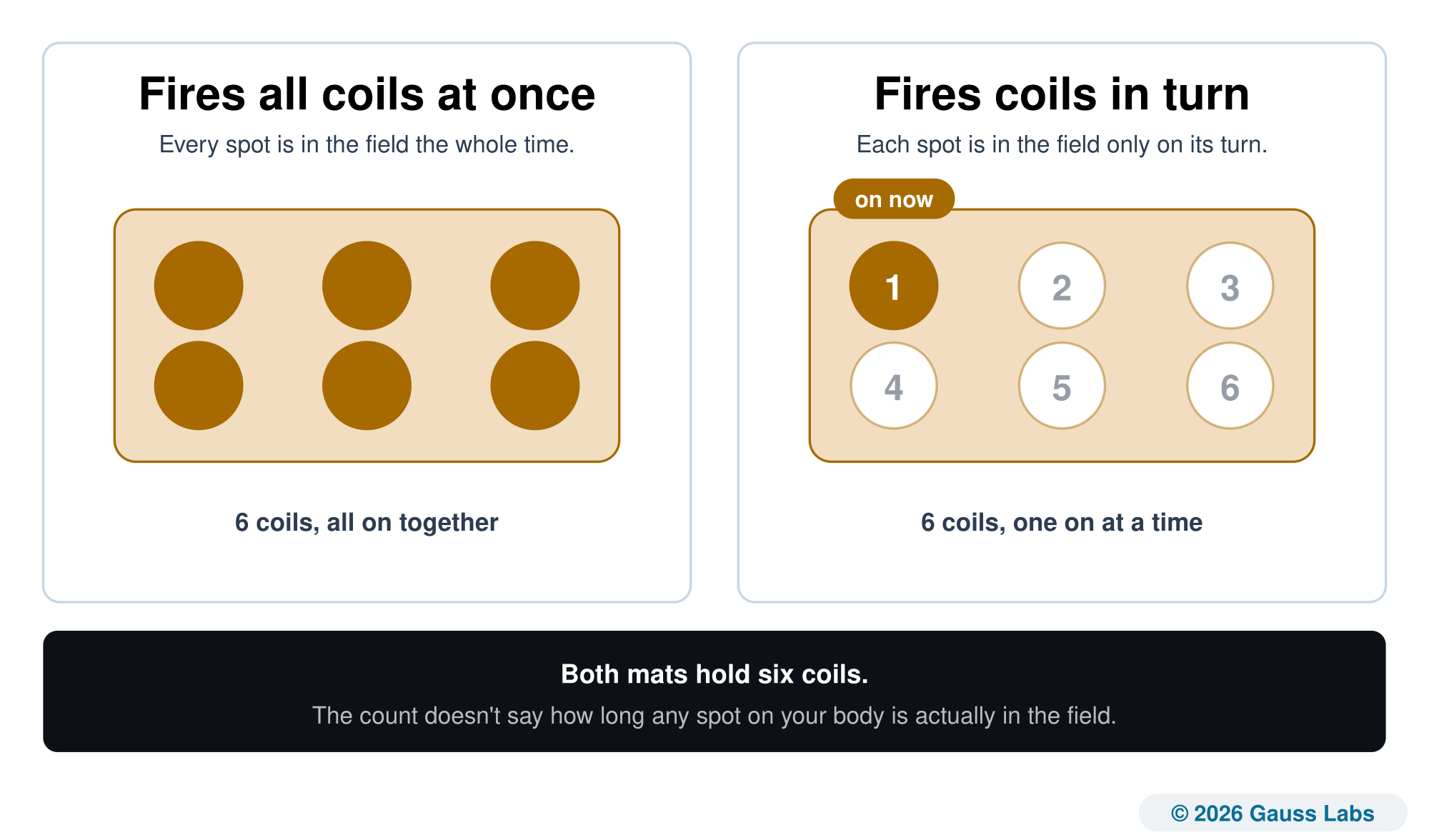
Firing all at once or in turn changes your time in the field.
A mat with several coils can run them two ways. It can fire every coil together, so every spot above the mat is in the field the whole time the mat is on. Or it can fire the coils in turn, one or a few at a time, cycling around the mat. On a mat that fires in turn, any spot is in the field only during its coil's turn. Six coils cycling one at a time means the field is off at any one spot most of the time.
Neither scheme is a flaw. Firing in turn draws less power at once and keeps the mat cooler. Firing all together keeps every spot in the field the whole session. They're different designs for different goals.
What most marketing doesn't say is which scheme a mat uses. How long the field is on versus off has a name: duty cycle. A spot under a coil that only fires on its turn is in the field for a small slice of the session, no matter how many coils the mat lists.
A coil count is a stand-in for coverage, not a measurement of it.
Two mats can list the same number of coils and still cover the surface very differently. How evenly the field spreads depends on the size of the coils and how far apart they sit, not on the headline count. Space the coils wide and the field can drop off between them, so some squares reach useful strength and some don't.
You can read a coil count off the box. You can't read coverage off it, not without measuring the field itself. That's the gap the count hides: it tells you how many coils are in there, not how much of the mat actually works where you lie down.
A surface scan shows what the mat really delivers.
When we test a multi-coil mat, we measure the field in a grid across the whole surface, not just at one bright spot. That shows where each coil actually sits, how much of the surface reaches a useful field, and how evenly the field is spread from one coil to the next. Together those show what the mat delivers. A coil count only hints at it.
So if you're comparing mats, the useful question isn't how many coils. It's what the field looks like across the surface, and whether the coils fire together or in turn. A manufacturer who has measured the mat can show you that picture. One who hasn't will point back at the coil count.
Want to know what a mat actually delivers across its surface?
Tell us about the device and we'll scope a test, or see what a finished report looks like first.
Schedule a Call See Example ReportsA mat can hold a lot of coils. What reaches your body is set by how the mat runs them and how evenly it covers you, and that's the part worth measuring.