
When you're buying a PEMF system for a horse, coverage matters more than a big Gauss value.
You're comparing two systems for equine work, and one leads with a much bigger Gauss value. That value deserves a second look. A horse is a large animal, and a coil built to cover that much area works differently from one built to concentrate a strong field in a small spot. Here's what to look for so you can tell them apart.
A horse is a large target, so the coil has to spread the field, not concentrate it.
Start with the shape of the accessory. A disc-style accessory concentrates a strong field in a small area. That suits a joint, a hoof, or a specific sore spot. A loop or large-area accessory does the opposite. It spreads a more moderate field across a wide stretch, the kind of coverage a shoulder, a back, or a hindquarter needs.
Neither shape is better. They're built for different uses, and the mistake is comparing them by the one value that favors the small one. Two quick terms: the coil is the wire itself, wound into a shape, and the accessory is the whole product you hold against the horse. What you're choosing between is how the field is shaped.
A bigger Gauss value is not more coverage, and it isn't more total field.
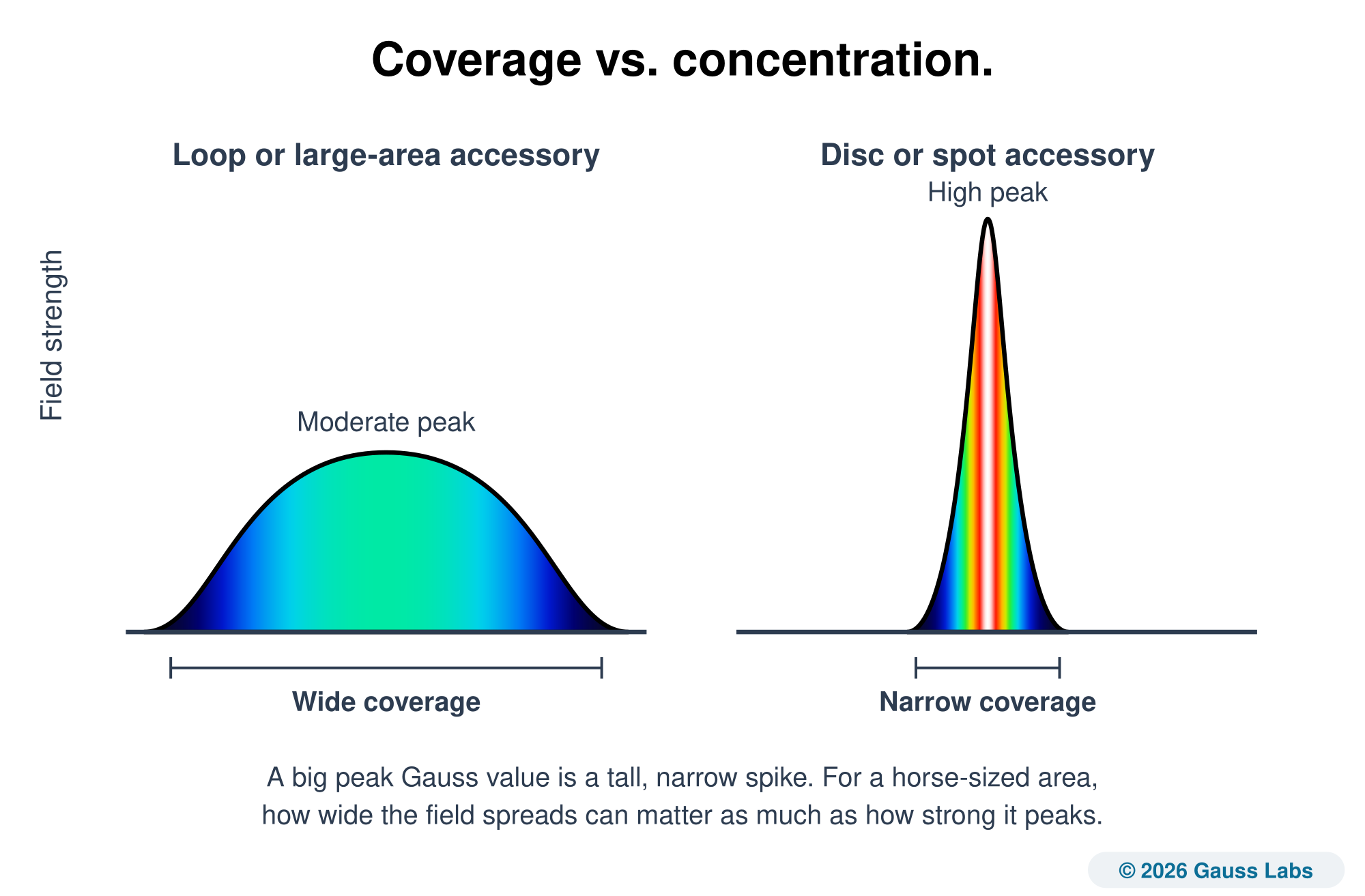
Peak Gauss is the single strongest point in the field, measured right at the surface. It's a real value, but it says nothing about how far the field carries or how much of it there is. Here's a measured example. We tested two accessories on the same device: a 3-inch strip coil and a 7-inch strip coil. The smaller one peaked at 22,410 Gauss. The larger one peaked at 8,670 Gauss, less than half.
Peak and total field are two different things. Peak is that single strongest point. Total field is the whole field added up across the surface. Here the larger coil carries almost twice the total field of the smaller one, about 9.5 versus 4.9 on our total-flux measure, even though its peak is less than half. A wider coil covers more area, so it can hold more field overall at a lower peak. That's the trade a loop makes for a horse, and no peak value on a spec sheet will show it to you.
Reach works the same way. A larger coil or a stronger pulse keeps the field above a usable level farther from the surface. That's greater reach, and it comes from the coil's size and the strength of the pulse, not from the field forcing its way deeper into the body. For a horse, more reach means the field stays strong farther from the accessory. That's geometry again, not one big value.
What to look for, in plain terms.
When you compare two large-area accessories, four things tell you more than the peak does.
Coverage. How wide the field actually stays strong, not just its highest point. The measure for this is the effective field diameter: the span where the field is still at least a tenth of its peak. A wider span covers more of the animal.
Evenness. Whether the field reaches evenly in every direction. A large accessory that's strong on one side and weak on the other leaves gaps. This is what a symmetry measurement catches.
Total field over the area. How much field the accessory puts out across its whole surface, added up, rather than at one point. As the example above showed, the higher peak isn't always the higher total.
Whether anyone measured it. A spec sheet is the maker's claim. An independent measurement is a checked fact. If the coverage, the evenness, and the total field were measured by someone other than the seller, you can compare on more than a single advertised value.
Competition and state rules are starting to reward measured output.
Two things are shifting under the equine market, and both make measured, checkable output worth more than an advertised one.
In competition, the Fédération Équestre Internationale (FEI), the governing body for international equestrian sport, permits a low-frequency PEMF device only when its field output stays below 0.1 Tesla (1,000 Gauss). That limit is written against the exact quantity we measure. We record the peak field at every setting, so we can confirm whether an accessory holds under the 1,000 Gauss line across its whole range, not just at the one setting a spec sheet happens to quote. Several equine loop-and-device pairs on our certification registry meet that limit, and each certificate is public.
This is exactly where a big advertised Gauss value gets slippery. An "8,000 Gauss" system is quoting a peak, at one setting, measured somewhere. To know how it sits against a competition limit, you need the peak value, the setting it was taken at, and where on the accessory it was measured. A measured certificate answers all three. An advertised value answers none. That's the single-number problem, landing in a real purchase.
Separately, a few US states have recently moved to classify PEMF on animals as veterinary practice. That changes who is allowed to operate the equipment, and more states are weighing the same question. We're not taking a side in that, and none of this is legal advice, so check the current rules where you practice. The narrow, useful point is this: as the category gets more formal, measured and certified device output is the evidence that carries across any line someone draws, whether that's a competition classification or a state rule.
Weighing coils for a large-animal practice?
We measure coverage, evenness, reach, and total field for any PEMF device or accessory, and publish the full report. If you'd like to see what a complete measurement looks like before you buy, our example reports are open to read.
Schedule a Call See Example ReportsThe biggest Gauss value on the page is the easiest thing to compare. That's why it leads so many equine spec sheets. For a horse, the field that covers the animal evenly is worth more than the field that spikes highest in one spot. Look at the whole field, not the single peak.