
A PEMF device's frequency is easier to understand once you know what the band names mean.
Delta, theta, alpha, beta, gamma: a PEMF frequency chart makes a device's settings look complicated, but the band names are simpler than they seem. Once you know what they actually mean, frequency is one of the few specs you can use to compare devices.
Frequency and field strength are two separate settings.
Frequency is how many pulses a device fires each second, measured in hertz (Hz), and it's independent of field strength: a device can pulse fast at a low Gauss output or slowly at a high one. So when you compare devices, read the two as separate specs. The Gauss value tells you how strong each pulse is, the frequency how often, and you need both to know what a device does.
Frequency is how often a pulse fires, not how fast it changes.
Frequency sets the cadence: how often a pulse fires. What it doesn't set is the strength of each pulse's stimulus, and that's the part that reaches tissue. A changing magnetic field induces a small electric current nearby, and by Faraday's law the size of that current tracks how fast the field changes, not how often the pulse repeats. So the stimulus comes from the steepness of the rising edge, not from the frequency. We measure that steepness as rise time and slew rate.
Two devices can pulse at the same rate and still deliver very different pulses, one with a sharp edge, one with a gentle one. We cover that edge in our post on rise time, fall time, and slew rate.
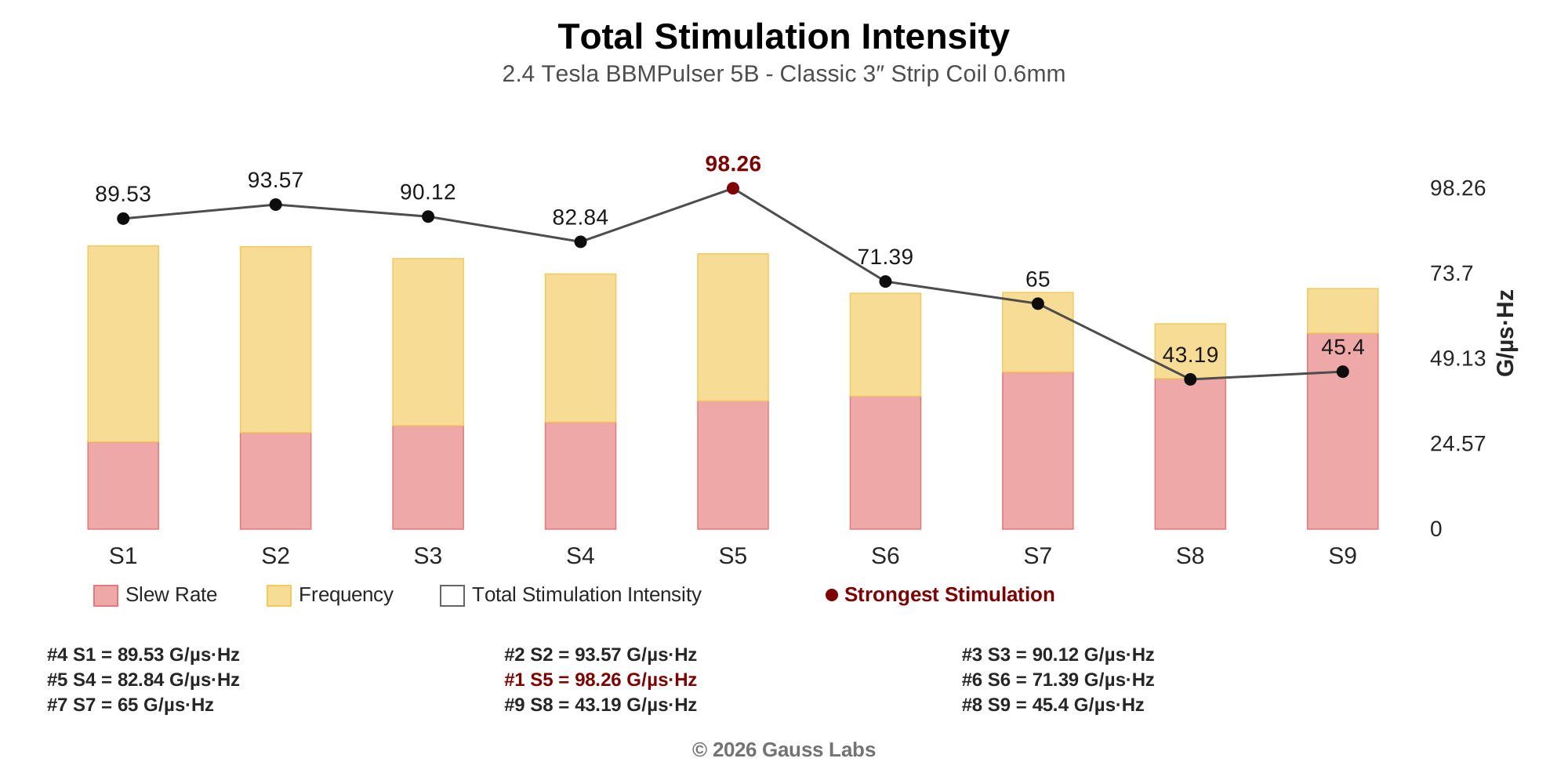
Both matter, so our report folds them into one metric. Total Stimulation Intensity multiplies the edge speed by the frequency: how strong each pulse's stimulus is, and how often it comes. Read frequency as one half of that, never the whole.
The band names come from brainwaves, but on a device they tell you the pulse rate.
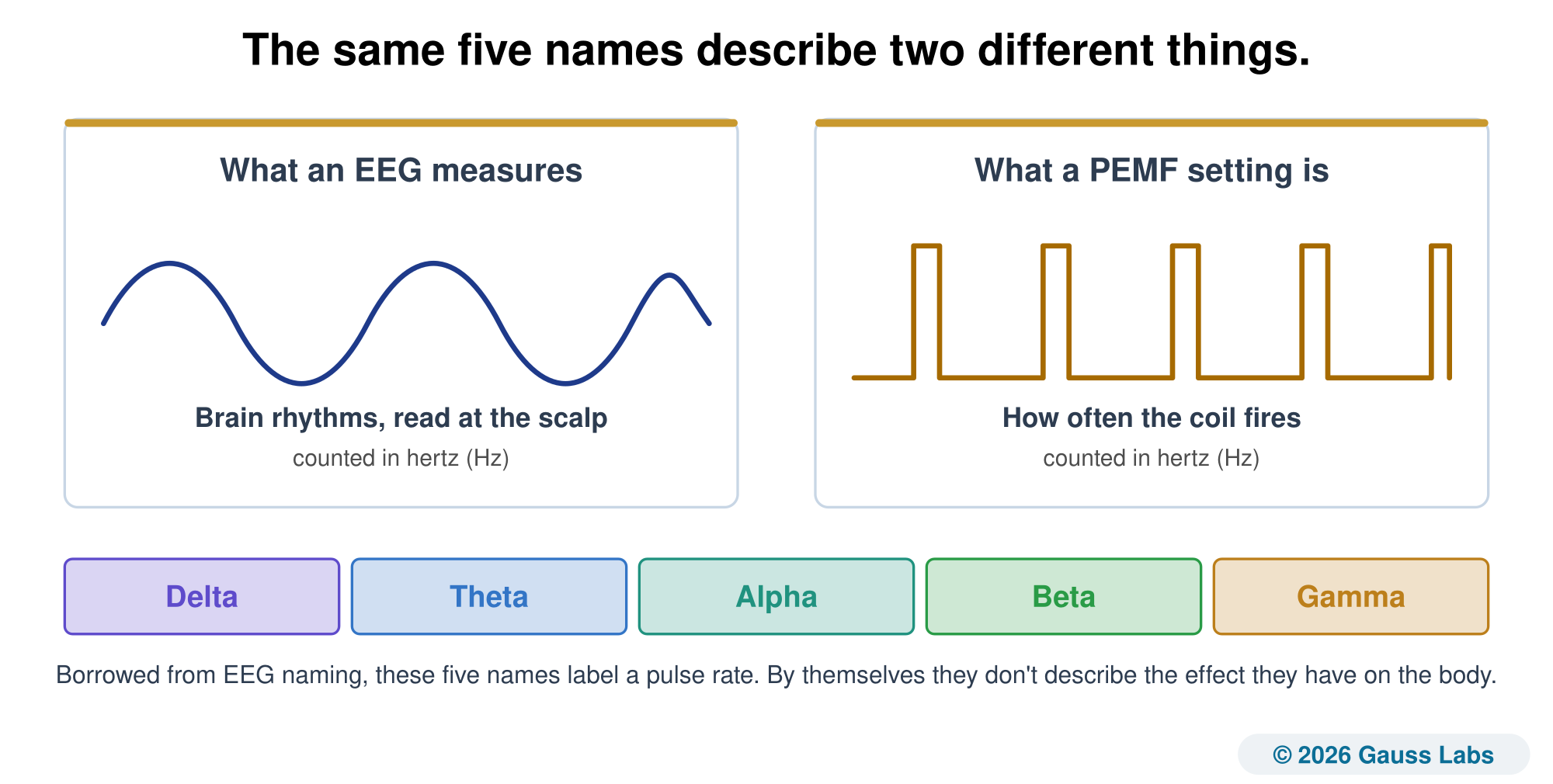
These names are borrowed from EEG, where delta, theta, alpha, beta, and gamma describe brain rhythms measured at the scalp. On a PEMF device the same band names mean something plainer, the pulse rate and nothing else. A setting labeled "alpha" borrows nothing from a relaxed brain except the word.
On that pulse-rate scale, delta runs from 0.5 to 4 Hz, theta from 4 to 8, alpha from 8 to 12, beta from 12 to 30, and gamma above about 30. So a setting in the alpha band simply pulses 8 to 12 times a second.
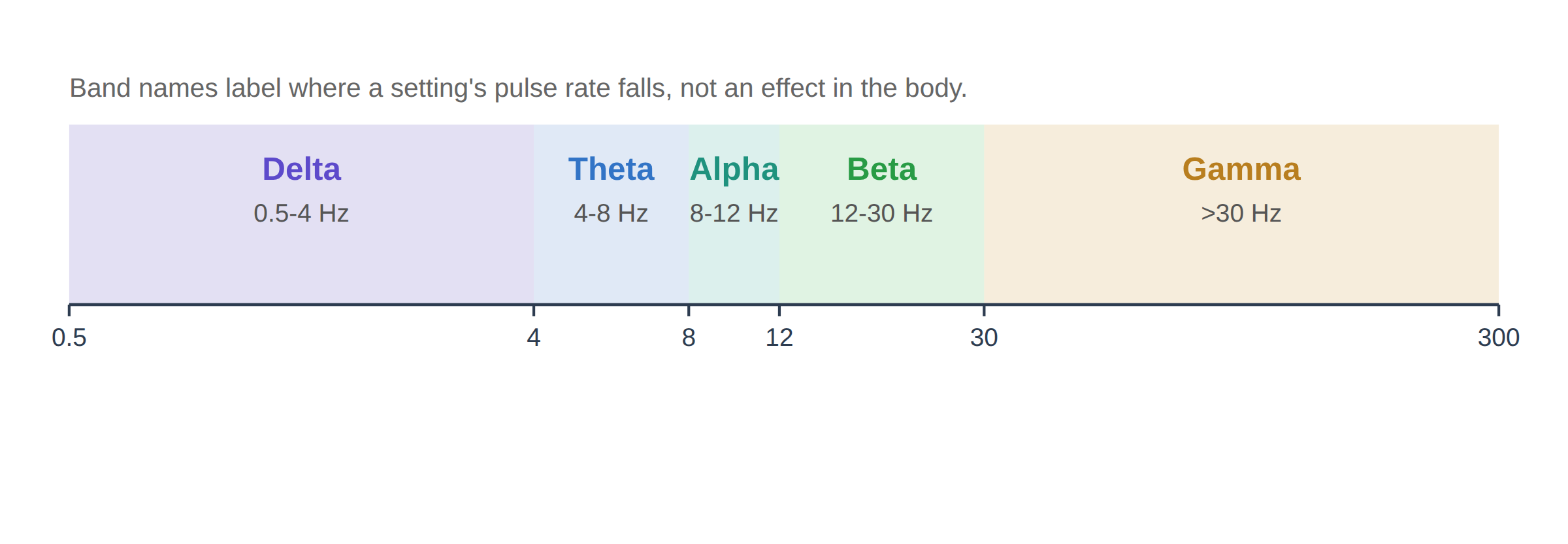
The devices we measure often operate below the named bands entirely.
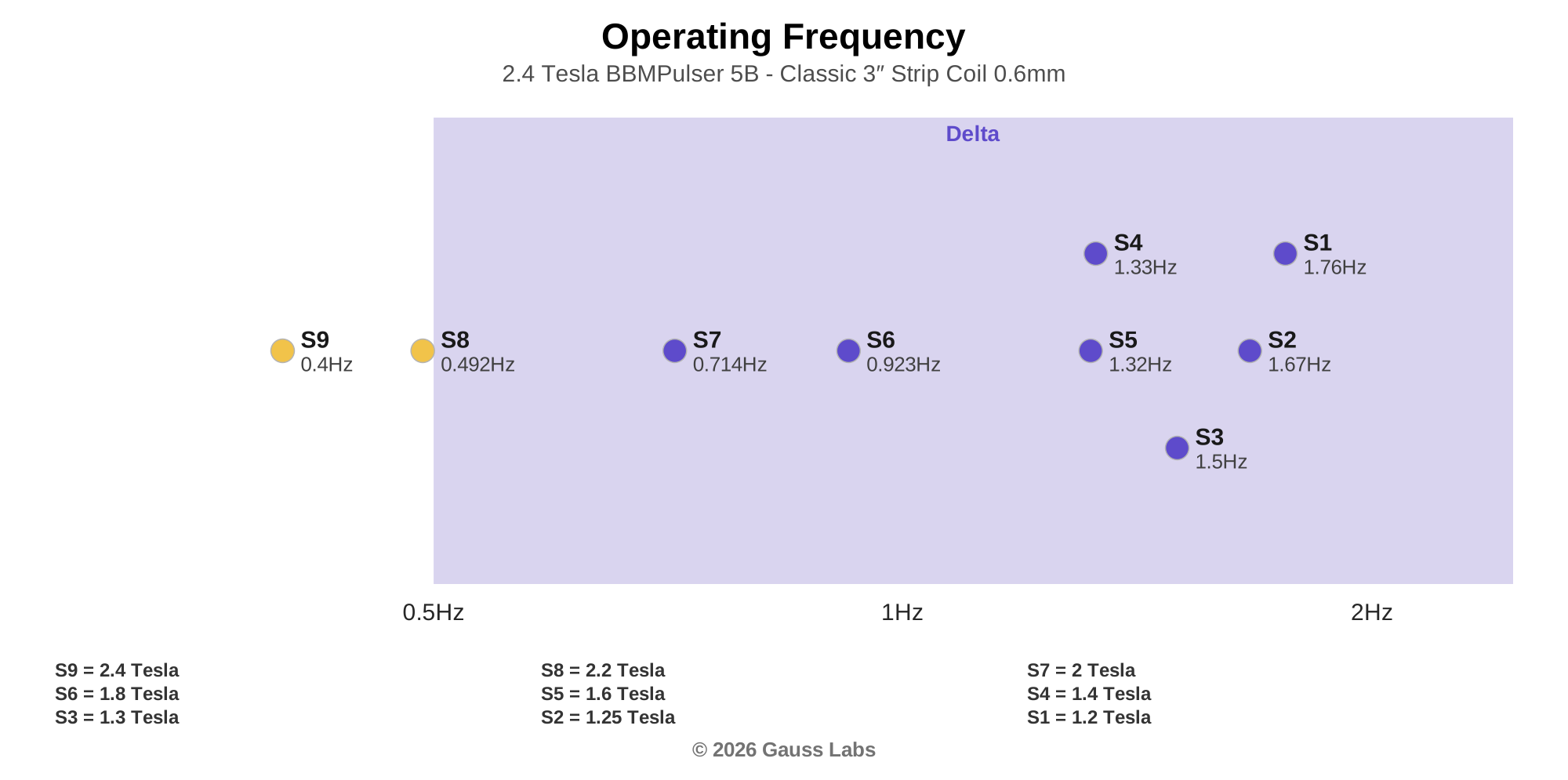
Here's something a band chart won't tell you: many real devices don't operate in those bands at all. The high-intensity pulsers we've measured in our own lab run below them. We bought both for in-house testing: a 2.4 Tesla BBMPulser 5B that pulses between 0.4 and 1.76 Hz across its nine settings, and a Sota Instruments Magnetic Pulser Paddle that pulses between 0.3 and 1.09 Hz. Both sit in or below the delta band, the lowest of the five, so the higher four labels never apply to them.
Don't read a low pulse rate as a gentle field, though. The BBMPulser fires under 2 Hz, yet each pulse rises to its peak in about 140 microseconds, a steep edge. It pulses rarely, but with a sharp rising edge each time. That's how strong pulsers are often built: a powerful pulse followed by a pause, so the frequency reads low by design. It's one more reason to read the rate a device actually operates at, not the band it falls on within a chart.
Our measured Total Stimulation Intensity puts both halves in one place at each setting, so you don't have to hold them apart.
Frequency does matter, in narrower ways than a five-band chart suggests.
None of this means frequency is unimportant. It's one of the main variables that describe how a device functions, and a few specific frequencies come up again and again, each worth knowing for what it actually is.
The 7.83 Hz Schumann resonance is a real electromagnetic resonance of the Earth, the fundamental of a series that also rings at roughly 14.3, 20.8, 27.3, and 33.8 Hz. Some devices tune to the 7.83 Hz fundamental on the premise that life evolved alongside that field, which is a design rationale, not an established biological requirement. A widely cited NASA study ran a roughly 10 Hz pulsed field on cultured nerve cells and saw the cells change, part of why pulse timing is worth measuring. It studied cells in a dish, though, and measured no health outcome. And the roughly 15 Hz signal in long-established bone-repair devices is tied to a real, measured response.
What these have in common is that they're narrow and specific. That's the opposite of a chart that assigns each band an effect in the body, one to relax you, another to help recovery, another to stimulate a cell. Those pairings trace back to marketing, not to primary studies. And even those real frequencies don't act on their own: what a pulse does depends on its strength, its waveform, and how long you run it. Frequency is one input among several.
Read a device's frequency alongside its strength and waveform, not by itself.
Here's how to put a frequency spec to work when you're weighing one device against another.
Put a device's frequency through three checks.
- Read it alongside the strength, not instead of it. The two are independent, so check both, and don't let a high Gauss number imply a fast pulse or the other way around.
- Read the pulse edge, not just the rate. The rise time and slew rate tell you how sharp each pulse is, which is what actually induces current in tissue.
- Ask for the frequency measured at each setting. A range printed on the box isn't always what the controller lets you select, and a band name on a marketing chart isn't a measurement. The measured value at each setting is the one you can check.
That last point is the one we can help with. On every device we test, we measure the pulse rate at each setting and report it plainly, in hertz, next to the band it falls in and alongside the pulse edge and the field strength. We also give you Total Stimulation Intensity at each setting, so you can compare two settings at a glance. You get the rate the device actually runs, checked on our own equipment, and the honest label for it.
Want the real numbers behind a device's settings?
We measure the pulse rate, field strength, and waveform at every setting, and publish them in full. If you'd like to see what that looks like, our example reports are open to read.
Schedule a Call See Example ReportsFrequency is a useful spec once you read it for what it is: a pulse rate, independent of strength, separate from the pulse edge, and labeled with a name borrowed from somewhere else. Read it that way and it earns its place on your shortlist.