
Twenty terms help you read a PEMF spec sheet, and four questions show what it leaves out.
A PEMF (pulsed electromagnetic field) spec sheet is easier to read once you know what its terms mean and which ones matter when you compare devices. We’ve picked the twenty that come up most and put each in plain words, with what it tells you when you compare devices. They’re grouped by the question they answer, so you can go straight to the one you’re stuck on.
Four terms cover how strong the field is.
Most spec sheets lead with one strength number. These four terms say what that number is, what unit it is in, and what it leaves out.- Gauss (G) and Tesla (T). Two units for the same thing, magnetic field strength, where 1 Tesla equals 10,000 Gauss and a kilogauss (kG) is 1,000 Gauss. We report in Gauss, and a bigger number is a stronger field at that point. A sheet that says 0.5 T and a sheet that says 5,000 G are giving the same strength, so convert to Gauss before you compare.
- Peak field strength. The highest field the accessory produces, measured in Gauss at its surface. It is the number most sheets print, and it describes one spot, so ask where it was read and at which setting.
- Amplitude. How strong each pulse is, in Gauss or Tesla. It is a separate thing from frequency, which is how often the pulses occur. A sheet that gives a pulse rate has told you nothing about strength, so look for both.
- Penetration depth. How far the field reaches from the accessory, measured out to the 5 Gauss edge in open air. A peak read at the surface says nothing about the distance you would actually use the device at, and this term gives that distance.
Seven terms cover how the pulse behaves.
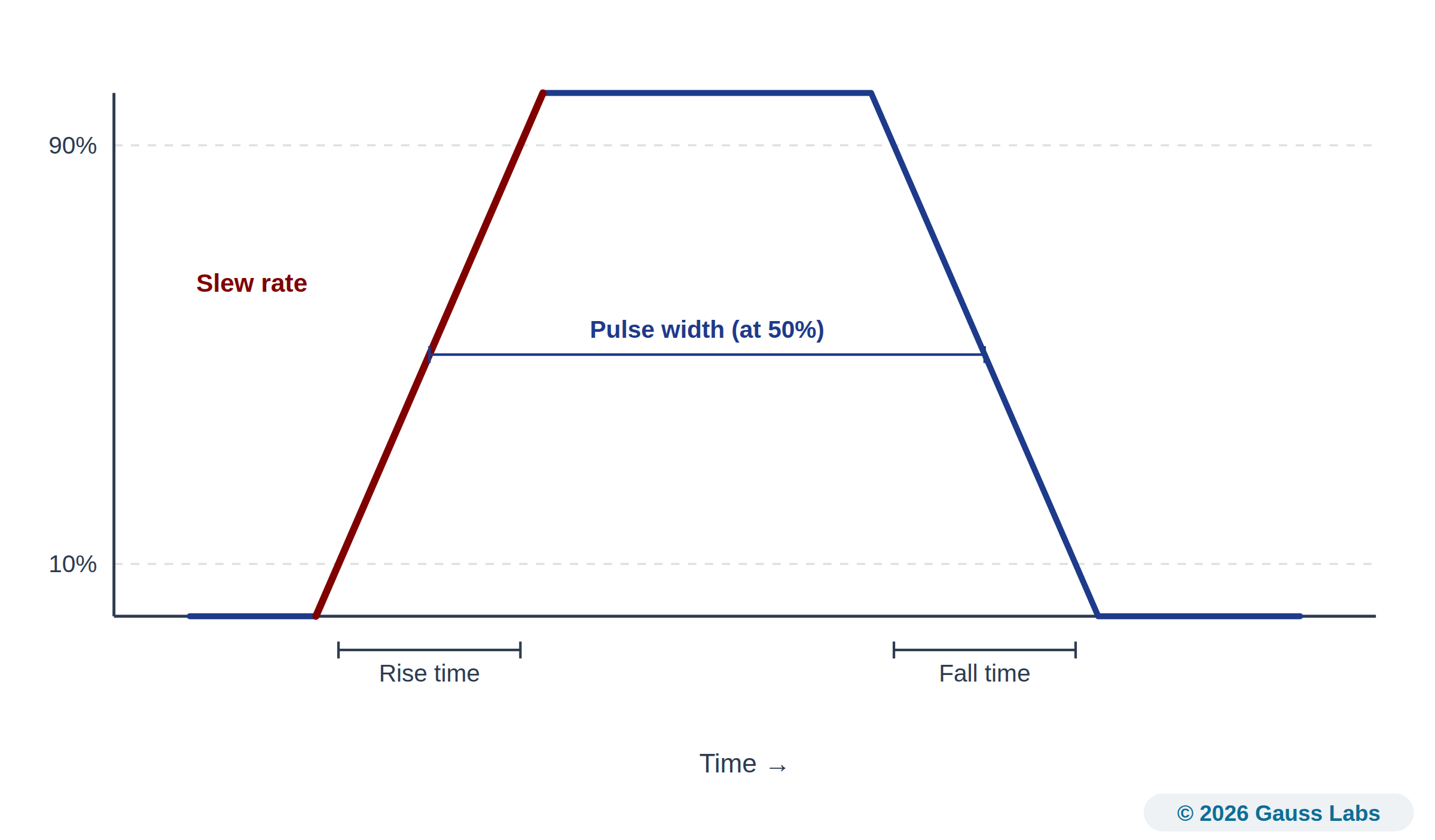
Two devices can print the same peak and still deliver very different pulses. These seven terms describe the pulse as it unfolds in time. We read them from an oscilloscope capture, as our post on rise time, fall time, and slew rate shows.- Faraday’s law. A changing magnetic field creates an electric field in nearby conductive material, and the faster the field changes, the stronger that electric field is. It is why a sheet should print how fast the field changes and not only how high it gets.
- Frequency (Hz). How many pulses a device delivers each second, in hertz. It is independent of field strength. A high pulse rate can come with a low Gauss figure and the reverse, so a sheet that lists only a frequency has not told you how strong the field is.
- Duty cycle (%). The share of each pulse cycle during which the field is on. A high peak with a very small duty cycle is on for only a fraction of the time, so it can’t be read as a steady strength.
- Rise time. How quickly the field climbs to its peak during a pulse, measured from 10% to 90% of the peak. Two devices with the same peak can climb at different speeds, and this is the number that tells them apart.
- Fall time. How quickly the field dies away after the peak, measured from 90% down to 10%. Many devices fall at a different pace than they rise, so one time covers only half of the pulse.
- Slew rate (G/µs). How steeply the field changes along a pulse edge, in Gauss per microsecond, measured as the slope from 10% to 90% of the edge. It puts one number on how sharp the pulse is, which a peak figure can’t do.
- Waveform type. The shape of the pulse, such as sine, square, triangle or sawtooth. We classify the shape at the coil, which usually differs from the shape a maker says the device drives into it, because a coil rounds the edges of whatever it is given. When a sheet names a waveform, ask whether it is the one at the coil or the one driving it. Both can be right, since they describe the same pulse at two points.
Six terms describe the accessory and how its field is shaped.
The accessory decides how the field spreads out as well as how high it peaks. These six terms cover the accessory and the shape of its field.- Accessory. The applicator that delivers the field to the body. Some makers call it an attachment, and it holds one or more coils. The accessory shapes the field, so the same device behaves differently with a different one.
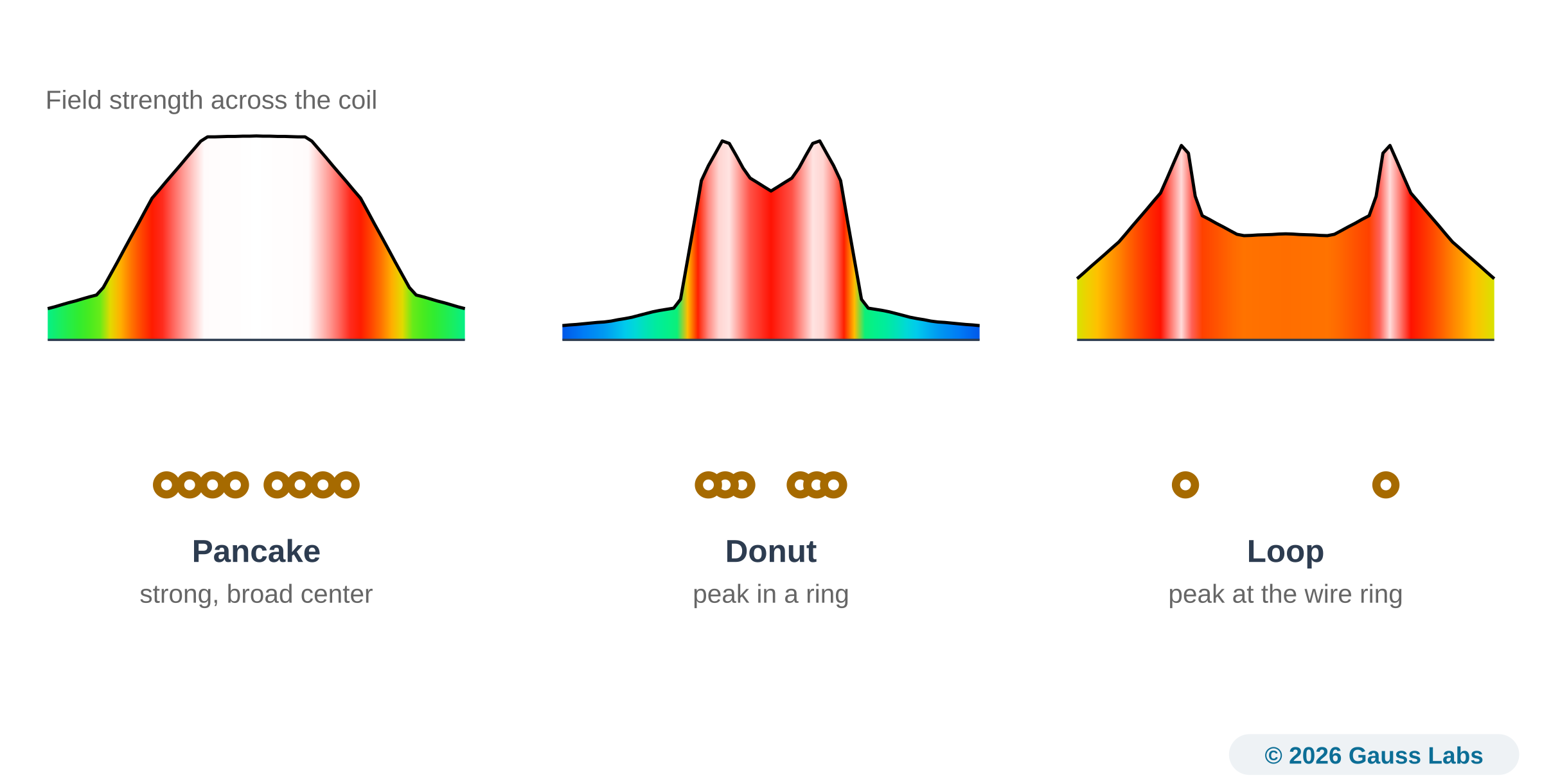
- Pancake coil. A disc-shaped coil wound in a spiral. Its field peaks at the center and drops toward the edges. It concentrates the field in the middle, so where you place it over the target area matters.
- Donut coil. A flat ring-shaped coil with an open hole in the middle. Its peak at the face is lower than a solid disc of the same size, and its field is broader and more even. A lower peak figure here describes a different field shape, not a worse accessory.
- Loop coil. An open coil made to go around a limb or curve around a body part, with the field passing through from all sides. Its field sits in a different place than a disc’s, so compare a loop with other loops rather than with a disc.
- Effective field diameter. The width of the area with meaningful field, out to where the field drops to 10% of its peak. It tells you how wide the area is, which a peak number can’t.
- Field symmetry. How evenly the field is spread in every direction from the center, scored from our readings along four axes. A high score means the field is nearly the same on every side, so how you position the accessory matters less.
Three terms tell you what was tested and how.
Every number on a sheet came from one device, one accessory, and one instrument. These three terms say which.- Pairing. One device tested together with one accessory. A device doesn’t produce a field on its own, so the same device can deliver a very different field through another accessory, which is why we test, report on, and certify each pairing. A sheet that names only the device describes half of what was tested.
- Gauss meter. The calibrated instrument that measures field strength at each scan point during testing. Every Gauss number on a sheet came from one, so ask what meter was used and whether it was calibrated, because a reading is only as good as the instrument behind it.
- Oscilloscope. A test instrument that records a signal over time. Pulse timing and shape are read from its capture. It tells you how a timing number was obtained, and “how was it read?” is a fair question for any sheet.
Apply the terms to the next spec sheet you read.
Checking a sheet takes a few minutes once you know the terms. The rest of the dictionary is on our terms page, and our post on higher Gauss versus a sharper pulse shows why peak and pulse speed are two separate specs. To see several of these terms on a real report, read our measurement of the Magnetic Pulser MP7.Four questions to put to the maker.
- “What’s the peak, in which unit, at which setting?” A bare Gauss figure could belong to any setting, and a figure in Tesla or kilogauss converts to the same scale.
- “How fast does the pulse rise, and how was that read?” Ask for the rise time or slew rate, and for the instrument behind it.
- “Which accessory do these numbers describe?” The pairing is the unit that was tested, so a sheet that names only the device describes half of it.
- “Is that waveform the one at the coil or the one driving it?” Both can be correct, and the one at the coil is the field the accessory actually produces.
Want these terms measured on your device?
We measure each device with each accessory at every setting, and a device that qualifies gets a certification and checklist on a public page any buyer can open. If you’d like to see the measurement work first, our example reports are open to read.
Schedule a Call See Example Reports