
Many PEMF devices are built to make a pulse that rises fast and falls slowly, so that shape on a report is usually expected.
When you open the waveform in a PEMF report, the field often climbs quickly and then falls slowly, and it's fair to wonder whether something is wrong. Usually nothing is, because many pulsed devices are designed to make that shape. We'll show the lopsided pulse on a device we measured, the design behind its fast rise, and the questions to ask the seller when a pulse has no clear shape.
Comparing a pulse's rise and fall shows how lopsided it is.
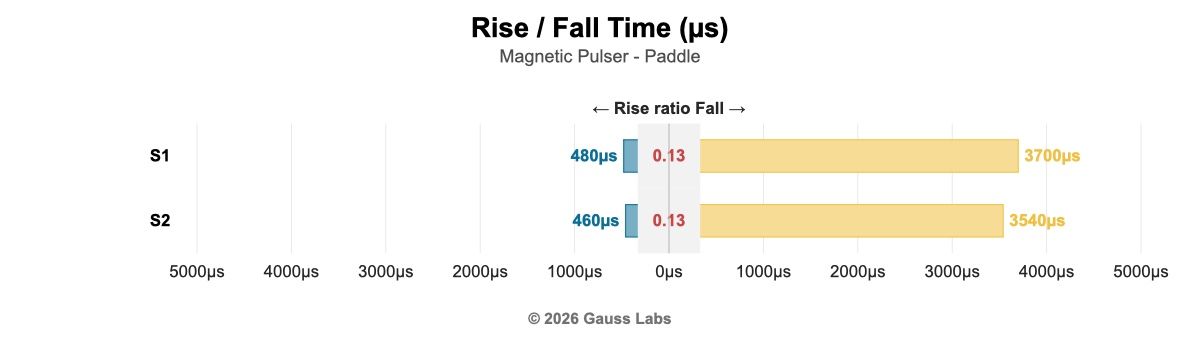
A peak alone can't show you a pulse's shape, so we time the climb and the fall separately. Rise time and fall time are each timed between 10 and 90 percent of the peak, as our post on rise time, fall time, and slew rate explains, and dividing the first by the second gives the pulse balance. A balance of 1.0 means the field ramps up and down at the same speed, and a value well below 1.0 means it climbs much faster than it falls.
On our in-house tester, the fall lasts over seven times longer than the rise.
We measured a Sota Instruments Magnetic Pulser Paddle, our in-house tester, at both of its settings (report M2606071704). On setting 1 the field peaks at 7,120 Gauss (712 millitesla), with a rise time of about 480 microseconds (µs, millionths of a second) and a fall time of about 3,700 µs. On setting 2 it peaks at 2,630 Gauss (263 millitesla), with a rise time of about 460 µs and a fall time of about 3,540 µs. At both settings the fall takes more than seven times as long as the rise, which puts the pulse balance far below 1.0.
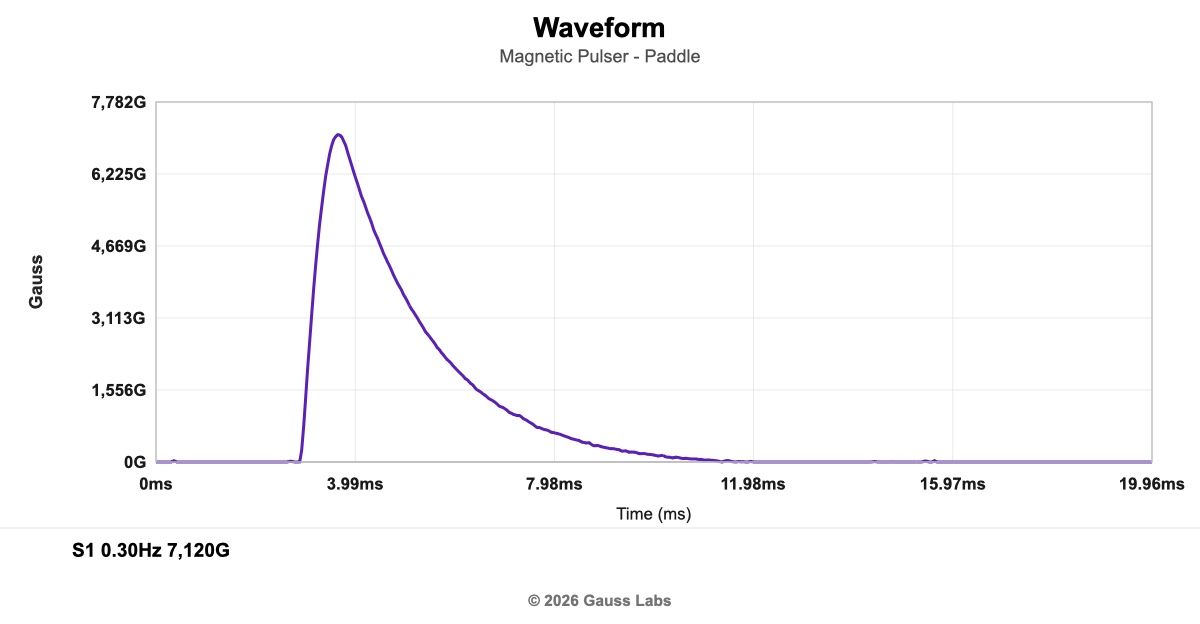
The rise and fall times barely change between the two settings while the peak drops, and our report classified the pulse as a sawtooth at both. A sawtooth is a strongly lopsided pulse with one fast edge and one slow one.
Many pulsers make the fast rise by releasing stored energy at once.
The sawtooth shape is common in devices that use a capacitor-discharge design. The device charges a capacitor in the quiet stretch between pulses, then releases that stored energy through the coil all at once, which is what makes the fast, high peak. We explain how that stored energy sets the height of the peak in our post on battery-powered devices.
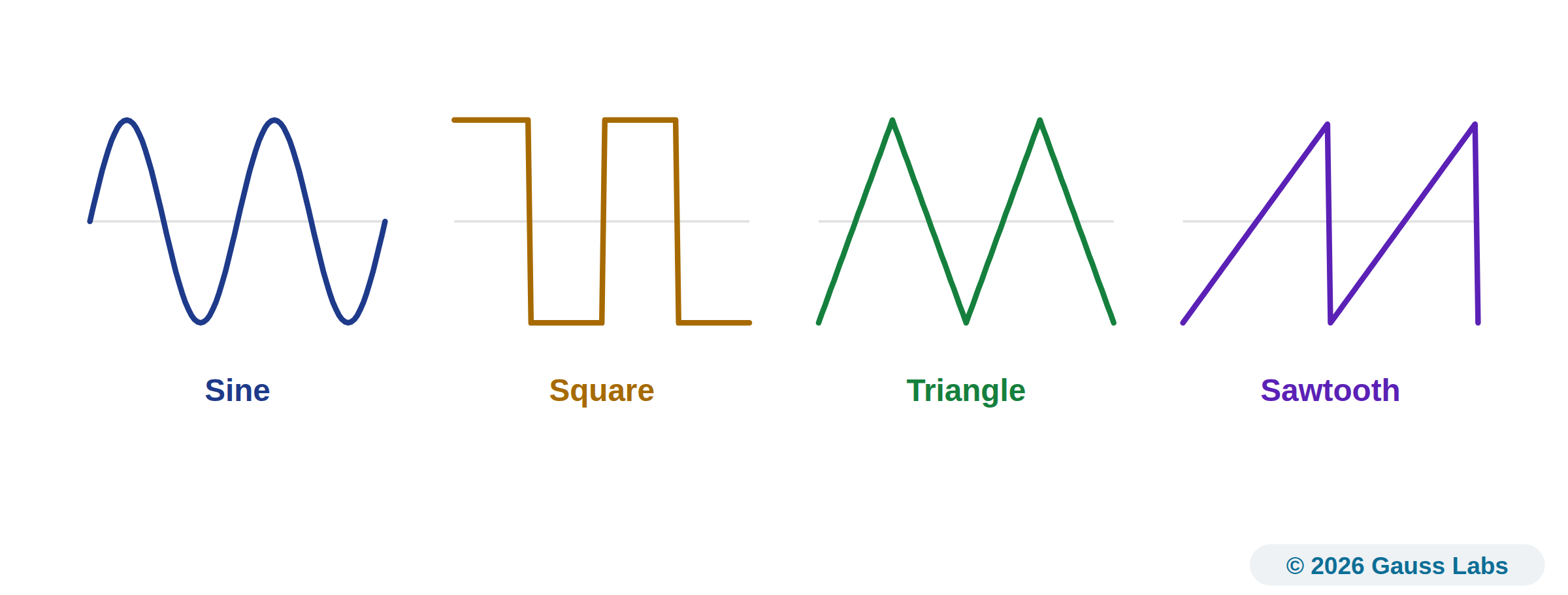
Other shapes don't have that one fast edge, since a square wave switches almost instantly in both directions and a triangle wave climbs and falls along straight edges.
Ask the seller about a pulse with no clear shape.
Two of the checks a pairing passes before we certify it look at the pulse itself. The clean waveform check asks that every setting we measure produce a clear, recognizable pulse shape, because a ragged or undefined shape can point to a fault. A second check confirms that the measured values agree with the maker's documents, including pulse width (how long each pulse lasts) and duty cycle (the share of time the field is on) where the maker states them.
The waveform type in our report names the shape measured at the coil. A coil rounds the edges of the pulse the device sends, so a square pulse usually looks rounded, which on its own isn't a reason to ask.
Three questions for any waveform you're shown.
- "What shape does the report name at each setting?" A sawtooth, a square, a triangle, or a sine is a recognizable design, so ask about a pulse the report can't classify.
- "Do the measured pulse width and duty cycle match your documents?" They should agree wherever the maker states them.
- "What are the rise and fall times?" Together they give you the pulse's balance.
Want your pulse shape measured and reported?
We test a device and its accessory as a pair, at a sampling of the device's settings, and report the waveform, rise time, and fall time for each setting we measure. Our example reports are open to read.
Schedule a Call See Example ReportsThe next time a pulse rises fast and falls slowly, check which shape the report names before you assume something is wrong.