
A battery doesn't set how strong a PEMF field gets. The stored energy and the coil do.
You're comparing a battery-powered PEMF device with one that plugs in, and it's natural to assume the battery one is the weaker. A battery tells you how long a device can run and how often it can fire, but it doesn't set how high the field peaks, because a pulsed device stores energy and then releases it in one short burst. So the number worth asking for is the measured peak of the device with its accessory, at the setting you'll use. Below we show how that works, check it against one of our own measurements, and end with four questions to put to a seller.
A pulsed device releases stored energy in one short burst.
A pulsed PEMF device doesn't run its coil continuously. It sends out short bursts, each one a pulse, with a rest between them. Most pulsed devices use a capacitor-discharge topology, which means a capacitor charges during the rest and then empties into the coil in the pulse. The capacitor recharges between pulses, which limits how often the device can fire, and a larger capacitor at a higher voltage makes a faster, higher pulse. This is general circuit physics from our dictionary, not a measurement of one device.
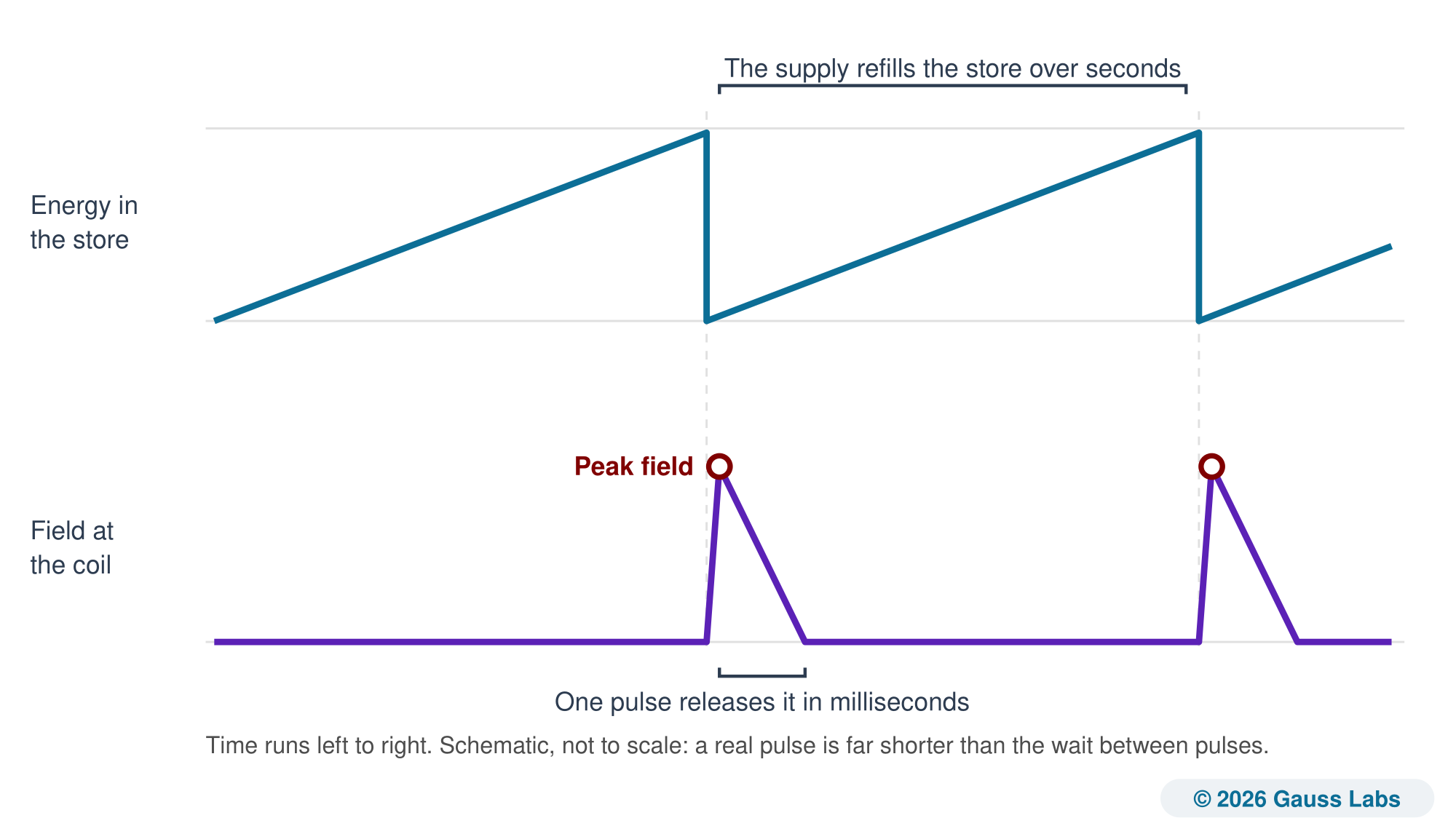
The supply, whether a battery or a wall adapter, does the slow part. A battery limits how much current a device can draw continuously, so it sets how quickly the store refills and how long a charge lasts. It doesn't limit what the store holds at the moment of the pulse, and the peak comes from that stored energy and the coil it lands in.
One unit of ours peaks at two heights on one supply.
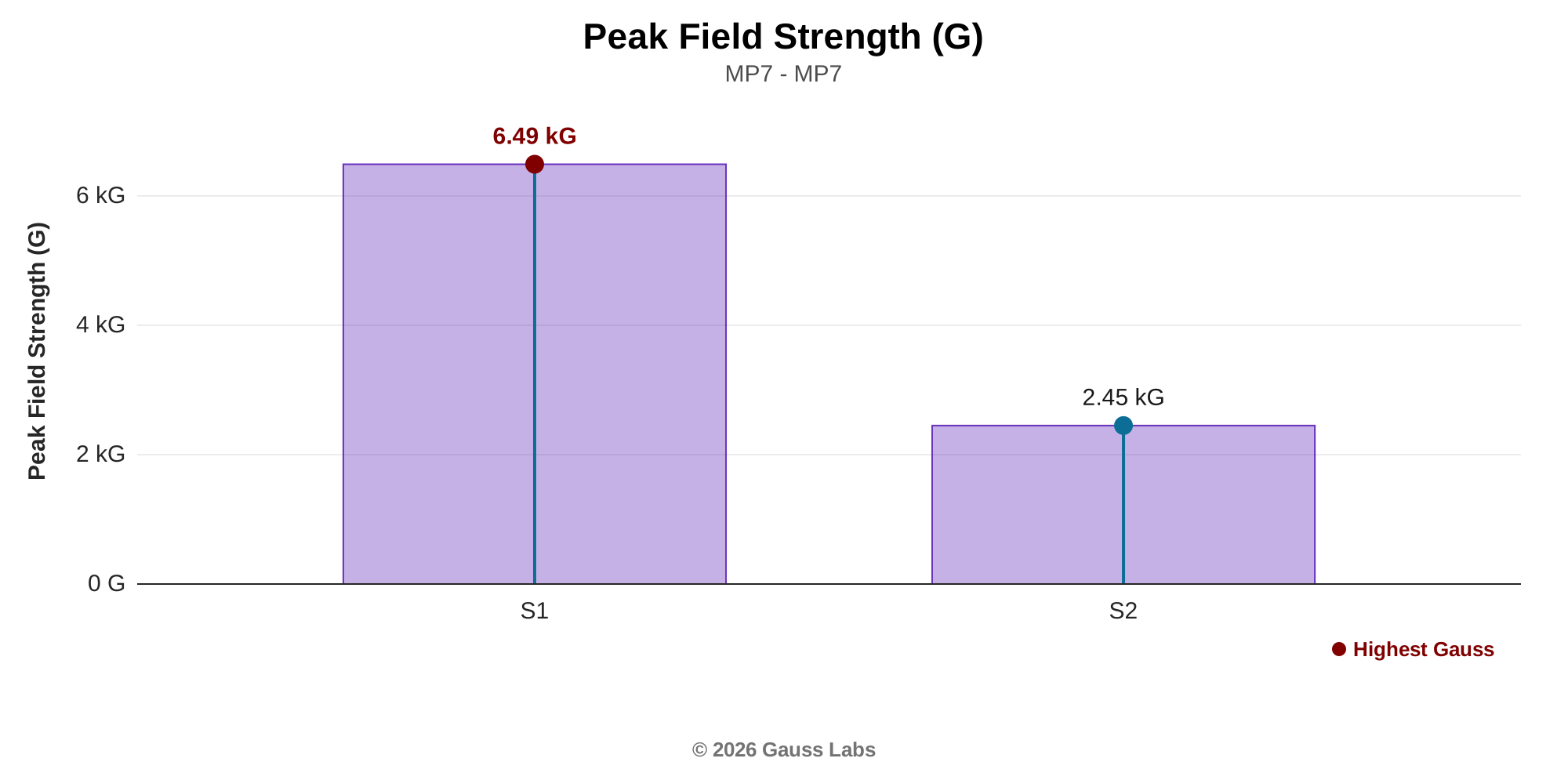
We measured the Magnetic Pulser MP7, our in-house tester, a unit customized for our own experiments. Its report (T2609191800) records two settings on the same accessory. Setting 1 peaks at 6,490 Gauss and setting 2 at 2,450 Gauss, a little under 40% of the first. Whatever powers the unit powers both settings, so the supply isn't what separates the two peaks.
The pulse is brief, too. At setting 1 it lasts about 1.8 milliseconds and repeats about every 3.6 seconds, so the field is on for 0.05% of the time (the duty cycle). That long quiet stretch is when the supply refills the store. We described the rest of this unit's report in our post on the MP7.
The coil and the accessory set the rest of the peak.
The field follows the peak current through the coil. Several things set that current: how much the capacitor holds, the coil's inductance, its turn count, the drive circuit, and which accessory is fitted. Swap the accessory and you have a different pairing with a different peak field strength, which is why we measure a device and its accessory together.
From our many years of experience with how these devices work, a 12 volt battery pack can supply enough to generate thousands of Gauss at the accessory surface. That's an engineering statement and not a Gauss Labs measurement, so a label reading "battery powered" tells you little about where the peak sits. The same physics runs the other way, since a plug-in device with a small store or a weak coil can peak low.
Accessory shape alone moves the typical peak widely.
Our anonymized group medians show how much. Across 25 finalized tests, grouped by accessory shape, the typical loop accessory (7 pairings) peaks at 847 Gauss and the typical disc (17 pairings) at 2.96 kilogauss. A median is the middle value of a group, and each group needs at least five tests, so no figure traces back to one device. Those describe the middle of each group and not any one product, and they say nothing about what powers it. They do show that accessory shape by itself is a large part of where a peak lands.
Battery or mains says little about how strong the field is.
That matters wherever a power source is expected to stand in for a field limit. One proposal for competition equipment pairs battery power with a field ceiling. It hasn't been voted on and we take no side on what the ceiling should be, and our earlier post on the proposal covers what it says. Whatever number is chosen, a limit on the field is checked by measuring the device and accessory as you'll use them.
Four questions for any battery-powered device.
- “Which setting and accessory does the peak belong to?” A unit with two settings has two peaks, as our MP7 does at 6,490 and 2,450 Gauss, and a different accessory changes the field again.
- “Was the peak measured, and by whom?” A maker's figure and an independent one are different kinds of evidence, and a “battery powered” label is neither.
- “How far from the accessory was the probe?” A reading at the surface and one at a standoff distance differ, so a peak with no distance attached can't be compared with another.
- “How often does it pulse, and how long does a charge last?” Those two come from the supply and the store, so they belong on the sheet next to the peak instead of in place of it.
Want the same measurements on your device?
We measure the peak field of a device with each accessory fitted, at every setting, and report what the pairing produces. If you'd like to see what that looks like, our example reports are open to read.
Schedule a Call See Example ReportsWhen a page says its device is battery powered, ask what the peak is, at which setting, with which accessory, and who measured it.