
Your PEMF Device Performs. The Question Is Whether You Can Prove It.
If you design and build PEMF equipment, you already know your product works. Your buyers are starting to want more than your word for it. The manufacturer who can hand them a third-party certification of measured performance is going to have a meaningful edge over the one who can't.
Five years ago, a confident peak Gauss number on a glossy product page was enough to close most sales. Today, the buyers calling you are different. Some of them are clinicians who burned themselves on a previous purchase that didn't live up to the spec sheet. Some are veterinary professionals comparing your machine against a competitor whose marketing math doesn't add up. Some are technically literate enough to ask about rise time, slew rate, and field uniformity, and they aren't buying anymore from companies that can't answer.
You can answer those questions. Your engineering team knows the device cold. The problem isn't that the data doesn't exist. The problem is that putting it in a form a customer can verify, that holds up against a competitor's claims, and that you can put on a website without your legal team getting nervous, is genuinely hard work. It takes equipment most product teams don't own, methodology most marketing teams haven't developed, and a level of test infrastructure that's a serious investment to build in-house.
Meanwhile, the market is shifting underneath you. Buyers are getting more sophisticated. Competitors are starting to publish independent test data. The industry is slowly normalizing the expectation that a PEMF manufacturer can produce a third-party certification on request, and the companies that can't are starting to look like they're hiding something even when they aren't. Internally, you may already feel the pressure. Every product launch raises the bar a little, and every spec sheet you publish is one a competitor will eventually compare against their own measurements.
The trap most manufacturers are stuck in
You probably already know the standard playbook for product specs in this category. Lead with peak Gauss. Add a frequency range. Mention the waveform by name (sawtooth, sinusoidal, square). Include a stylized field-line diagram. Maybe a falloff curve at three distances. Done.
The problem with that playbook is that it's no longer differentiating. Every competitor is using the same format. Every buyer has seen it dozens of times. Increasingly, buyers know what it leaves out:
- Peak Gauss alone says nothing about where on the coil the field actually peaks. A donut presented as a pancake will fail in clinical use the moment the operator places it over a small target.
- Field-line diagrams aren't measurements. They're textbook illustrations. Sophisticated buyers know the difference and increasingly ask for the actual data.
- A single-axis falloff curve hides directional bias. If your coil is stronger on one axis than another, a competitor with a four-axis scan will be able to show that on a slide.
- Peak Gauss without rise time tells the buyer nothing about dB/dt , which is what actually drives induced current in tissue. The technically literate buyers know this.
- Per-coil intensity numbers on multi-coil mats hide the parallel-versus-sequential question. A competitor who explicitly publishes “all coils fire simultaneously at rated intensity” while you're silent on the topic is going to win that comparison every time.
None of this is a criticism of your product. Your product probably handles all of these questions just fine on the bench. The criticism is of the format. The marketing surface most manufacturers in this space are using no longer covers what buyers want to know.
What third-party certification actually changes
This is what Gauss Labs does. We test PEMF devices and accessories on calibrated equipment, produce a full multi-axis, multi-setting analysis report with measured spatial distribution and time-domain pulse data, and certify that the unit performs as documented. The methodology is recorded in enough detail that the result is defensible and reproducible by another lab if anyone ever has reason to challenge it. You receive numbers you can publish in your own documentation, with our certification standing behind them.
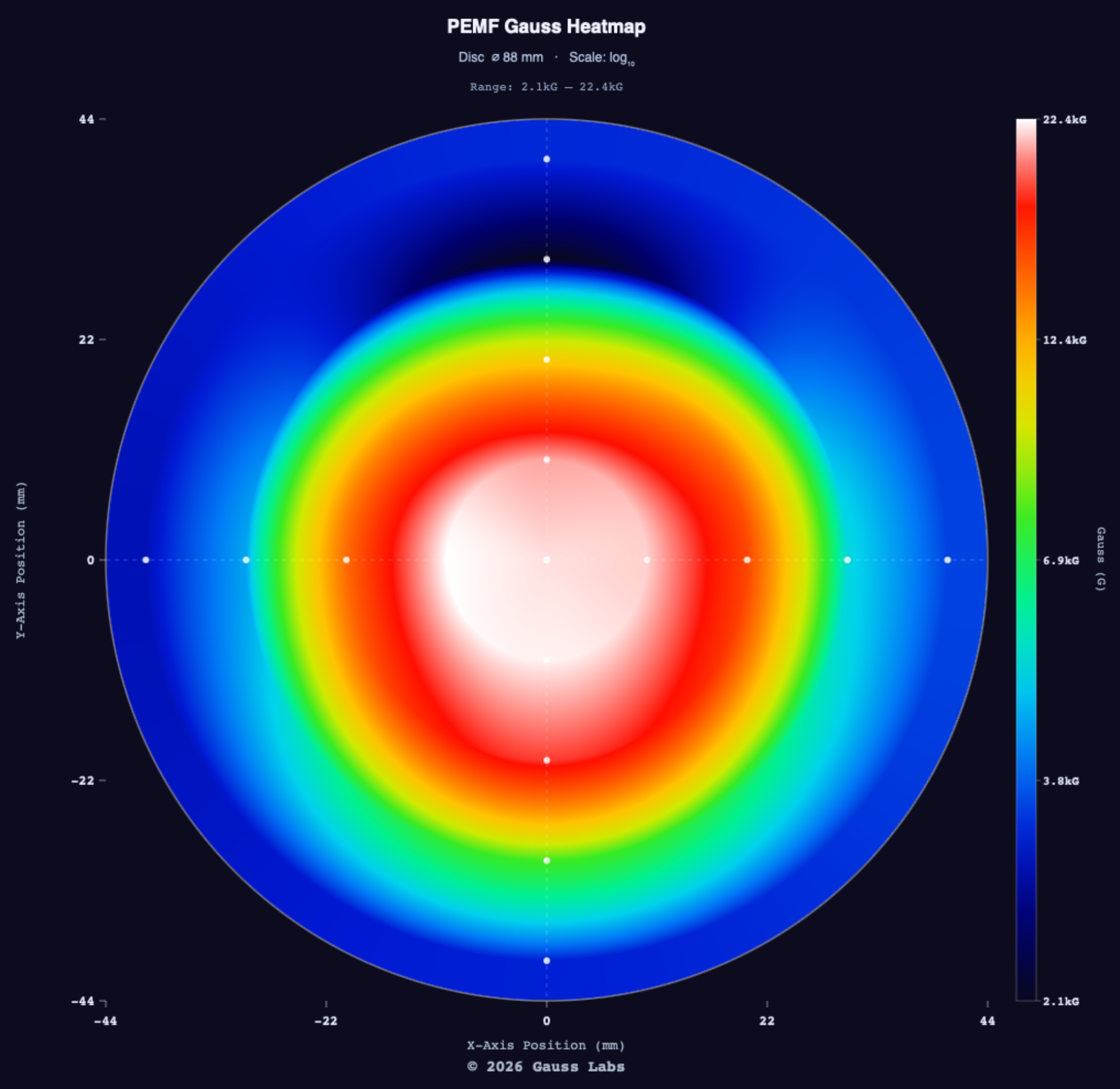
The reason that matters for your business is that an independent report is a different category of document than internal QC data. Your engineering team can produce excellent measurements, but those measurements come from inside your company. A buyer evaluating your claim against a competitor's claim can't weigh them. Both are coming from the seller. An independent report is something you can hand to a buyer, point to in a sales conversation, link from a product page, and submit alongside regulatory filings, with the methodology and the lab named on the document.
To be precise about what this is: a Gauss Labs report is a certification of measured performance . We test your device or accessory on calibrated instruments, document the methodology, and certify that the unit produces the field strengths, pulse characteristics, and spatial coverage documented in the report. You can put those values in your product documentation, on your spec sheet, in regulatory filings, and in front of buyers, with our methodology backing them up. The certification comes with branded badges you can place on your literature, your website, and as labels on the product itself. It also comes with a public listing on our certified clients directory that buyers can verify independently. What it isn't is a regulatory clearance (FDA, CE, etc.) or a clinical efficacy claim. Those are separate processes that require different bodies of evidence. However, our test results support those clearances by providing the underlying measurement infrastructure they need: defensible numbers, produced by a third party, with the methodology on the record.
What you get back
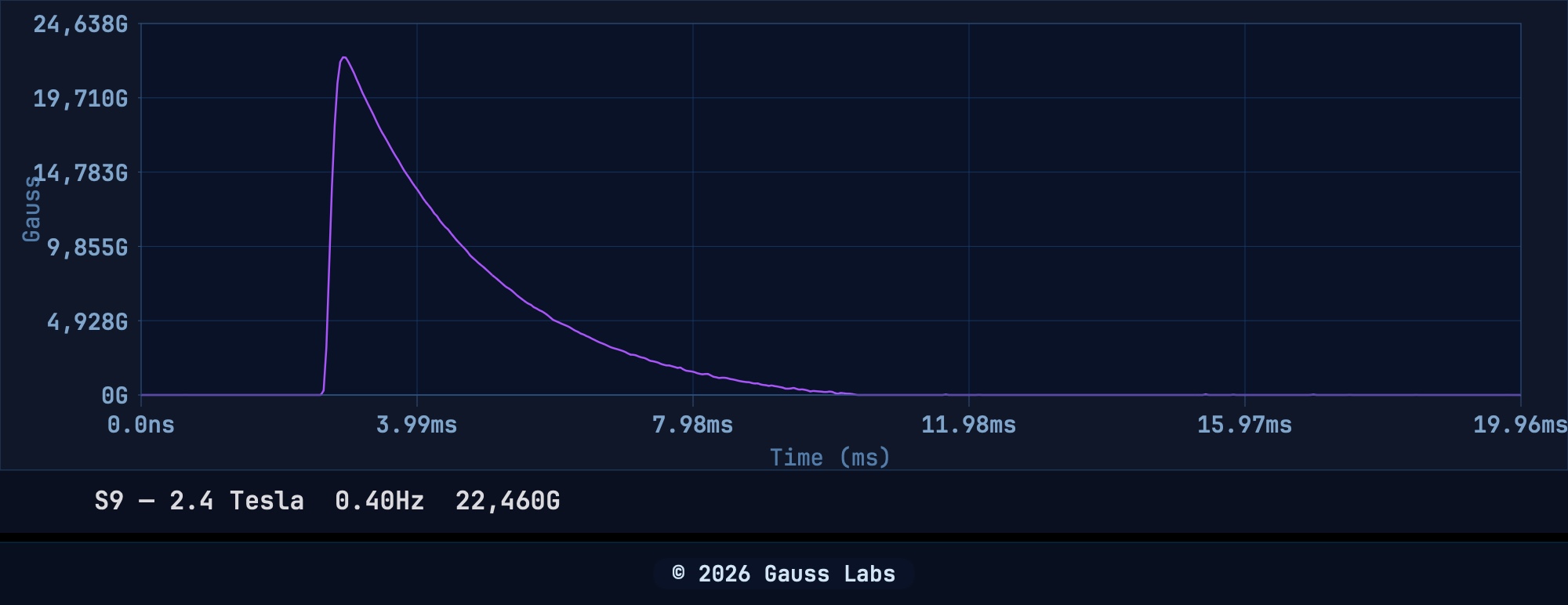
Each Gauss Labs certification is delivered as a complete report containing all charts, graphs, methodology, and analysis in distributable form. Alongside the report itself, you also receive every chart and graph as a separate high-resolution image file, ready to drop into your own spec sheets, product literature, marketing pages, and submissions without having to extract them from the report. Three example reports are publicly available so you can see exactly what you receive before committing to anything: a full device analysis with oscilloscope-captured pulse waveforms, a pancake coil accessory analysis, and a donut coil accessory analysis.
What it's worth to your business
Three things, mostly.
Sales conversations get shorter and end better. When a sophisticated buyer asks the hard question, you have a third-party certification to point at. Not just an internal measurement. Not just a marketing claim. You don't have to talk around the answer. The competitor who can't do this loses ground in every comparison where it comes up.
Your engineering team gets a calibration check. A second set of instruments and a second methodology measuring your product is independently useful regardless of marketing. Every manufacturer we've worked with has found at least one thing in the report (a per-setting behavior, a coil saturation curve, a pulse-balance asymmetry) that fed back into product improvement.
You build a moat the competition has to match. The first PEMF manufacturers in a given segment to publish third-party certification reports raise the bar for everyone else. The competitors who follow are doing so because they have to. The ones who don't follow start to look like they're hiding something even when they aren't.
Buyers can verify your certification independently. Every certified product is listed on the Gauss Labs certified clients directory . A buyer who sees your certification badge on your product page, your literature, or the product itself can click through and confirm it without having to take your word for it. That kind of independently verifiable trust signal is something a manufacturer-produced spec sheet structurally can't provide.
The plan: how engagement works
From first conversation to delivered certification, in four steps
- Schedule a Call. We discuss your device's coil count and geometry, drive scheme, machine settings, and the accessories you want tested. We send you a proposal with scope and timeline.
- Send Us Your Devices. We coordinate logistics so the equipment is handled correctly at every step.
- We'll Analyze Your Equipment. Multi-axis spatial scan at every relevant setting, oscilloscope pulse capture, electrical characterization, photographic documentation, and methodology notes.
- Review Your Results. The full report, every chart and graph from the report also delivered separately as high-resolution image files, certification badges for your literature and product labeling, and a listing on our public certified clients directory. The right to publish, distribute, and reference the report and badges freely.
If you want to see exactly what the deliverable looks like before you talk pricing, the three published example reports below are a complete preview. Same format, same depth, same methodology you would receive for your own product.
Talk to us about certifying your equipment.
Each proposal is tailored to your specific device and accessories. The initial conversation costs nothing, and we'll tell you up front whether your certification needs are a fit for what we do.
Schedule a Call See Example ReportsYour buyers are going to keep asking harder questions. The companies that can answer cleanly are going to keep winning more of those comparisons. The format of PEMF marketing is shifting, whether the industry as a whole admits it yet or not, and the manufacturers who get out ahead of that shift have a real, durable advantage over the ones who wait.