
Here's exactly what a certification engagement looks like.
When you send equipment to a third-party lab, you should know what the process is before it starts. Ours is four steps over about three weeks, with regular updates throughout.
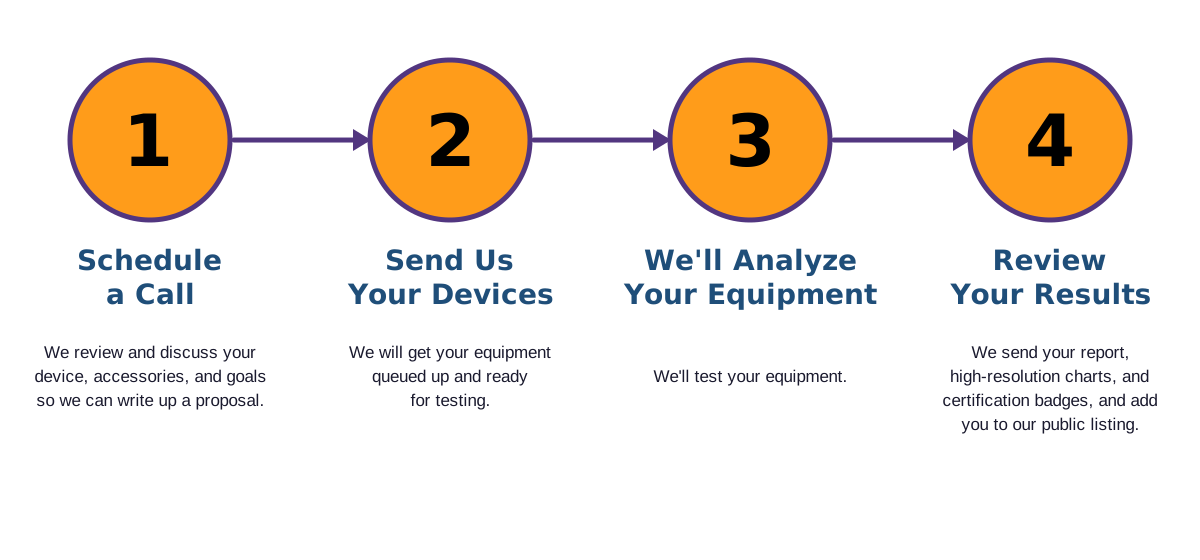
Step 1. Schedule a Call.
We start with a call to discuss your requirements. It runs 30 to 60 minutes. It's a working session, not a sales pitch.
We'll ask about your machine specs and which accessories you want tested. If you have internal test data, send it.
By the end of the call, you'll either have a proposal with a timeline in your inbox within a few business days, or a clear answer that we're not the right fit.
Step 2. Send Us Your Devices.
Once the proposal is approved, please ship your devices and accessories to Gauss Labs.
Send everything required to run the device across all settings: the unit, the accessories from the proposal, and the cabling, power supplies, or supporting equipment. Also send your product documentation (user manual, internal spec sheet, and any performance claims you've made about the device).
Step 3. We'll Analyze Your Equipment.
The analysis splits into two tests: Device and Accessory.
Device analysis focuses on the unit's waveform. What does each pulse look like? How fast does the field rise? How does it decay? Oscilloscope captures give us rise time, fall time, slew rate, peak dB/dt, and pulse balance. By Faraday's law, what stimulates tissue is the rate of change of the field, not the peak field. So a 5,000 Gauss pulse with a sharp edge can deliver more stimulus than a 21,000 Gauss pulse with a slow rise.
Accessory analysis focuses on the field at the accessory surface. Where does the field peak? Where does it fall off? Is coverage symmetric? Multi-axis scans answer those questions and produce a heatmap, a falloff profile, and spatial metrics: peak field, total effective flux, concentration score, effective field diameter, and field symmetry. We also measure the coil's electrical properties: resistance, inductance, and how quickly it charges up. Two accessories with the same peak Gauss can differ dramatically on these.
We run our tests on calibrated equipment using well-documented methods that can be repeated by another lab. We compare our test results to your documentation to verify that your device and accessory perform as expected.
The work usually takes two to three weeks for a single device with one accessory, and longer for larger portfolios. Your proposal has the exact timeframe.
Step 4. Review Your Results.
When the analysis is complete, the certification package lands in your inbox:
Step 5. We return your equipment.
Send us a return label. We'll carefully pack up your equipment and ship it back.
When buyers compare, certified manufacturers with clear charts and metrics tend to win.
The market is shifting, whether the industry admits it yet or not. Buyers know more every quarter. Competitors are publishing independent test data. When buyers compare two manufacturers, the one with a third-party badge and shareable charts and metrics tends to win.
Sales calls get easier once you can show your certification and charts.
When measurements come up, you can say you're Gauss Labs certified, and your buyers can verify it on the public registry themselves. Internally, the report becomes a working reference: your product team sees how the device performs at every setting, your engineering team has measured baselines to test future changes against, and your marketing team gets ready-made high-resolution charts to drop into spec sheets.
Our example reports show exactly what you'll receive, with the same format, depth, and methodology. The first call is a conversation about your device, with no commitment.
Talk to us about certifying your equipment.
Each proposal is tailored to your specific device and accessories. The initial conversation costs nothing, and we'll tell you up front whether your certification needs are a fit for what we do.
Schedule a Call See Example ReportsNow you know exactly what working with us looks like. Buyers are asking harder questions every quarter, and the manufacturers who can answer them clearly land more customers.