
Two discs can look identical from the outside, but the coil wound inside sets the field's shape.
You're looking at two discs the same size, and their peak Gauss values aren't close: the bigger one is over four times the smaller. It's tempting to read the bigger number as the stronger device. But both came off the same device. The coil inside the disc, not the device's power, set the peak.
A disc is just a housing. The coil it holds might be a pancake, a donut, or another shape entirely, and from the outside two discs can look the same. What you can't see is the wire inside, and that's what shapes the field.
The coil inside sets the field, not the housing.
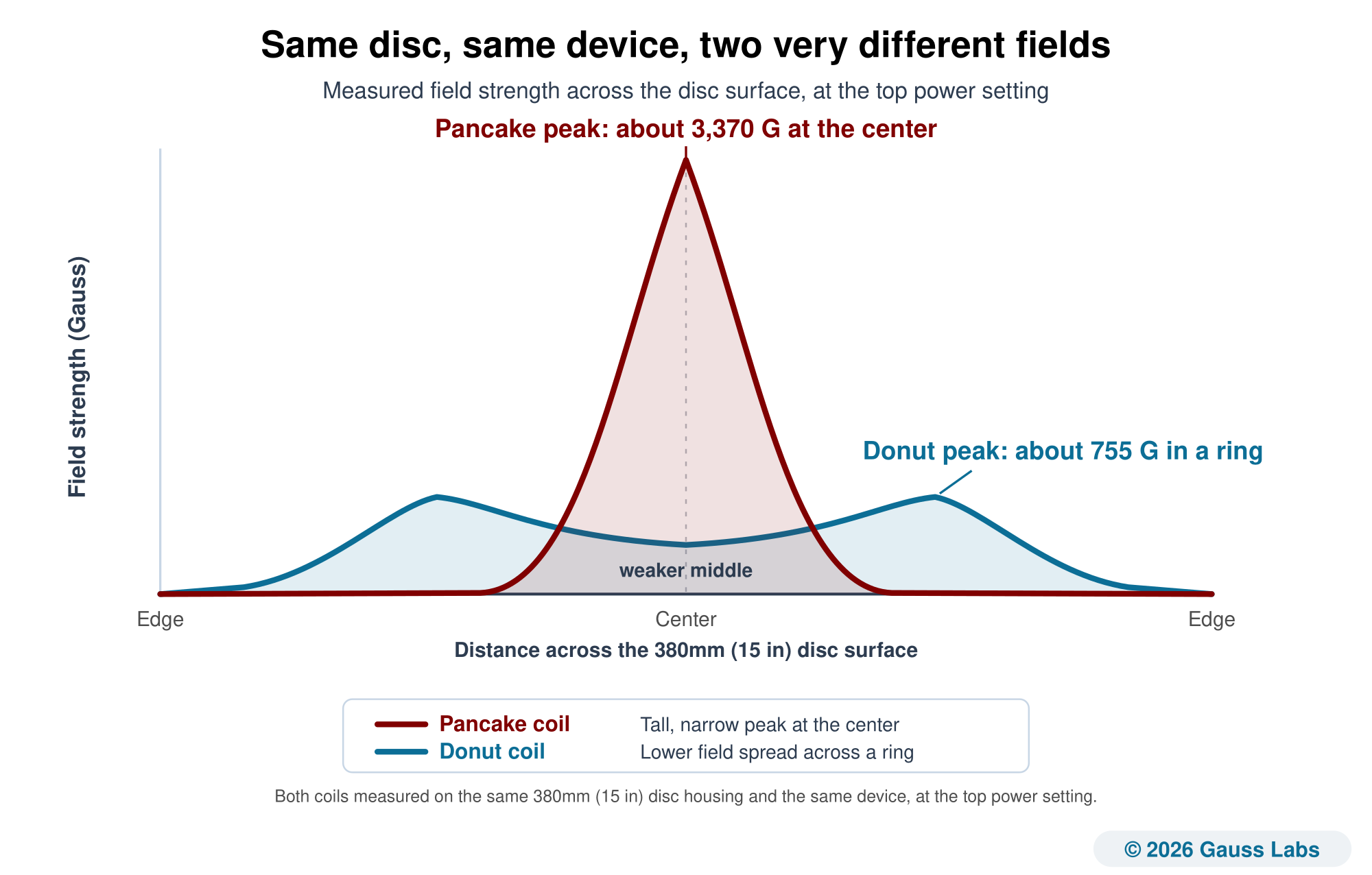
Current flowing through wire creates a magnetic field around it, so the field is strongest where the wire is. A pancake coil's wire spirals all the way in to the center, so the strength piles up there and falls off toward the edges. A donut coil is wound into a ring with an open middle, so the strength rises over the ring of wire and dips toward the center. Two discs of the same size can hold those two patterns, and the housing looks the same either way.
Those are the two curves above. Where the wire sits is the only thing that changed between them.
One disc peaks at the center, the other in a ring.
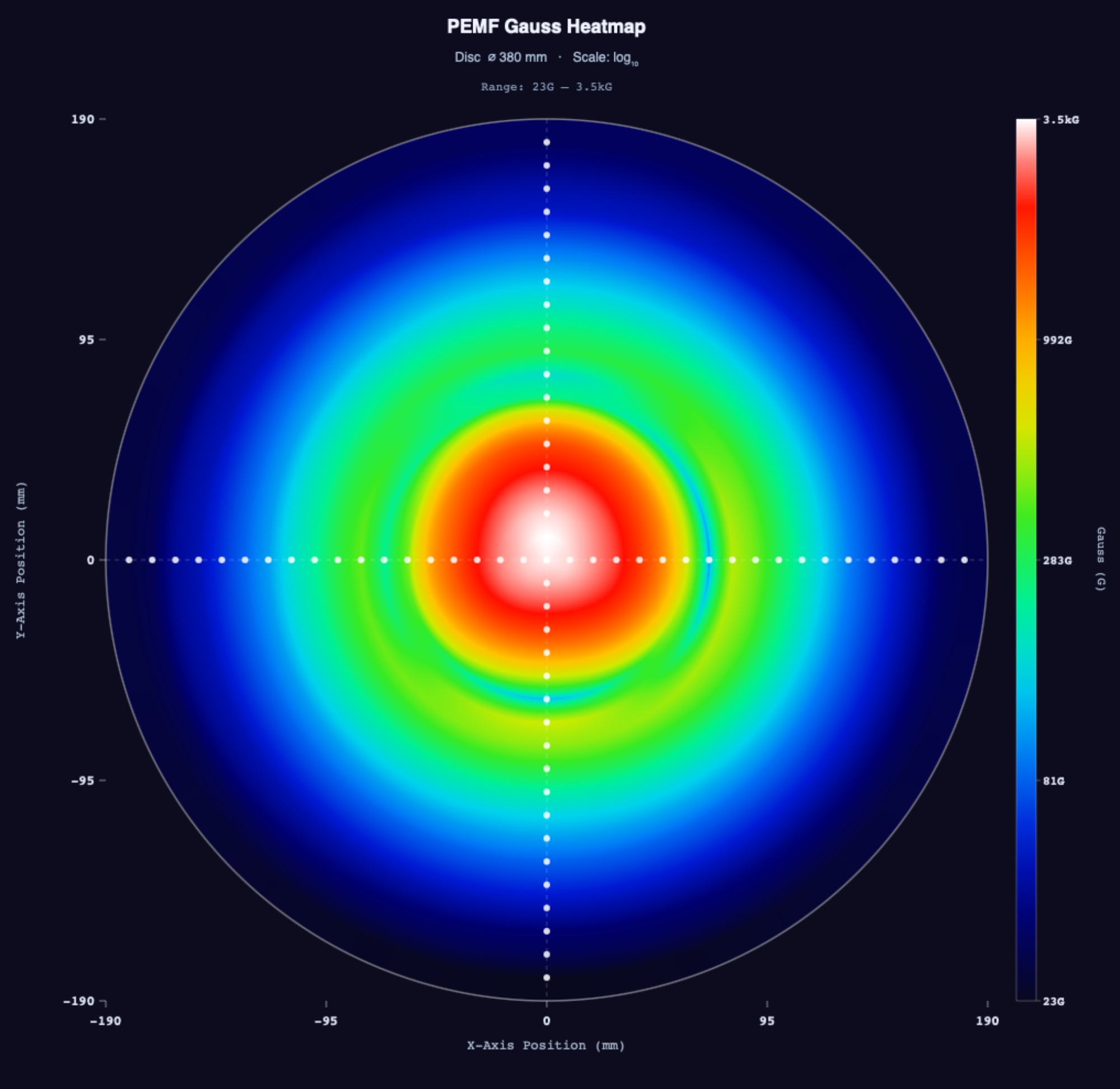
Pancake coil
Donut coil
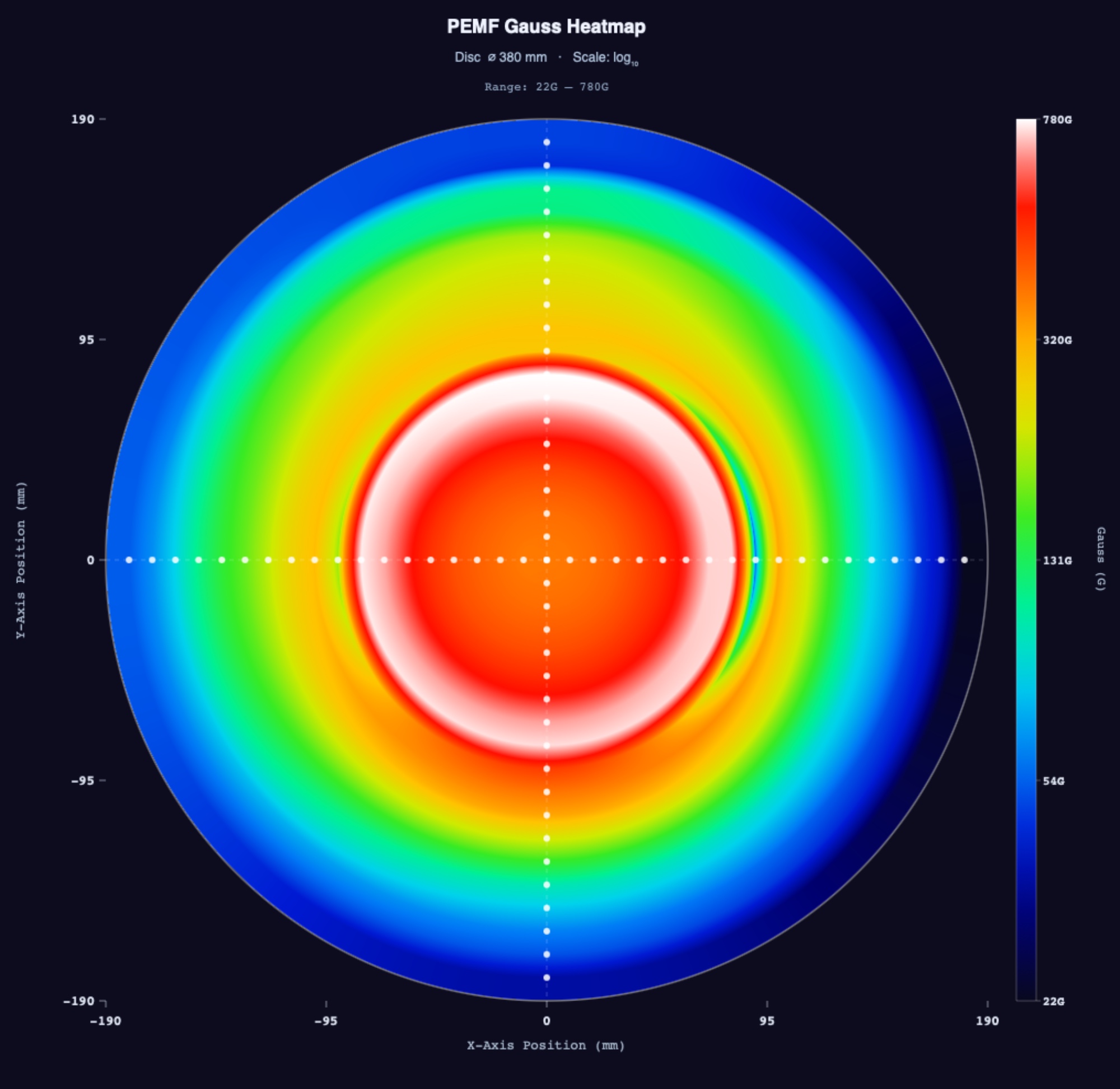
The pancake peaks at about 3,370 Gauss, right at the geometric center. The donut peaks at about 755 Gauss, out in the ring, and its middle measures roughly half of that. Same device, same disc size, same setting, and the pancake's peak is more than four times the donut's.
A higher peak means a more concentrated field, not a stronger device.
The pancake's turns all run in toward the center, so the field gathers into one tall peak there. The donut spreads the same drive across a ring of wire, and a ring of the same diameter holds fewer turns than a solid spiral, so the peak comes out lower and sits wider. A higher peak doesn't mean more total field. It means the field is packed into a smaller area.
You can see the trade in how wide each field reaches. The pancake's useful field is about 135mm (5.3 in) across, a tight zone built for a single small target. The donut's runs about 320mm (12.6 in) across, most of the disc, built to cover a broad area. The pancake concentrates. The donut covers. Neither one is the weaker tool.
Peak Gauss alone can't tell two discs apart.
This is why a single peak value is hard to compare across discs. You just saw one device produce both peaks, with nothing different but the coil. A peak value on its own can't tell you whether a disc runs strong or just runs concentrated. Line up two spec sheets that each print only that one figure, and you have no way to know which you're looking at.
So ask for the picture, not just the number. A heatmap or a falloff chart shows the field's shape in one glance. If the hot spot sits at the center, it's a pancake. If it forms a ring around a cooler middle, it's a donut. Once you can see the shape, match it to your target: a concentrated field for a small joint, a spread field for a broad area of soft tissue. The peak value never told you that part.
See both fields, side by side, in our example reports.
Our example reports lay a pancake and a donut out the same way: the heatmap, the falloff chart, and per-setting tables for strength, coverage width, and concentration. Set them next to each other, and a brochure that prints only a peak Gauss value shows its gap. It never says where the field peaks or how far it reaches, and those are the two things that tell you where the disc belongs against the body.
Ask which coil is inside, and ask to see the field.
A pancake and a donut can ship inside the same disc and produce very different fields. Our example reports show what each one looks like measured end to end, so you can choose the field that fits your target instead of guessing from a single number.
Schedule a Call See Example ReportsTwo discs can sit side by side and pass for the same product. The fields don't. Which one you reach for comes down to the coil inside, so that's the thing worth asking about.