
Every spec sheet says Gauss, but few of them mean the same measurement.
You're comparing two devices. One lists 20,000 Gauss, the other lists 800, and the first looks twenty-five times stronger. It might be. It might also be weaker. Until you know what each maker measured, the two values can't be compared at all.
In June 2026 we read the public product and testing pages of PEMF makers across the industry, from high-intensity coils to low-intensity mats, and logged how each one states its field strength. There is no shared convention. Most publish a single Gauss figure without saying how it was measured. A few publish a time-averaged value. At least one publishes nothing at all. The patterns below are real. The makers stay unnamed because the problem is the convention, not any one company.
The industry default is a single value with no label.
The most common pattern looks like this: "up to 20,000 Gauss," "5,000 Gauss at device output," "2 Tesla delivered at every pulse." The wording implies a peak, but nothing on the page says whether the value was measured or calculated, what instrument measured it, or where on the accessory it was taken. A value without its method can't be checked against any other maker's value. The comparison a buyer wants to make simply isn't available.
Part of this is equipment. An ordinary gauss meter can't capture a pulse that rises and falls in microseconds, so a maker without pulse-rated instruments may genuinely not know its own peak. The rest is choice. Either way, the buyer reads a confident figure that no one can reproduce.
Low-intensity mats add a different complication: their output is usually stated in microTesla. The conversion is simple (1 µT is 0.01 Gauss), and the unit choice is reasonable for small fields, but it's one more way two spec sheets fail to line up side by side.
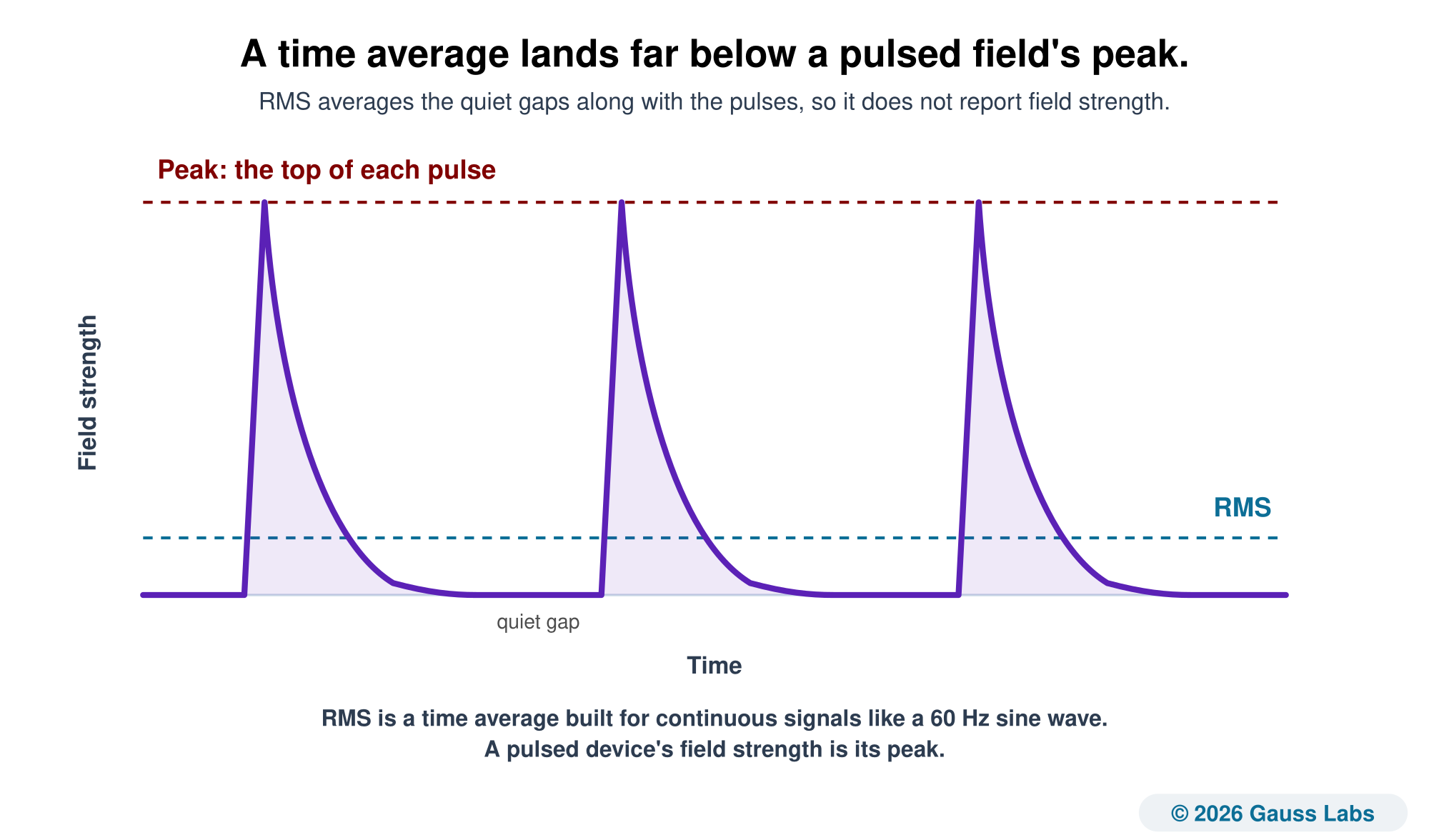
RMS is a time average, not a valid way to state a pulsed field's strength.
The peak is the top of each pulse, the strongest instant the field reaches. RMS is a time average built for continuous waveforms like a 60 Hz sine wave. A PEMF device doesn't produce a continuous waveform. It fires a short spike, then sits quiet until the next one. Averaging that signal folds each spike into the long quiet gap around it, so the RMS value lands far below the actual peak. How far below depends on the pulse shape and the duty cycle, the fraction of each cycle the field is actually on. Two devices with the same peak can publish completely different RMS values. Comparing RMS figures across devices compares their duty cycles, not their field strength.
Here's where the label starts to matter commercially. Field ceilings are written as peak values. The FEI, which governs international equestrian sport, permits low-frequency PEMF equipment at sanctioned events only below 1,000 Gauss. We found time-averaged values published in exactly the place you'd expect a small value to be useful: near a ceiling like that one. An RMS value below a limit doesn't show that the peak is below it. For a sharp spike, the peak sits far above the time average, and it's the peak the rule is written against.
To be fair to the metric: RMS isn't dishonest math. An RMS current or power is the right way to work out how warm a device runs, because heating follows average power rather than the peak. What an RMS value cannot do is state a pulsed field's strength. The problem is never the average itself. The problem is an average presented as a maximum, or a value published with no label at all.
Some publish no value and call it proprietary.
Some makers refuse the question entirely: no field-strength value anywhere, on the argument that intensity isn't efficacy. There's real physics in that position. Tissue responds to how fast the field changes (dB/dt), not to the field's steady strength; an MRI scanner's static field is enormous and induces no current in tissue, precisely because the field doesn't change. That much is true: a Gauss value by itself doesn't tell you what a device delivers to tissue.
But a blank spec sheet doesn't solve the problem the bare value created. It moves the problem onto you. The buyer who couldn't compare two values now can't compare anything, and there's no claim left to verify. The fix for a misleading value is context around it (the waveform, the rise time, the rate of change), not removing the value.
A few makers already report more carefully.
The survey wasn't all bad news. One maker publishes a peak measured by an outside lab and names the meter that captured it. Another separates two values its waveform actually contains: the brief spike at the pulse's front edge and the steadier level across the rest of the pulse. Neither one is the full picture, but both give the buyer something a bare figure never does: a hint of the waveform behind the value, and a way to ask the next question.
Four conditions make a Gauss value comparable.
Everything the survey found missing comes down to the same four conditions. They're the standard we hold our own reports to, and none of the spec pages we read meets all four.
Every comparable claim meets these four conditions.
- The metric is named. The value says what it is: a peak measured at the accessory surface, not an unlabeled "output" figure or an average presented without its label.
- The value is measured, and the method says how. A calibrated gauss meter, its probe held at a set standoff, captures the field at the surface; an oscilloscope traces the pulse shape; and the spec names both instruments (measured, not calculated from coil specs).
- The waveform is reported beside it. Rise time and slew rate sit next to the peak, because tissue responds to how fast the field changes, not to the headline value alone.
- The method is reproducible. The write-up carries enough detail that another lab could run the same test and land on the same value. A measurement no one can reproduce is an anecdote with units.
If you manufacture a device that measures well, these four conditions are your friend. A certified, reproducible peak with its waveform beside it is a claim your sales team can hand to a skeptical buyer and stand behind. If you're the buyer, the four conditions are your checklist: any spec sheet that meets them can be compared, and any that doesn't can't, no matter how large its value prints.
Publish a value a buyer can trust.
We measure the peak with named instruments, report the waveform beside it, and document the method so it can be reproduced. Our example reports show what that looks like, end to end.
Schedule a Call See Example ReportsThe unit was never the problem; a Gauss is a Gauss. What varies is everything around the value: what was measured, with what, during which slice of the pulse. Until the industry settles on a convention, read every spec sheet on its own terms. It says Gauss, but it rarely means the same measurement as the one next to it.