
When a seller shows you a PEMF certification, check whether it covers the device or the person running it.
You're on a product page that says certified, and there's no obvious way to tell what that word is covering. Sometimes it's the practitioner who finished a training course, and sometimes it's the device and the accessory it was measured with by an impartial lab. Only the second one tells you anything about the equipment you'd be buying, so here's how to tell them apart.
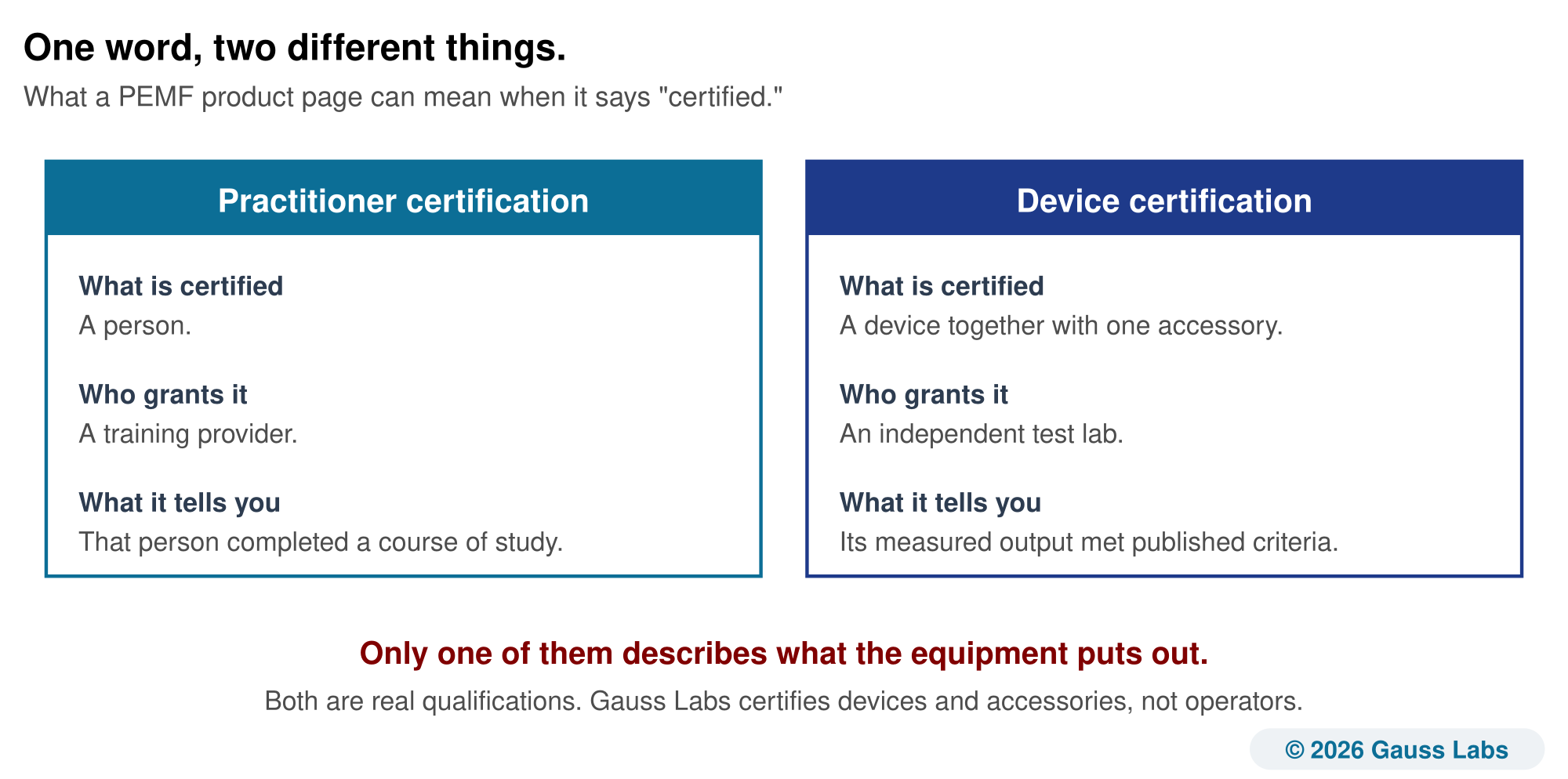
One certificate covers the person running the session, and the other covers the device.
A practitioner certificate means someone finished a training course, usually run by a training provider or by a manufacturer, and holds the document to show for it. That tells you how the person running your session was taught, which is worth knowing when you're booking one.
A device certification records what an independent lab measured coming out of a specific device with a specific accessory fitted, and whether those measurements met a published set of criteria. That's the one to look for if you're buying, since a well-trained operator can't change what the device puts out.
Gauss Labs certifies devices and accessories. Every listing on our registry records what we measured from a device with an accessory fitted to it.
A certification covers a device and the accessory it was measured with.
A PEMF system has two halves, since the device generates the pulse and the accessory carries the field to the body, and the peak field and the shape of the field come out of the two working together. Swap the accessory and the measurements change with it. That's why one device sold with two accessories ends up with more than one certification.
This matters while you're shopping. If the accessory in your cart isn't the one on the listing, the listing doesn't describe what you're about to buy, so ask the salesperson which pairing was certified.
You can read every criterion a pairing was judged against.
A device certification is a set of criteria applied to measured data rather than a grade somebody assigned, and every listing on our public registry shows those criteria, written as plain sentences:
- The pulse has a real, functional rising edge, the basic requirement for any PEMF device.
- The device runs at a deliberate therapeutic frequency, clear of power-line interference.
- The operating frequency sits within a recognized therapeutic band.
- The device produces a clean, well-formed pulse.
- The accessory delivers a therapeutic field strength to the body.
- The field reaches the body evenly in every direction around the accessory.
- The measured performance stays within tolerance of the documented specification.
Not every criterion applies to every item, since a device listing and an accessory listing are judged on different things, and a criterion the data can't speak to is marked not evaluated rather than counted against the device. So a listing tells you what was examined as well as what passed, which is why it's worth opening the one that covers the item in your cart.
The measured values behind those criteria stay with the manufacturer, since a report belongs to the company that paid for it. What goes public is the certification, the pairing it covers, and the checklist.
A certification can also record an outside limit the pairing stays under.
Alongside our own criteria, a certification can record that a pairing's measured field stays under a limit somebody else publishes. The Fédération Équestre Internationale (FEI), the governing body for international equestrian sport, caps the field of a PEMF device used around a competition horse at 1,000 Gauss, and that FEI Gauss Limit is the one standard on our registry today. You can filter the registry by standard to see which pairings conform, and each conforming certification is marked on its card.
Whether a pairing clears that limit depends on the pairing rather than the device alone, since the peak comes from the driver and the coil working together, so no device is "FEI approved" by itself. And our certification records a measurement against our own criteria rather than an endorsement by anyone else. That distinction matters more this autumn than usual, since the FEI is considering a proposal to lower the limit, which we cover in a companion post on the 100 Gauss proposal.
Telling the two apart takes about a minute.
Four questions that tell you which one you're holding.
- Who or what is named on it? If it names a person, it covers training. If it names a device model and an accessory, it covers the equipment.
- Who issued it? A training provider certifies people. An impartial test lab certifies equipment.
- Can you open it without asking anyone? A device certification should have a public page you can reach on your own, with a number matching whatever the seller showed you.
- Which pairing does it cover? Check that the accessory you intend to buy is the one the certification was measured with.
Neither certificate does the other's job, and a clinic can reasonably want both. What you can't do is read one and take it as an answer about the other.
Want your device certified on what we measure?
We measure your device with each accessory you sell and publish the certification and its checklist on a page any buyer can open. Your measured values and your full report stay with you. If you'd like to see what the measurement work looks like, our example reports are open to read.
Schedule a Call See Example ReportsWhen a page just says certified, ask what was certified. If the answer is a device and an accessory, the page behind it is public, so open it.