
Is PEMF safe? Three measurements show what a device puts out, and your clinician can answer the rest.
You're about to buy a PEMF device, and before price or features you want to know whether it's safe. Whether a session suits your body depends on your health history, so that part belongs with your clinician. What we measure is the equipment: how strong the field is, how fast it changes, and how much heat the coil makes. Those three come up whenever safety is discussed, and here's what each one means, using a device we measured.
Field strength is the size of the field at its peak.
We measure strength in Gauss. We measured our in-house tester driving its Classic 3-inch strip coil at all nine of its power settings. At the lowest setting the field peaks at 10,450 Gauss (1.05 T). At the highest it peaks at 22,410 Gauss (2.24 T).
That's the same device and the same coil, and the field more than doubles across the dial. So a strength figure only means something with its setting and its accessory attached, because the field comes from the two working together.
Safety limits are built on how fast the field changes.
A changing magnetic field induces a small electric field in nearby tissue, which Faraday's law explains. The faster the field changes, the stronger that induced field. That is why the International Commission on Non-Ionizing Radiation Protection (ICNIRP) writes its low-frequency exposure limits around the induced field, and why the International Electrotechnical Commission (IEC) limits the rate of change in its standard for magnetic resonance imaging (MRI) equipment, 60601-2-33. Both come from medical imaging and workplace exposure, so they work as a reference point for how fast a field changes and not as a pass or fail mark for a wellness device.
We measure the rate of change as slew rate, the average slope of the pulse as it rises, read from an oscilloscope capture. On the same coil, the lowest setting climbs at 48.7 G/µs and the highest climbs at 109.3 G/µs.
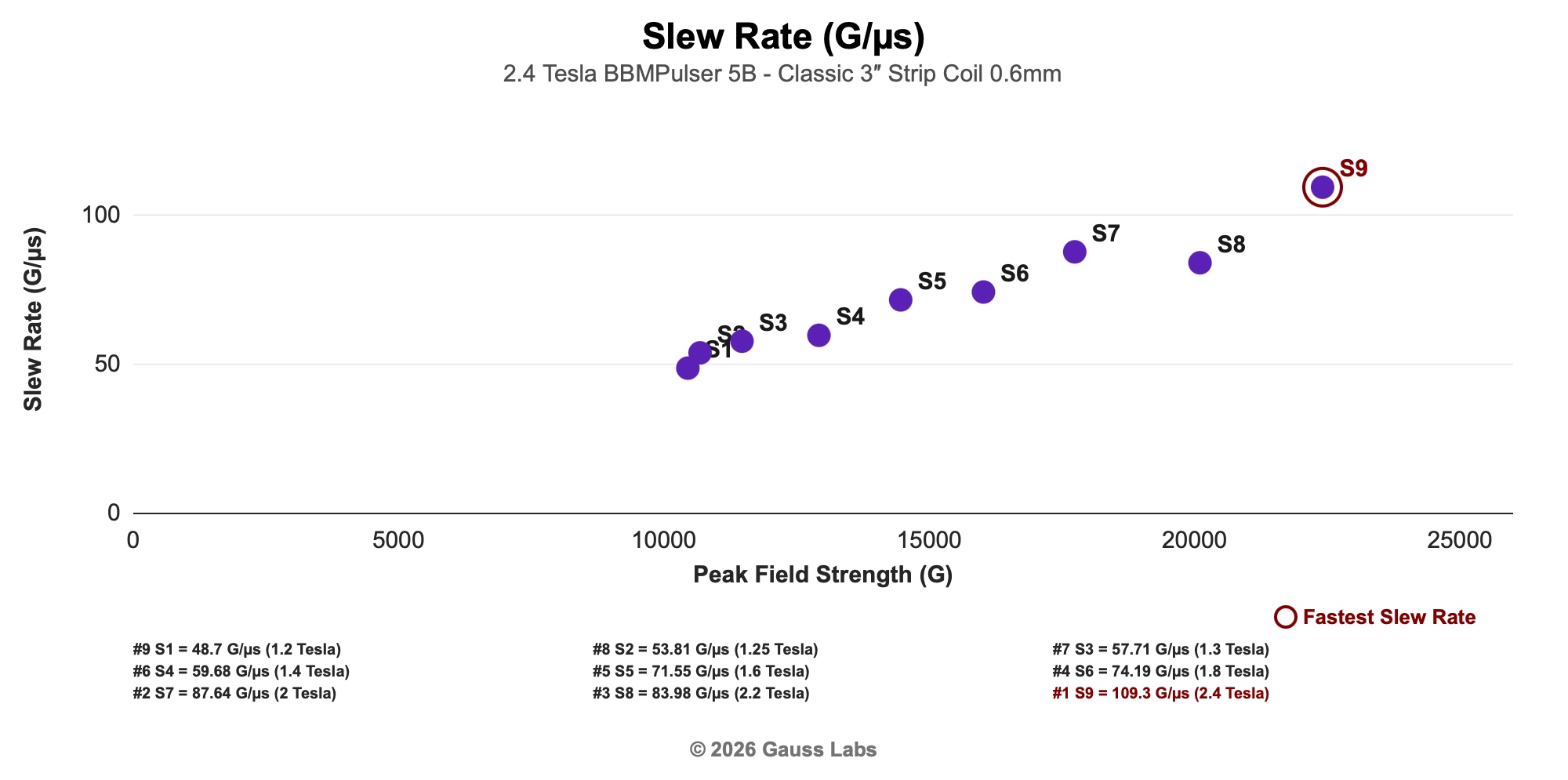
Slew rate compares one setting or device with another. The limits are written against the sharpest instant of a pulse, which is a different reading from an average slope. Our post on how PEMF works goes further into why the change matters more than the height.
Thermal load is how much heat the coil makes.
Every coil turns part of its drive into heat. We calculate it from the coil's resistance and the current through it, then place the result in a low, moderate, or high band of thermal load. The temperature you'd feel on the surface also depends on the coil's area, how it's mounted, and how it's cooled, and the general safety standard for medical electrical equipment (IEC 60601-1, Clause 11) measures that directly under defined conditions.
Two more things matter for heat. A higher duty cycle delivers more energy and makes more heat. And a device that overheats can cut its own output, which is called thermal throttling, so the field late in a session can be lower than at the start.
A public listing shows what was measured.
Our certification records what Gauss Labs measured from a device with a specific accessory fitted, also referred to as a pairing, and whether the results met a published set of criteria. One criterion is that thermal load stays out of the high band. Where a sealed unit gives us no electrical readings to calculate from, that criterion is marked not evaluated, so a listing shows what was examined as well as what passed. Our post on what a PEMF certification covers explains how to read one.
Ask four questions before you trust a safety claim.
- "Which accessory and setting do these numbers describe?" On the coil above, the lowest and highest settings differ in both strength and edge speed, so a figure with no setting attached could describe either.
- "How fast does the field change, and how was that read?" Strength alone isn't the quantity the limits are based on, and a rate quoted without the points it was read between can't be compared with another.
- "How was the heat figure found?" A calculation from current and a surface-temperature reading answer different questions, and the page should say which one you're reading.
- "Who measured it, and can I look it up?" A seller's own figure and a figure measured by Gauss Labs are different kinds of evidence, and a public listing lets you check what the certification covered against what you were shown.
Questions about your own body go to your clinician.
Whether a session is right for you depends on your health history and whatever else you're using, and a clinician who knows you is the person to help you decide. If you have a pacemaker or another implanted device, ask your clinician about PEMF before you buy a device.
Want your device's output measured and published?
We measure the field a device and accessory produce at every setting, and we publish the certification and its checklist on a page any buyer can open. Your measured values and your full report stay with you. If you'd like to see the measurement work first, our example reports are open to read.
Schedule a Call See Example ReportsWhen a page tells you its device is safe, ask what was measured, with which accessory, and who measured it.