
A PEMF mat makes a magnetic field and a grounding mat connects you to earth. Only the first gives a lab something to measure.
A PEMF (pulsed electromagnetic field) mat and a grounding mat can look nearly identical in photos. Both lie flat, both go under you on a bed, and both are sold as wellness purchases, so it’s fair to ask whether they’re the same product. They aren’t, and the difference shows up in what a lab can put a probe on.
PEMF mat vs grounding mat: what each one does.
A grounding mat gives you a conductive connection to the earth. A multi-coil mat works differently: it holds several coils, and when the device drives them, each coil makes a magnetic field that rises and falls in pulses while you lie on the pad.
A changing magnetic field creates a small electric current in nearby tissue, as Faraday’s law describes, and the faster the field changes, the stronger that current. That’s what PEMF is built on, so a PEMF mat is judged by the field it makes. We go further into why the change matters more than the height in our post on how PEMF works.
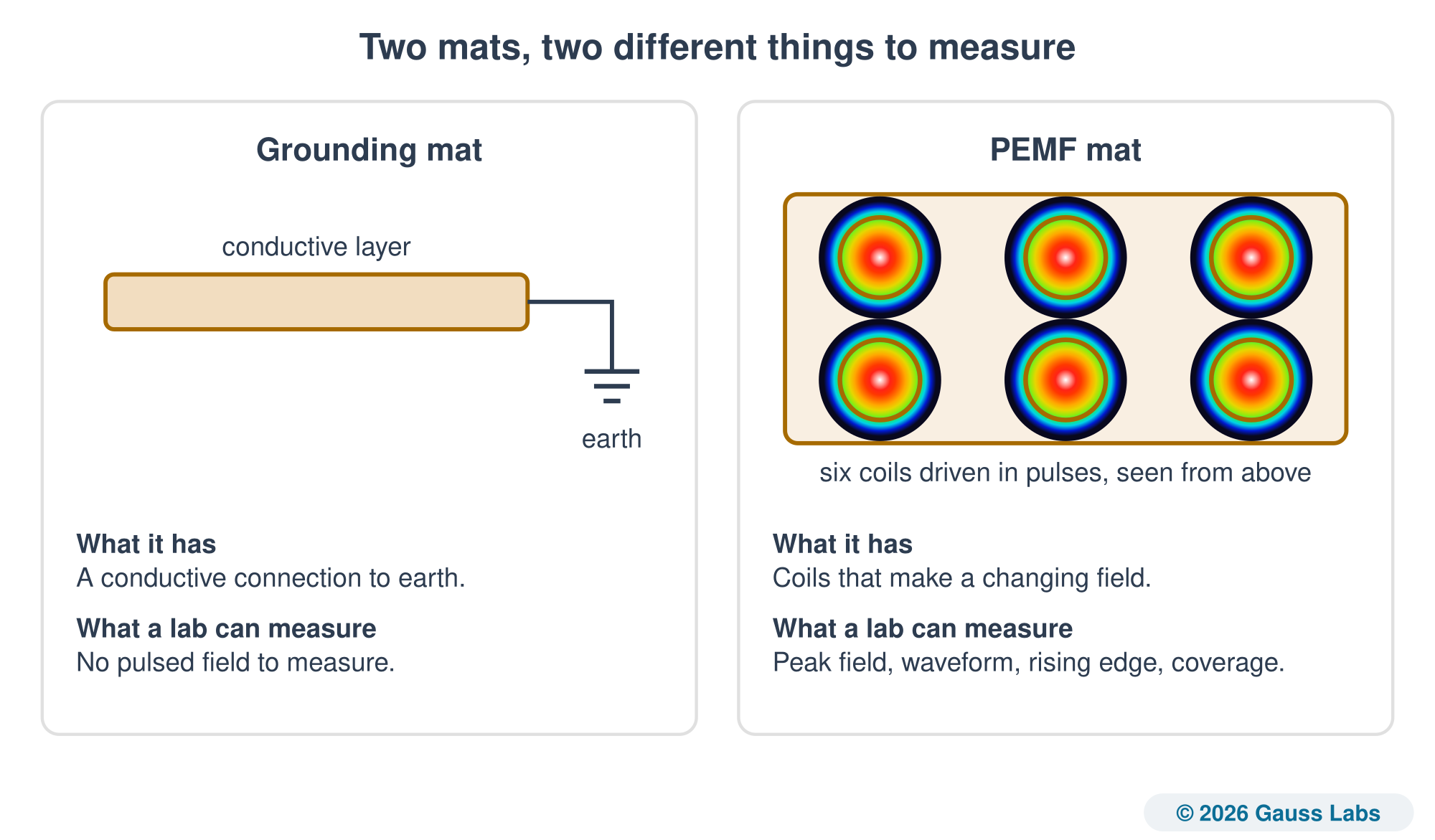
A PEMF mat gives a lab five things to measure.
Because a PEMF mat makes a field, we can put a probe (the sensor that reads field strength) in it and capture its pulses on an oscilloscope. A mat’s report measures and maps every coil individually rather than the pad as one big coil, and it reads these five:
- Peak field strength. We find the highest field each coil produces at the surface of the mat, in Gauss (G), which is its peak field strength.
- Waveform. An oscilloscope (an instrument that draws a signal over time) shows us the shape of the pulse the coil actually makes, and that waveform type is usually not the shape the device drives into it.
- Rising edge. From the same capture we read the rise time, how quickly the field climbs to its peak, since the induced field follows how fast it changes.
- Coverage area. We report how much of the mat surface carries a meaningful share of the peak field, which is its coverage area.
- Coverage uniformity. We compare the peaks from coil to coil, and coverage uniformity reports how consistent they are.
A grounding mat gives our instruments none of those readings, because it doesn’t make a pulsed field to measure.
This is about what our lab measures, not about whether either product works. Grounding has its own claims and its own discussion, and we don’t weigh in on it. We measure fields, so a grounding mat sits outside what we test.
On a PEMF mat, the coil count on the box describes the hardware and says little about what reaches you, as we explained in our post on coil count. And a sealed mat can still be measured from the outside, since the field sits in the air above the pad (we walk through how).
Ask either seller what was measured.
Whichever mat you’re leaning toward, the same habit helps: ask what the seller can show for what the product does.
Four questions to ask about either mat.
- “Is this mat a field or a connection?” A seller should be able to say in one sentence which of the two the product provides.
- “If it makes a field, what was measured?” Ask for the peak, the waveform, the rising edge, and the coverage, each with the setting and the distance it was read at.
- “If it’s a connection, what was checked?” Ask what the seller can show for the connection itself.
- “Who did the measuring?” A seller’s own figure and an independent lab’s are different kinds of evidence, and a listing on our public registry shows what was verified on a PEMF product.
Want your PEMF mat’s field measured and published?
We map a mat coil by coil, at every setting and every height we measure, and we publish the certification and its checklist on a page any buyer can open. If you’d like to see the measurement work first, our example reports are open to read.
Schedule a Call See Example ReportsBefore you compare two mats, ask whether each one is a field or a connection, and what the seller measured to show it.