
"Calibrated" should mean you can trace the measurement back to a standard.
You've seen the phrase on every lab's page and half the spec sheets in your category: calibrated equipment. It shows up so often that it has stopped meaning much. So what should it actually tell you?
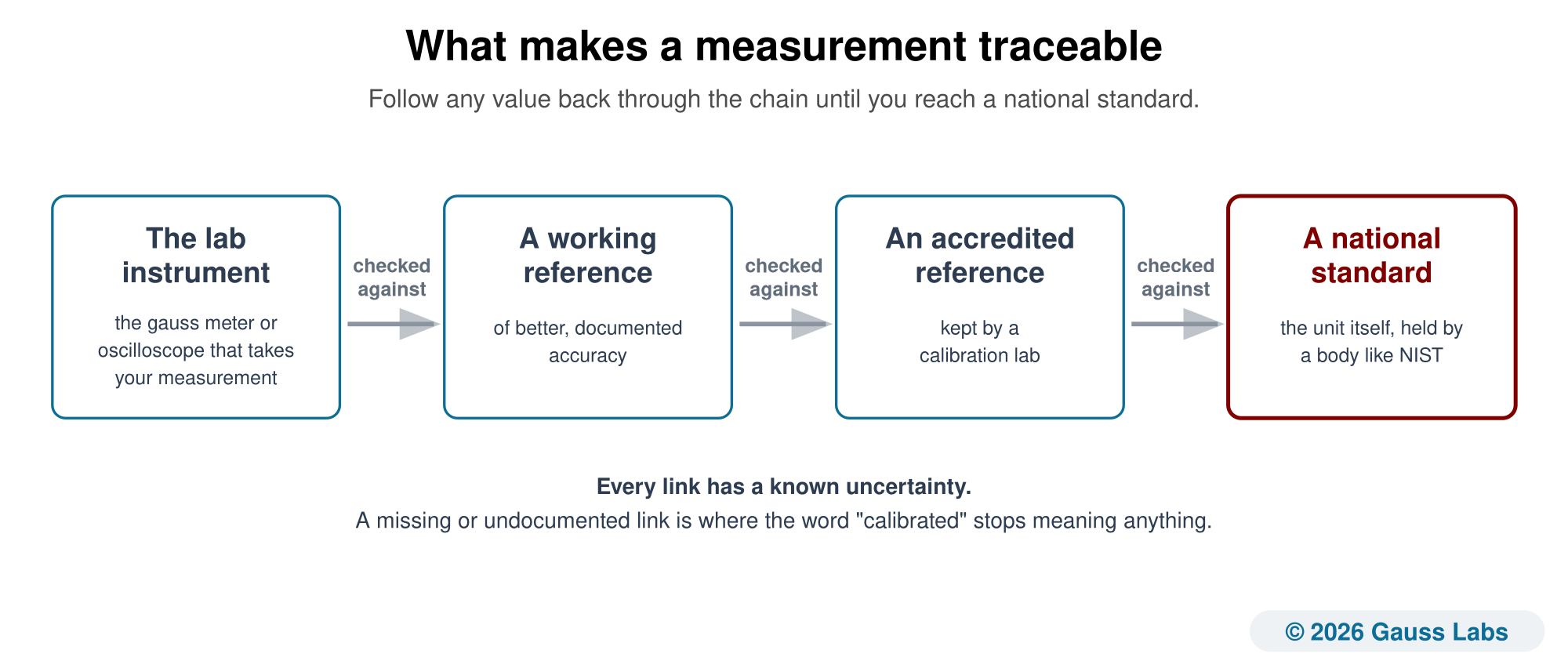
Calibration checks your instrument against something more accurate.
Calibration is a check. You compare what your instrument reads against a reference that's known to be more accurate, then record the difference and correct for it. And it isn't one-and-done. Instruments drift over time: components age, a probe gets knocked, temperatures change. A meter that read true last year can be a few percent off today. That's why a trustworthy measurement comes with the date the instrument was last checked.
The reference needs a reference of its own.
Checking against a reference only helps if that reference is trustworthy too. So that reference is checked against something even more accurate, and so on up the line, until the chain reaches a national standard. In the United States that's NIST, the body that defines the official unit. Every link in that path is documented, including how far off it might be. That is what traceability means. Miss one link, and the reading at the start of the chain can't be trusted.
Traceability decides whether your performance claims survive a second look.
This is the part that lands on you as a manufacturer. When you publish a performance value, you're inviting a check. A procurement team forwards your spec sheet to an engineer. A distributor goes looking for a weak point. Another lab measures the same unit. If the instruments behind your value are traceable, it holds up against all three. If they aren't, the first hard question is one you can't answer.
Four questions that turn "calibrated" into something you can stand behind.
- Calibrated against what? Ask the lab to name the reference each instrument was checked against, not just claim that it was.
- Traceable to which standard? Naming a reference isn't enough. It should trace back through a documented chain to a recognized national standard.
- To what uncertainty? A real calibration states how far the instrument could still be off. A calibration with no uncertainty attached isn't finished.
- Documented where? The instruments, dates, and uncertainties should appear in the report itself, where a buyer or another lab can read them.
These work on any lab you hire, and they work on us.
We document the equipment behind every measurement.
Every Gauss Labs report lists the equipment behind the measurements: the meter, the probe, and the oscilloscope. It also spells out the method, so another lab could repeat the test and check our work. That's traceability in practice. You don't have to take the result on our word, because the evidence is right there in the report.
See the instruments and methods inside a real report.
Our example reports lay out every instrument, method, and uncertainty we used, the same way your own report would.
Schedule a Call See Example Reports"Calibrated" is easy to print. A measurement you can follow back to a standard is the one worth trusting, so ask for that chain, on your own equipment and on anyone else's.