
Three new PEMF certifications went on the public registry in August, and you can open all three listings yourself.
When a seller tells you a PEMF system has been tested, the testing and the claim about it usually come from the same company, which leaves you nothing to check the claim against. So every certification Gauss Labs grants gets its own page on a public registry, naming what was measured and which criteria it cleared.
One device and two accessories went up on August 13.
All three belong to Spectra PEMF LLC, which became the sixth manufacturer on the registry, and each is listed as active.
- Spectra Apex HSR, device certification, D2607221753. Measured with the Full Body Mat and with the Ring Attachment. See the listing.
- Ring Attachment, accessory certification, A2607261148. Measured with the Spectra Apex HSR. See the listing.
- Full Body Mat, accessory certification, A2607221817. Measured with the Spectra Apex HSR. See the listing.
That brings the registry to six manufacturers and 29 active certifications. Every new certification gets the same listing in the same order, whoever it belongs to.
A certification covers a device and an accessory together, not a device on its own.
A PEMF system has two halves: the device generates the pulse, and the accessory carries the field to the body. The peak field, the pulse edge, and the shape of the field all come out of the two working together, so change the accessory and the measurements change with it. That's why a certification names the pairing it was measured in rather than clearing the device on its own, and why one device and two accessories produced three separate listings this month.
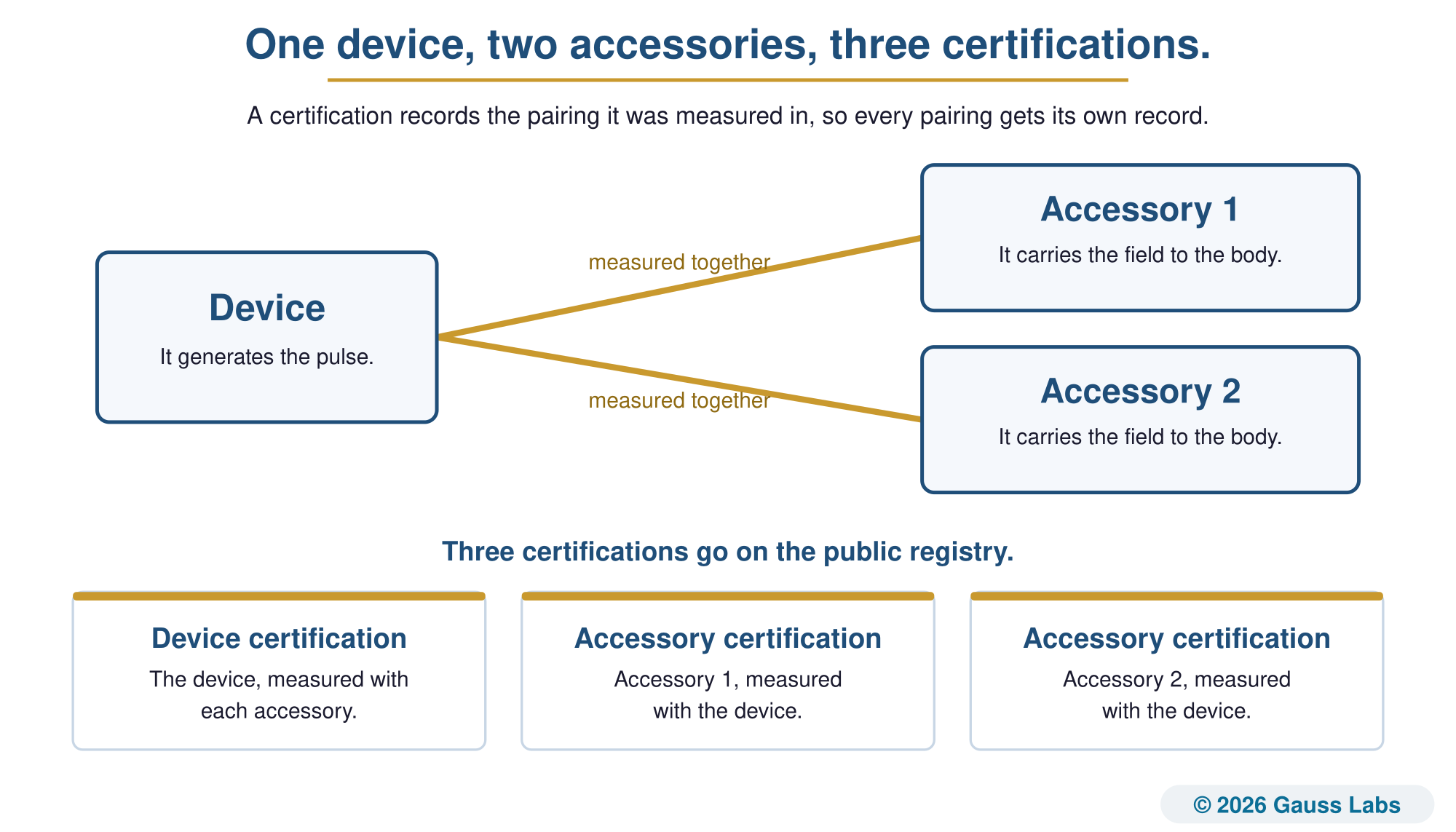
This matters while you're shopping, because a company can certify one pairing and sell you a different one. If the accessory in your cart isn't on the listing, the listing doesn't describe what you're about to buy. Ask the salesperson which pairing was certified, since that question has an answer you can check.
The checklist is the part of a certification that's yours to read.
Each listing shows the criteria the pairing was judged against, written as plain sentences rather than lab shorthand. They cover the pulse, the field that reaches the body, and whether the measurements agree with the manufacturer's own paperwork:
- The pulse has a real, functional rising edge, the basic requirement for any PEMF device.
- The device runs at a deliberate therapeutic frequency, clear of power-line interference.
- The operating frequency sits within a recognized therapeutic band.
- The device produces a clean, well-formed pulse.
- The accessory delivers a therapeutic field strength to the body.
- The field reaches the body evenly in every direction around the accessory.
- The measured performance stays within tolerance of the documented specification.
Not every criterion applies to every item, since a device listing and an accessory listing are judged on different things, and a criterion the data can't speak to is marked not evaluated and never counts against the device. So a listing tells you what was examined as well as what passed, which is why it's worth opening the one that covers the item you're looking at.
The measured values behind those criteria stay with the manufacturer, since a report belongs to the company that paid for it. What goes public is the certification and its checklist.
Checking a certification takes about a minute.
How to check a badge you've been shown.
- Open the registry. Every certified company has its own page under gausslabs.tech/client-certifications/.
- Find the item, not just the company. A company page lists each certified device and each certified accessory separately.
- Match the certification number. The number printed on a badge or a spec sheet should be the number on the page.
- Check the pairing. Confirm that the accessory you plan to buy is one the certification was measured with.
This post runs every month.
Next month's edition lists what goes on the registry in September, in the same form: company, item, certification type, number, date, and a link to the page.
Want your device on the registry?
We measure your device with each accessory you sell, and the certification and its checklist go on a public page any buyer can open. Your measured values and your full report stay with you. Our example reports show what the measurement work looks like end to end.
Schedule a Call See Example ReportsIf a seller shows you a badge, the page behind it is public. Open it and read the record.