
One line of readings can't tell you if an accessory is stronger on one side.
If you've checked an accessory with a handheld gauss meter, you measured one spot, and the value you got depends on where you held the probe. We map the whole surface instead. A probe on our CNC sweeps four lines of readings out from the center, and comparing those four is how an uneven field turns up.
Nobody holds the probe by hand.
A gauss meter probe reads the field at one point, so we build a map of the surface one point at a time. The probe goes in a jig or on our CNC, because the standoff distance, the gap between the probe tip and the accessory surface, has to be the same for every reading. A probe that drifts a millimeter closer reads higher for reasons that have nothing to do with the accessory, and no hand holds a gap that steady across a whole scan.
From the geometric center we step the probe outward, stopping at each scan point a set distance from the last, and that row of readings is a scan line. Four of them run out from the center, one in each direction along the two horizontal axes. Together they make up the multi-axis scan.
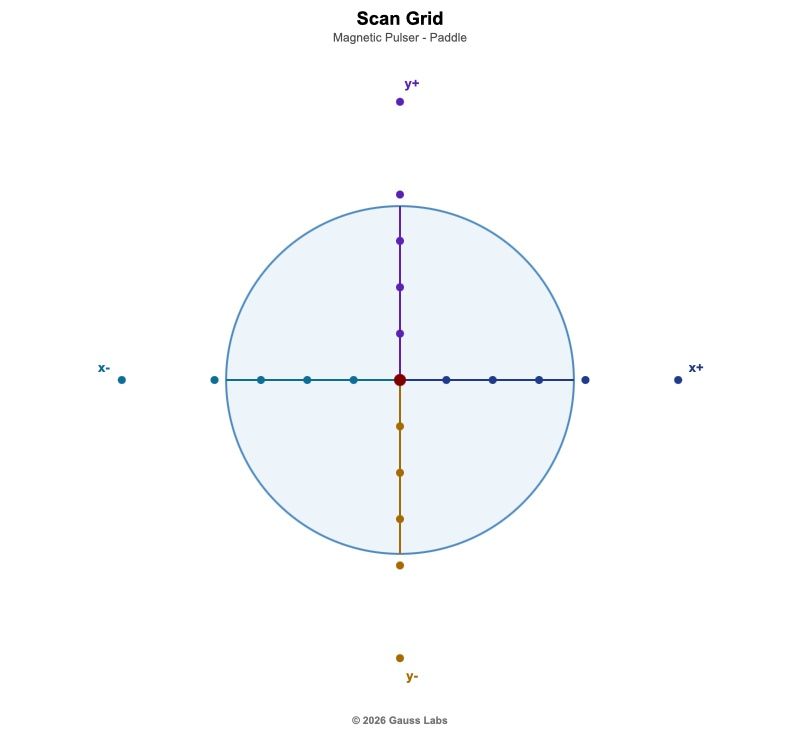
A curve from one line always looks even.
Run one line across the middle of an accessory and you learn how fast the field falls off along it. Drawn as a curve, that is a mirrored falloff profile, and it looks even on both sides of the center because one set of readings got mirrored, not because the accessory is even.
Field symmetry is what four lines give us that one can't. At each distance from the center we compare the four readings against their own average, and the closer they sit to it, the higher the score. We report it for round accessories like discs and loops, since a mat is a different shape and gets coverage measures instead.
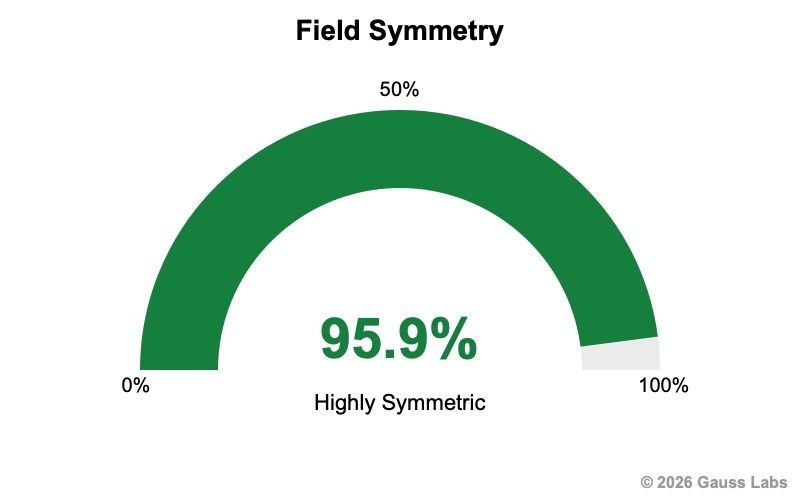
The Paddle scores 95.9 percent, so the field reaches evenly in every direction with almost no bias to one side. Turn it whichever way you like against the body and you get about the same field. A lower score would mean the field runs stronger in some directions than others, and we'd want that back with the build rather than in a customer's hands.
Four lines give us five values and a map.
Those four lines feed the spatial half of the report. Here's what they produced on the Paddle:
- Peak field strength, 7,120 Gauss. Nothing in the scan grid read higher, and it's the one value most spec sheets already carry.
- Effective field diameter, 56.4mm (2.2 in). A standard measure of coverage, marking the span where the field is still at least a tenth of its peak. The two boundaries behind it come off the same scan lines.
- Concentration score, 77.2 percent. How tightly the field focuses near the coil surface. It's a surface measure, not a depth measure.
- Total effective flux, 0.911 milliwebers. All the magnetic flux across the coil area out to its boundary. Flux is a different quantity from field strength, and it doesn't convert to Gauss.
- Field symmetry, 95.9 percent. How evenly the field spreads across all four axes.
Those five describe the same accessory from five directions: how strong the field gets, how far it usefully spreads, how tightly it focuses, how much field it puts out in total, and how evenly it reaches on every side. No one of them substitutes for the rest, and only the last needs all four scan lines to exist at all.
Alongside the values, the scan draws a heatmap, a color-coded map of the surface with warm colors marking the strongest field. The values tell you how one accessory compares with another. The map is what you look at when you want to know why.
The gaps between the lines are drawn, not measured.
Look back at the scan grid, then at the heatmap the same report produces. The grid is four arms of dots. The heatmap is a filled disc with nothing missing from it, so everything off those four arms was worked out from the readings on them.
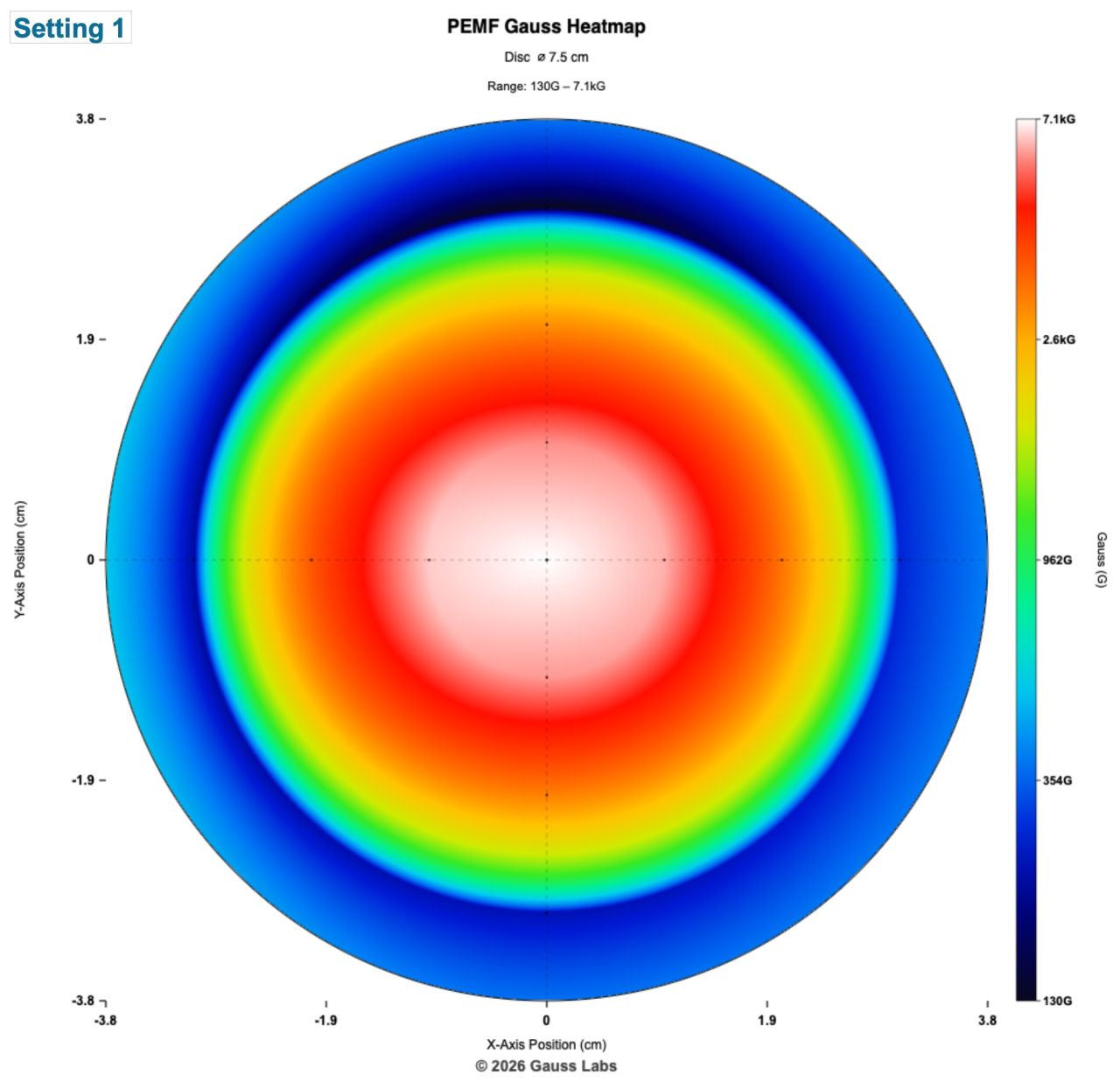
That's fair as long as the picture says how it was filled. This one rebuilds the field from the nearest scan lines and draws it round, which suits this accessory, because its four axes agree closely. On a mat the choice matters more, since the coils sit apart and the scan lines don't cross every one of them, so our public 3D viewer offers a choice of reconstructions of the same scan and names the one each picture uses. All of them draw the same measurements different ways. None of them adds a reading nobody took.
Four questions to ask about any field map.
- Ask what held the probe, and how far off the surface. Readings taken closer look stronger for no other reason, so a map without a standoff distance can't be compared to anything.
- Ask how far apart the readings were. A coarse scan can step straight over a narrow peak or a dip.
- Ask how many directions were scanned. A symmetry value takes all four, so one line across the middle can't produce one.
- Ask how the gaps were filled. A good report names the reconstruction without being asked.
Want your accessories scanned on all four axes?
We scan every accessory across its surface and report the five spatial values with the heatmap and the scan grid behind them. If you'd like to see what that looks like, our example reports are open to read.
Schedule a Call See Example ReportsOne reading tells you what the field does at one spot. Four lines out from the center tell you what it does everywhere else, and that's the part a spec sheet leaves out.