
One Gauss value tells your buyer too little, and a blank spec sheet tells them nothing.
You may have left the peak Gauss value off your product page on purpose, because a single value on its own gives a buyer the wrong idea about what the device does. That reasoning is sound. The problem is that it leaves the buyer hanging, without enough information to make an educated purchasing decision.
The objection to a single Gauss value is correct.
A peak field strength is the highest reading anywhere on the accessory, so on its own it says nothing about where that reading was taken, how quickly the pulse got there, or how far the field spreads from it. Tissue responds to how fast the field changes rather than how high it reaches, which is why a higher Gauss value doesn't automatically beat a sharper pulse. Two accessories can share a peak and put out very different fields, so a buyer who ranks them on that one figure is ranking them on the wrong thing.
So the objection is right. What gets done about it is where it goes wrong, because a value that doesn't say enough is a reason to publish more rather than a reason to publish nothing.
Your buyer falls back on price and the photograph.
Picture the person you're selling to with two browser tabs open. One page carries a peak value they can't fully interpret, and yours carries none at all, so they can't rank the two on anything you've given them. What they fall back on is price, the photograph, and whichever page sounds more confident, and none of those describe the field your device actually produces.
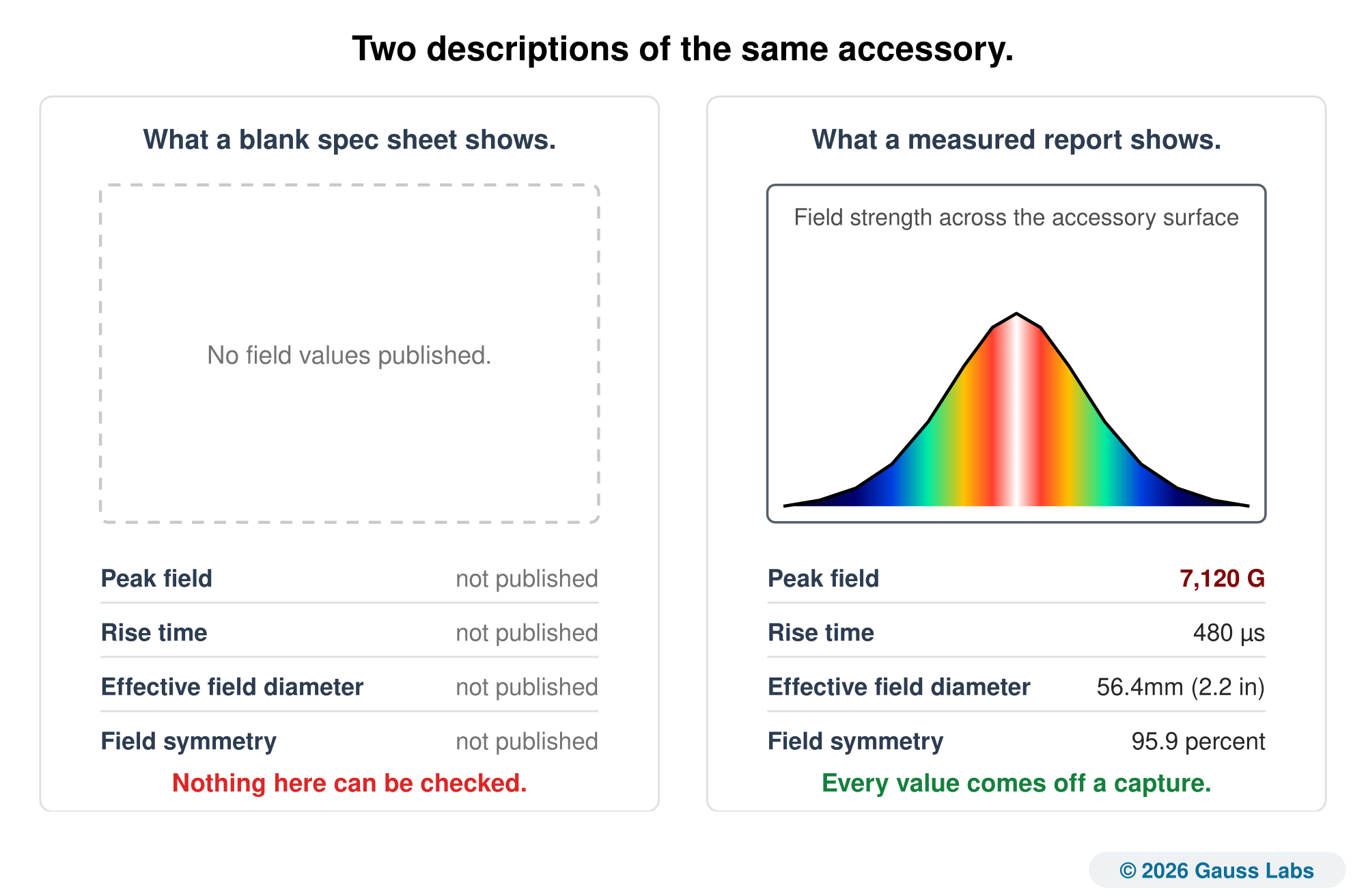
Withholding the value doesn't stop that comparison happening either, it just takes your device out of it, so buyers go on comparing peak values with yours missing from the comparison.
Researchers hit the same gap when they compare studies.
This isn't only a retail problem, and there's now a citable source saying so from the clinical side. A systematic review published in Biomedicines in July 2026 went through 28 studies covering 1,060 participants on PEMF for chronic musculoskeletal conditions, and its authors conclude that the absence of standardized reporting of technical parameters, naming waveform and dB/dt as the examples, leaves what they call "a critical translational gap."
Their point is that protocols differing widely in intensity, frequency, waveform and pulse duration all get published under one name, so nobody downstream can line two of them up. That is the same gap a buyer meets on a product page, reached from the research end instead, and the two parameters it names are the shape of the pulse and how fast the field changes. Both are in every report we publish.
Four values turn a peak into something a buyer can check.
Here's what that looks like on a real pairing. We bought a Sota Instruments Magnetic Pulser for in-house testing and measured it driving its Paddle. It has two settings rather than a dial, so we report both: the field peaks at 7,120 Gauss on the stronger one and at 2,630 Gauss on the other.
The peak is the value a spec sheet would normally carry alone. Three more sit beside it. The rise time is 480 microseconds, which is how long the field takes to climb, and the effective field diameter is 56.4mm (2.2 in), the span across which the field is still at least a tenth of its peak. Field symmetry reads 95.9 percent, so the field reaches evenly on every side and a buyer turning the Paddle against the body gets about the same field whichever way round it goes.
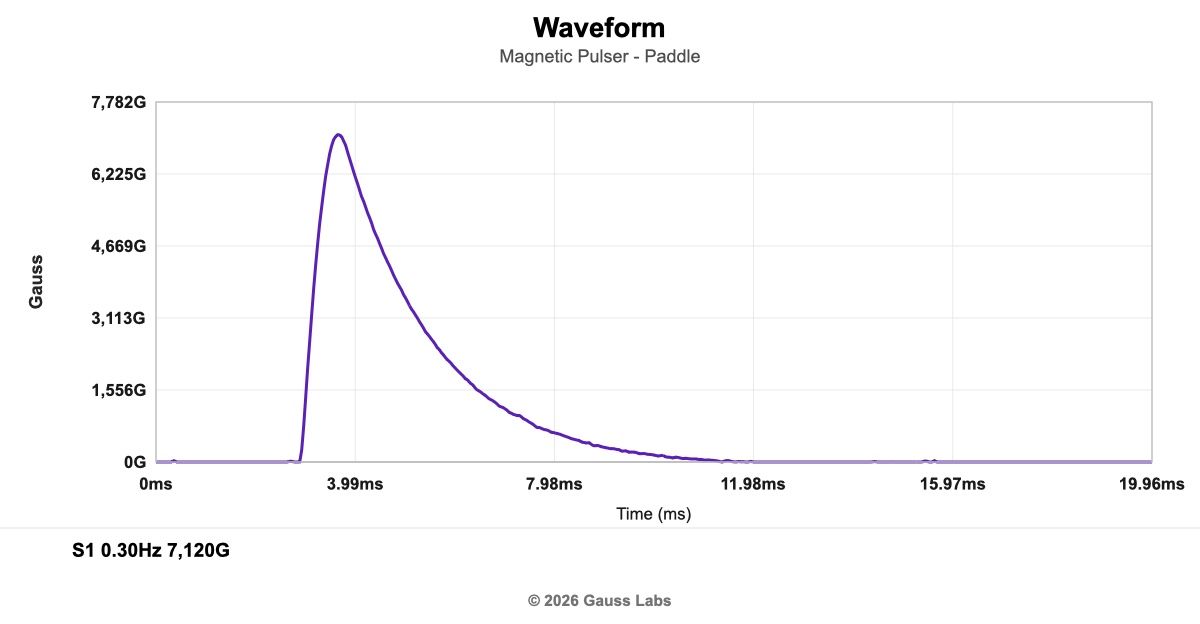
No one of those four values replaces the others, which is why they're published together, and each one answers a question the peak leaves open. The trace is where the rise time came from, so a buyer can see the measurement instead of taking the figure on trust. Our post on a published slew rate covers the four things to state alongside that figure.
A field measurement doesn't give away how you built the device.
The other reason companies give for a blank page is that the numbers reveal the design, and part of that is fair. Turn count, wire gauge, the driver topology and the firmware are yours, and a field measurement doesn't expose any of them.
What a field measurement describes is the field itself, which anyone who buys the unit can read with a gauss meter and an oscilloscope. That part left your building with the product, so publishing it gives away nothing that a determined competitor couldn't measure in an afternoon. What it does give a buyer is a figure they can hold you to. The same goes for tolerance: stating the spread you build to reads as confidence, while a single exact value with no spread behind it reads as a value nobody checked.
Publish these four things beside your peak value.
- Say where the peak was read, and how far off the surface. A reading taken on the surface and one taken at body distance can differ by a lot, so the standoff distance is what makes the value mean anything.
- Give the rise time and the waveform it came from. The peak says how high the pulse reaches and the rise time says how quickly, and the two together are what a buyer is actually asking about.
- Say how far the field usefully spreads. An effective field diameter tells a buyer whether the accessory suits the area they want to cover, which a peak on its own can't.
- Name the setting each value came from. A device with more than one output level has a different set of values at each one, so a lone figure leaves the buyer guessing which end of the range it came from.
That's four lines on a product page, and you don't need our report to write them. If you already measure your own output, publishing what you measure gets you most of the way there, and a scan across the whole surface is what fills in the rest.
Want these values measured on your own device?
We scan every accessory across its surface, capture the pulse at each setting, and publish the values with the conditions they were measured under. If you'd like to see what that looks like, our example reports are open to read.
Schedule a Call See Example ReportsA buyer who can't check anything you've published has to decide on something else instead. Publish the four things beside your peak, and they can decide on the device.